No, these lovely sugar cookies aren't part of the Modern Baker Challenge. But they are some of my favorite sugar cookies ever. These bunnies were part of our Easter Monday
Kaffee und Kuchen extravaganza.
Kaffee und Kuchen is a German tradition and translates to "coffee and cake". The whole gist of it, which I've never understood, is that you invite people over, usually one or two, and serve them coffee and cake. It's sort of the same in the States, only you serve, um- coffee and -er- coffee cake.
Although I absolutely love having people over, our small apartment can only handle so many. If the smokers hang out on the balcony that barely fits two people, and everyone that loves to watch me frantically prepare food or fill bowls with reserve snacks stays in the kitchen, then maybe there's enough room for everyone else in the living room. And, no, even though the balcony is attached to the bedroom can anyone sit on the bed. It's too full of coats. In the summer we get a pile of winter coats and put them on the bed just so no one will feel tempted to stay.
Easter is a strange thing in Germany. Although we are getting screwed out of four holidays this year (May Day, German Reunification Day, and 25/26 December all fall on weekends and we don't get replacement days), you can always count on the Easter holidays to give you four holidays in spring. Germans get Good Friday and Easter Monday, then, forty days later, Ascension, known as
Himmelfahrt (literally, the drive to the sky/heaven), and then
Pfingstmontag, which is the Monday of Pentecost. Some federal states even get Fronleichnam (Corpus Christi) as a holiday. However, the next holiday after these is usually on the third of October- German Reunification Day.
So when we were planning our Easter invite, we decided to invite everyone we knew. Only we were counting on half of our friends being away. It being Easter and all.
But no.
We had been counting on half of our invitees to show up, but all but four of the people we invited showed up. Plus one party-crasher that we had forgotten to include on our list. Which was okay. Except that no one was smoking on the balcony. And no one was in the kitchen watching me struggle with an oven that had bottom-half-died the week before.
By the time I figured out that the lower heating element had died in the oven, it was simply too late to cancel the event. We had already received RSVPs from almost everyone on the list.

I know I probably said I would never have multiple breads in a single post, but these five breads were planned for the Kaffee und Kuchen, so they all belong together.
The first bread was the Fennel Fig and Almond bread. I made this one Saturday, two days before Easter Monday. Though not in the recipe, I had to add raisins to the bread. For some reason, my nut guy at the market misunderstood me and gave me 150g of dried figs instead of 250g, so the taste was not as awesome as I would have liked.

The thing about quick breads, though, is that you basically mix the dry ingredients, which are basically flour, leavener, and salt, and then set them aside. You mix the wet ingredients, which usually include some combination of milk, buttermilk, butter, eggs, and/or sugar.

And, after mixing both together, you add all the fruit and additives. There's really nothing to it.

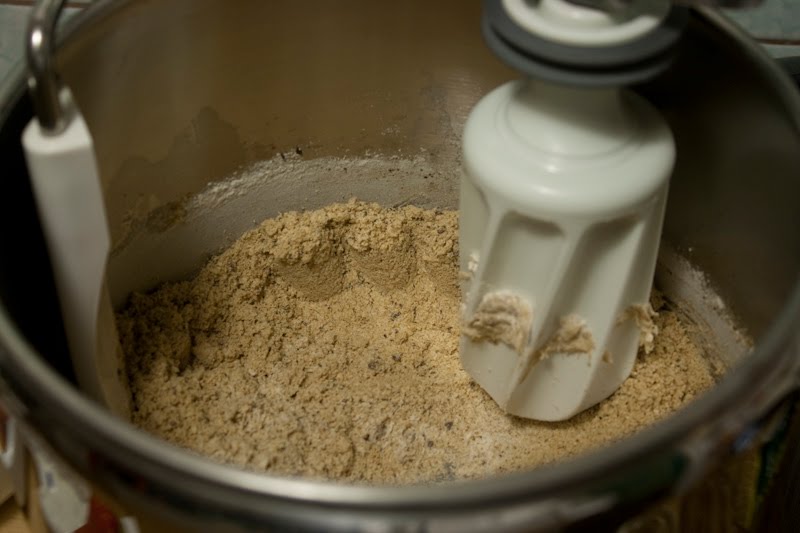
Just take care not to overmix. That is, mix until everything barely comes together. If you have fruits or nuts, you mix them in after that stage, so don't worry if everything is not quite all mixed through. If it looks like the above just before you put it into a pre-heated oven, it will turn out fine.

The second bread made on Saturday was the third bread in the book-

Whole Wheat Currant Bread. Which turned out to be Whole Wheat Cranberry and Sour Cherry Bread because my nut guy just gave me a look when I asked for
getrocknete Johannisbeeren- dried currants. No? Well, then sour cherries and craisins it is.

Day two started with the fifth bread from the book- Apple Raisin Bread. And, though I was ever-patient and very sure to take pictures of all of the
mise en place, I somehow forgot this one.

Even though I forgot the way-before image, I certainly didn't forget the not-quite-after pic.

Also on Saturday, Date Walnut Bread. The dates were pitted then soaked in hot water.

You start with the eggs and the sugar, mixing them up to a light color, and then add the vanilla extract.

Then you mix in the dates.

As usual, you mix the dry ingredients separately, add them to the wet ingredients, then fold in the walnuts at the end.

I know, I know. It's a silicon cake mold. Even worse, it's that ugly blue that almost all plastic based kitchen equipment in Germany is made from. Someone must have had bonus boatload of blue. Bad. But it's all I have.

Day Three is no-stress day. However, Day Three is also the day of sugar cookies, hot cross buns for the Mellow Bakers Challenge which I probably will never get to post. This day is the day of the event. This day is the day of Chocolate Spice Bread.

Only there's one hitch. Remember the oven?
While baking the White Bread for the Bread Baker's Apprentice Challenge, I discovered that the oven was not heating properly- Which also accounted for the bad bottom of the Tuscan Bread as well.
But it was too late when I realized that, no, the oven is not broken in that way. I had thought that the oven was shutting off before it got hot enough. Ah, the thermostat. Of course. But then I put my two oven thermometers on different shelves. The top was plenty hot, but the bottom was about 50 degrees lower. In Centigrade. Which is like 100 degrees Fahrenheit.
Just before I embarked on baking these five breads. I did a test. I cranked up the oven. After about 15 minutes I put my hand on the bottom half. Warm. But not hot. I turned the knob to bottom heat only. After about 30 minutes, the oven was cold.
So how did I manage to bake all five breads in one weekend while the oven was half broken.
I pulled myself together and cranked up the oven to maximum. Placed my baking stone on the oven floor to reflect heat, and did my best.

Which was all I could do. This is how ugly it got. On the second night, I pulled out the Date Walnut Bread, flipped it out of the cake mold- And it all melted into the center. The center was not even cooked. I ended up covering half the cake in foil and making a sort of inverted funnel to redirect the oven heat into the center of the cake in order to fully cook it.

Despite all that, the cake was wonderfully moist and dense. Very sweet, but without being overpoweringly or shockingly sweet. This would have been my favorite if the others had not been just as good.

The Fig, Fennel, and Almond bread was a bit dry, but perhaps because I hadn't wrapped it tightly enough. Or perhaps because the top was done before the bottom.

But it was still delicious. I would have liked more figs, but it really is my own fault for not paying closer attention. Next time I'll get enough figs for this bread and more.

The Whole Wheat Currant Bread- again with a substitution. Again with a too-brown crust. Slightly dry because of me wanting it to be completely cooked through.

But still awesome. The craisins and sour cherries a perfect match for the weight and nuttiness of the whole wheat flour.

I have to say that the Chocolate Spice Loaf was my least favorite, but that doesn't mean that I didn't eat two slices of it.

The chocolate was pronounced, with a little hint in the back with the spices. Good. Excellent, even, but I did have to sample all of the loaves, no?

And the one nominated for and awarded the prize of "Will definitely make again when the oven is fixed" was the Whole Grain Apple Raisin Bread.

I don't know what it is about apples and their wonderful flavor in bread. But I know I'll be making this one again. I can only hope that the crust is as crunchy as the one on this bread.
Yes, I'm in the
Modern Baker Challenge. And, yes, I have 9 more quick-bread-like baked goods to complete in 6 weeks. Let's hope I have time to blog them all.