
We almost didn't make it.
I had ticked off the Poilâne bakery on Rue Cherche-Midi as one of the stops on our Paris trip last August, but it looked like the list of things we wanted to see and do would outweigh the list of things we would actually do. The only thing that was a must-see on my list was La Défense, the big modern complex outside of the Paris Peripherique with the humongous Grand Arch that announces the triumph of modernism over the old, traditional Paris.
We had been warned more than once not to visit Paris in August, since everyone would be away on vacation. Also, we were told that and that the dates we had chosen were the worst dates to be there. The fifteenth of August is the Assumption of Mary, so in addition to most Parisians being away, we were going to be there on a holiday which fell on a Saturday, so already it seemed as though two of our four days were going to be spent hitting shops which would be closed.
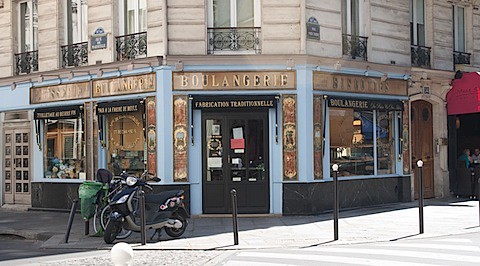
Luckily, or, unluckily for us, it only happened once. On the morning of the fifteenth, we tried going to Du Pain et Des Idees but they were closed, and my high school French could not even begin to decipher the cryptic note taped to the inside of the glass door. We peeked in the windows- it was a beautiful bakery, even when closed.I had Poilâne on my maybe list, knowing that if we didn't visit that one, or if it was closed, we could just visit Gosselin, whose bread inspired Peter Reinhart's Pain a l'Ancienne recipe. But something was just pulling me there. I wanted to go.
That morning, even before trying to visit Du Pain et Des Idees, we were planning our day at the hotel during breakfast, and Amy asked about the bakeries. She wanted to have a picnic somewhere, and if I knew whereabouts the bakery was, couldn't we get some bread?Immediately, I opened up Clotilde's Culinary Adventures in Paris, and crossed referenced the address with Paris Pratique. 8 Rue Cherche-Midi.
(Here I have to take pause and wholeheartedly endorse Clotilde's wonderful volume. Not only did we refer to it more often than the DK Guide to Paris, but we found some amazing places within its pages. One of the best thing is that she also lists the closest Metro stop. Unfortunately, there is one single map of the Arrondissements, but you can easily cross reference with your very practical copy of Paris Pratique, a small booklet of maps with a street index. It's available at most newsstands for about 5 Euros, and allows you to avoid the "I am a Tourist" maps flying into your face with every breeze. These two books are the most important ones you can pack for your upcoming trip to Paris.)
After breakfast we took the Metro to Père Lachaise, as we had planned, and visited Proust, Ernst, Wilde, Callas and Piaf. After the disappointment of the other bakery, we took the Metro to St. Sulpice. Rue Cherche-Midi was odd. It seemed like it was hidden away, and just as we turned the corner onto the street, I thought, this can't be it. I was going to check the address again when I looked up and saw it, just across the street.
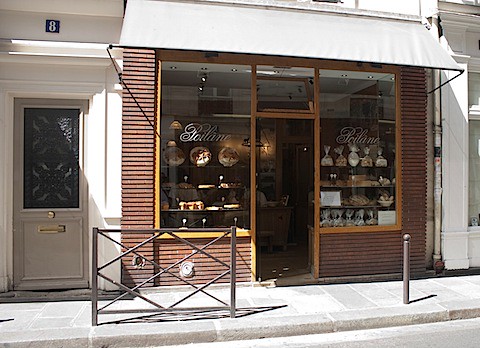
Immediately upon entering, I cheerily, but politely said "Bonjour" in my best french accent and smiled. My eyes grew wide at all the loaves of huge loaves of bread. Just before I could say anything further, we were each rewarded with a Punition! I thanked the shopkeeper and gazed around at all the bread. I asked, again, in my best French accent, "Vous parlais Anglais?" making sure to carry over the final "s" onto "Anglais". The shopkeeper said shyly, "un peu."
Though I knew I could switch to English, the entire trip I had tried my best to keep to my minimal French. Because of this, people were super friendly. Even the ones whose English was atrocious kept apologizing. Later, I even got into a conversation in four languages with a waiter in Montmartre, after he said something in French I didn't understand. I switched to English, then German, then Spanish.
My original plan had been to buy some bread as well as a pillow of bread to keep on the couch, but in all my excitement, I completely forgot about the pillow. Later, during a quiet moment away from the bread excitement, I would recall the numerous loaves of bread on the right hand side of the shop, and wonder why they were there, above all the bags and knives and stuff. Of course. Those were the bread pillows!
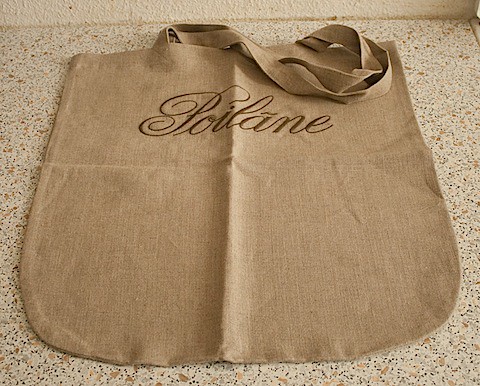
Instead, I ended up getting a linen bag embroidered with the Poilâne logo, which they very kindly packed in one of their beautiful white paper bags. I also got a half loaf. They weighed an 800g half for me and asked if it was enough. I asked if I could get a whole kilo, and before I could say anything further, a whole loaf was taken from its place and halved in what looked like one of those dangerous paper cutters with a single sharp blade, but for bread. We also got a few rolls to sample as well as a loaf of the most delicious brioche I have ever had.Later that afternoon, loaded with other food goodies, we took the Metro to our picnic spot, an artificial island in the middle of the Seine. On the way there, I was looking out the train window, and spotted the other Poilâne bakery in Paris as we rumbled forth.
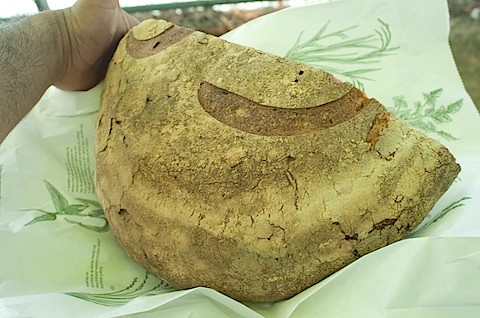
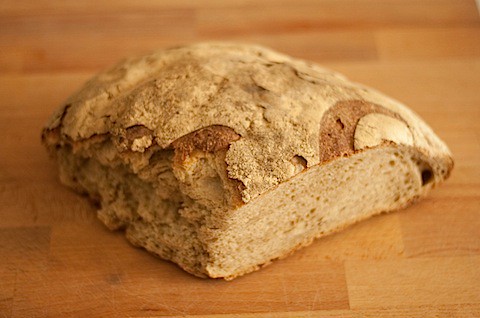
The bread was marvelous, fresh and crusty. After snapping this picture, I immediately took a chunk out of the crust. Wonderful. Sour and light and dense and just everything perfect about bread. I loved the color, the scoring, and the flour dusting the loaf. We had eaten a good chunk of the bread before I turned it over and discovered what has puzzled me since.
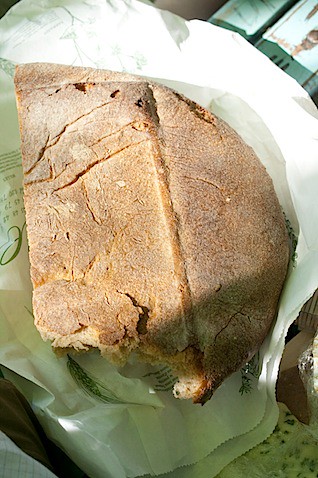
There was some sort of odd line on the bottom of the bread. The strange thing was that it formed part of a larger square that was slightly higher than the rest of the crust, as though the bread was placed atop a part of the oven that had a dimple. I've actually encountered similar odd formations on the other loaves of Poilâne bread I've eaten.
Now, you're probably asking "Is that it? Did you have the picnic and then get back on a plane to Berlin?" Well, not quite. We were only able to devour a third of the half loaf before we were full. After all, cheese and eggplant caviar as well as blue potato chips also need their place in one's stomach. After the picnic we walked around with a the remaining chunk of bread, taking turns carrying it on our adventures that day. Though it was a bit inconvenient, I loved knowing that I could just reach in and break a chunk off any time I wanted.
That evening, after a boat ride on the Seine, we took the train to La Défense and sat on the side of the Great Arch facing away from Paris. On the way there, I had joked that it would be funny if the city abruptly ended there, giving way to a sudden forest.

Strangely enough, on the far end of the arch, facing away from the modern business center, Paris ends and gives way to a highway and lots of trees. Though not an abrupt end to the city, it was closer to my expectations than I had truly expected.
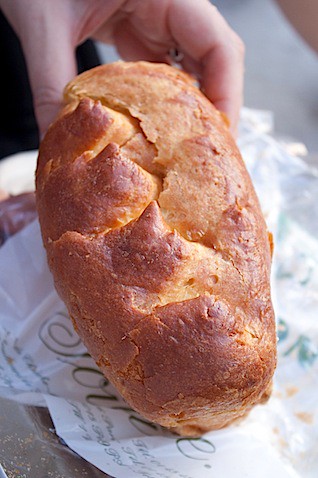
On the steps, watching the sun set, we devoured the brioche we had bought that afternoon, before heading back into the heart of the city for dinner.
Where to find it:
In Berlin, Das Poilâne Brot is available at Galeries Lafayette- Friedrichstrasse on the corner of Französische Strasse. (U-Bhf Französische Strasse.) Note that the bread arrives fresh from Paris every Wednesday and Friday except for French holidays, and if you get there too late, they might have already cut the whole loaves into halves and quarters.
Paris is lucky enough to have two Poilâne bakeries, at 8 Rue Cherche-Midi and 49 Boulevard de Grenelle.
London also has a Poilâne bakery, at 46 Elizabeth Street in Belgravia, conveniently located between the Underground stops of Victoria Station and Sloane Square. This bakery is notable not only because it is the first bakery outside of Paris, but also because it has the first wood-fired oven in London since the Great Fire of 1666.
Further Reading:
In Berlin, Das Poilâne Brot is available at Galeries Lafayette- Friedrichstrasse on the corner of Französische Strasse. (U-Bhf Französische Strasse.) Note that the bread arrives fresh from Paris every Wednesday and Friday except for French holidays, and if you get there too late, they might have already cut the whole loaves into halves and quarters.
Paris is lucky enough to have two Poilâne bakeries, at 8 Rue Cherche-Midi and 49 Boulevard de Grenelle.
London also has a Poilâne bakery, at 46 Elizabeth Street in Belgravia, conveniently located between the Underground stops of Victoria Station and Sloane Square. This bakery is notable not only because it is the first bakery outside of Paris, but also because it has the first wood-fired oven in London since the Great Fire of 1666.
Further Reading:
If you haven't clicked on a link already: Poilâne's very beautiful website
La Punition from the wonderful Chocolate and Zucchini
A recipe for Punitions from the incredible Smitten Kitchen
Du Pain et Des Idees from Serve it Forth
La Punition from the wonderful Chocolate and Zucchini
A recipe for Punitions from the incredible Smitten Kitchen
Du Pain et Des Idees from Serve it Forth
An amazing behind-the-scenes post from Ann Mah
Tomostyle's trip to Poilâne and the next door Cuisine de Bar
Not Quite Nigella's look at some of their baked goods
A video of Martha Stewart visiting the bakery
A 2007 Slideshow from Business Week
A 2001 Article from Fast Company
Small Update: Dorie Greenspan has just posted an amazing video of the late, great Lionel Poilâne making Punitions. Her recipe, from the man himself, is on her essential post on Butter.
Tomostyle's trip to Poilâne and the next door Cuisine de Bar
Not Quite Nigella's look at some of their baked goods
A video of Martha Stewart visiting the bakery
A 2007 Slideshow from Business Week
A 2001 Article from Fast Company
Small Update: Dorie Greenspan has just posted an amazing video of the late, great Lionel Poilâne making Punitions. Her recipe, from the man himself, is on her essential post on Butter.
Here's Part Two


