Showing posts with label paris. Show all posts

Thursday, October 28, 2010

Berlin Honey


Once Is Happenstance

Earlier this year, I had read a German article about beekeeping on the roof of the Paris Opera. The honey was then sold at the Opera gift shop. I thought this was rather clever, but wondered what the honey would taste like. Other than a trip back to Paris, which is continually in the pre-planning stages, it was unlikely that I would be able to taste honey that came from there, and only from there.
Twice Is Coincidence
About two months later, the tweeters I follow were all abuzz with a video of Tim Hayward making bread with Richard Bertinet. While the video was pretty awesome, another one caught my eye. Urban beekeeping in London. The thing that really got me was that the bees were being kept on the roof of Fortnum and Mason, where we had afternoon tea, after stumbling about London in a mad rush to see everyone we knew. We were trying to find a tea place across the street from an Audi dealership, and, in the end, I remembered the name Fortnum and Mason. As we entered the fourth floor, we were ushered into an empty room to leave our luggage, and then to a table at the back of the restaurant, right next to the kitchen. I didn't mind. After I saw the video, I thought about the London honey that I could have bought.
Three Times... You Pay Attention
I had come across the Berlin Honey website once before, and had contemplated buying some, but in the end, I didn't. I'm not sure why. It wasn't until Peggy of Multikulinarisch.es wrote an article about them that I realized I had to get some. Now, I didn't order any right away, though I really wanted to. Honey from Berlin, I wouldn't have thought that possible if I hadn't read about Paris and London. And why not? With one quarter of Berlin being lakes and forest, it is a perfect environment for bees. In any case, I liked the way it sounded: Paris Honey, London Honey, Berlin Honey.
My History With Honey
I had never really consciously thought about honey. I knew that it came from bees, and also knew that it was stored in honeycombs. A few times, during our trips to Mexico, my parents would buy some honey with a piece of honeycomb floating in it. Sometimes they would only buy a honeycomb filled with honey. We would pop the cells and empty out the honey, chewing the wax like gum. Other than that, we had the occasional honeybear full of clover honey. I never gave a second thought about why it was called clover honey except in the rare case that I bought orange blossom honey. Which tasted slightly of oranges. That I could understand. But clover?


My first conscious experience with honey as a food, as something that wasn't just plain clover honey, or, in Germany, Akazienhonig (as common here as clover honey is over there) was when I bought a very small, and very expensive jar of Tannenhonig (pine honey) at a Bioladen. It was dark and woodsy, aromatic and full of rich forest flavor. I would drizzle it on wonderfully tart fresh goat cheese, taking up a habit, just so I could have the two flavors together.


When we visited Paris last year, Amy discovered a listing in the in-flight magazine for the Maison du Miel. It took a while to find it, we were re-checking the address in the pocket notebook where we had made our notes. When I saw the address, I realized that the address wasn't Rue Vignon 9, but rather Rue Vignon in the 9th arrondissement.


After much consideration, and fully aware that I already had two heavy blue steel baking sheets in my luggage, I chose a small jar of the Rosemary honey, and one of the Bruyère Blanche (tree heath). For our friend, who was housesitting for us, we chose a small jar of coffee honey, produced by bees that hang around coffee plants, getting their pollen fix. I also noticed two bars of honey soap (I have a thing for natural soaps), and snapped them up to complete our purchase.

Then, last spring, on our hiking vacation, we stopped in a small German Deli in Prerow. They had tons of sausages, and best of all, cheese. When I asked which cheese was local, the woman behind the counter quickly answered- "We're in the wrong Bundesland for cheese. That's Schleswig-Holstein. We're in MeckPomm." Fair enough. "I'll take that semi-hard cheese, then".
I don't remember what cheese we ended up having that night, but I do remember coming across a small jar of Buckwheat honey. When I picked it up and put it in the basket, the saleswoman asked me if I had tasted it before, as many people buy it without tasting it, and try to return it. She motioned to a small table with tasting crackers, honey, and a some olive tapenade. I tried the honey.


Buckwheat.

Buckwheat honey tastes the way a barn smells. Musky and dark, and extraordinarily earthy. You get notes of bitter grass and hay, and it's particularly flavorful when paired with some really tangy goat cheese. But then again, which honey doesn't?

Berliner Honig

After coming back from a whirlwind four days in London, Amy and I were invited to a Berlin food blogger picnic by the very lovely Anette and Jemi of Berliner Honig. Oh, wait, say what? Me? A food blogger. I was invited to a food blogger picnic? But I'm not a food blogger. I sent an RSVP, and kept waiting for the follow-up email where they'd realize they had made a mistake. It never came, instead, the next email had more details about the event. So I slowly realized that, yes, I do blog, as infrequently as it seems to be nowadays, and that I do write about food, bread in particular.

The event was held on August 28 at Berliner Honig Headquarters in Friedrichshain. It was originally intended to be held outside in Volkspark Friedrichshain, but bad weather, combined with rain the night before, had pushed it indoors. The office was really white and had huge beautiful windows with blinds. We began with introductions, and a glass of Sekt as a greeting drink.


The night before, I had mixed together a dough using a technique I've named "Overnight Sourdough". Basically, I mix together a dough as close to midnight as I can, do stretch and folds until I go to sleep, then put the dough on the balcony for the bulk rise. This works great in summer, when it's warm enough to sleep with the balcony doors open, but cool enough that a batch of sourdough won't overrise and lose its structure. I usually wake up at six, shape the bread, turn on the oven with the stone in, and sleep for an additional two hours while the bread does a final rise atop the warm stove. I put the bread in at eight, and it's ready by nine. Unfortunately, I'm usually not, so the day of the picnic, the bread was ready before we were.


In attendance were our hosts, Anette and Jemi, Karin from Geniesser Zeit, Peggy from Multikulinarisch.es, Anne from Kekstester, and Suzan from Foodie In Berlin. I was also looking forward to meeting other Berlin Food Bloggers, but they shall remain nameless until I do actually get to meet them. There were some last-minute cancellations, all for very good reasons, I later found out. However, I did wish more of them had been able to attend, because there are a lot of great Berlin Blogs out there. Of course, nearly all of them in German.

Although I was starving, I held on, and snuck a slice of bread while Anette and Jemi talked about honey, bees and beekeeping. In Germany, as in the rest of the world, about 30% of bees die out every year due to Colony Collapse disorder. The thing is, this happens mostly in the countryside, where more crops are farmed. I know, you would think more crops would equal more pollen, but because our agricultural system has evolved into a monoculture system, bees that live around agriculture (and especially industrial agriculture) don't get as much a variety of food as they would have in the past when farms grew a bit of everything. Also to blame are pesticides, which can wreak havoc both on the bees' immune systems as well as their natural navigation systems.

On the other hand, cities have a huge variety of flora. Home gardeners don't just plant one variety, they plant tons, and cities usually plant many different types of trees for aesthetic purposes. Plus, you have a relatively low incidence of pesticides. And you have a rich environment in which bees can thrive. Think about it, if New York can have its own beekeepers association, then surely Berlin, one of the greenest cities in Europe, can be a playground for bees.

And, so, Berliner Honig is produced. The company is a sort of collective/distributor for the various beekeepers in Berlin. Although the average age of beekeepers in Germany is about 80 years, all the beekeepers from Berliner Honig are quite young. Beekeeping itself is not a hobby you can do every other month, as the bees do require weekly maintenance. So, it's usually something that retired people usually take up as a hobby.


Anette (with Jemi chiming in) gave us an explanation on how honey is produced, how the hive works- the social structure and all, and let us touch some of the hive related material she and Jemi had brought. Here's she's holding two frames, though I'm pretty sure they were the ones that hadn't been built upon. Note the brown hive on the left. In a country that has a whole system of standards (DIN), there isn't any real hive standardization. So, there's a wide variety of hive structures. After all our questions, she asked if we were ready to meet the bees, and opened up the hive.


When she and Jemi opened the hive, I gasped. When I was younger, a couple of bees had set themselves up in a hollow part of one of our walls, so I knew well enough to ignore them, and they would mind their own beeswax. Still, I hadn't been around multiple bees in quite a while. Luckily, the hive itself was under glass. In the above picture, the dark areas correspond to the brood- the places where new bees are born and raised, and the honeycombs that are covered are the reserve food, the honey, if you will.


Seeing the bees up close was pretty awesome. They were buzzing and crawling about like crazy. Though she's out of the depth of focus in the above shot, the queen bee was painted with a blue dot, so you could spot her easily. Well, if you looked closely, you could also find her by her size- she was at least two times as big as any of the worker bees.


Holding all the various bee-related things was my favorite part of the day. This is part of a frame, after it has been emptied of its delicious honey.


After all that, we were ready eat and sample the honey. I'm actually kicking myself because I didn't take more pictures of the food- Anette and Jemi had spread out a large table with figs, goat cheese, Gruyere and bread. They also had coffee, and hot water for tea. The funny thing is, Germans usually don't get the concept of a potluck party, but I guess that whenever I have people over, I don't really expect them to bring anything either. Still, there was tons of great stuff on offer. I did manage to snap some of the Eierkuchen and Honey ice cream.


The bread gods had actually blessed me on that day- Usually, I shape the bread in the morning, after a bulk rise in the refrigerator, but this time, I had shaped the bread, then put it in the fridge. So when I did take it out, it was already pretty huge. So, when I baked it, the bread was perfectly risen, with not much oven spring (since it was perfectly risen, haha), but with an awesome crumb.


Suzan from FoodieInBerlin, brought a plum tart, which you can see in the upper right background. Forgive the bread shot, but I usually take photos of my own bread for reference. The plums were all picture perfect, sliced and with no signs of the pits.


When I asked what she did with the middle parts of the plums (where the pits were) she sort of looked at me all puzzled and said, "I ate them." I guess I asked because I would have baked with all the parts of the plums, and wouldn't have even thought of making it aesthetically pleasing, or saving the leftovers for breakfast.


I loved the thinness of the plum tart- I even had a second piece. The plums were laid on a layer of marzipan, which in turn rested on the pastry crust. I was quite shocked when Suzan mentioned that she had used rye flour in the crust, since I didn't know you could to that. Well, you actually can, but she only did because she had run out of other flour. I really should not have been surprised. Since then I've kept an eye out, and noticed that many of the better Berlin bakeries are making their crusts out of spelt.


Also in attendance was Anne from Kekstester, one of my favorite German blogs. The name literally means "cookie tester" and she focuses on cookies and other desserts. While we were all expecting her to bring cookies, she brought Arabic Almond-Honey squares instead. I had two, or, at least two. I think I might have had two and a half. They weren't as honey sweet as most honey and dough desserts that you sometimes find. The cake was a great base for the almonds and honey, and was understated with the real treat being the almond-honey topping. You can find the recipe, as well as her account of the picnic, here (in German).

Peggy from Multikulinarisch.es brought a beet-peanut spread that was simply delicious. It was sweet beets, combined with peanuts and lots of garlic. I don't remember when I began eating beets, but once they crept into my salads, I knew there was no going back. The beet texture with the fat and flavor of the peanuts and the overwhelming yumminess of the peanuts. Even if you're not a beet fan, this pink mix was simple and simply delicious. You can find the recipe here, though, it's only in German.

Tasting Notes


I know that by now you are all dying to know how the honey tasted.

My first impressions were that the spring honey, the Berliner Frühling (on the left) just tasted like honey. Very subtle honey, but without that overt "HONEY" flavor that you sometimes get from clover honey. It was good. It tasted fresh and the way you expect a light honey to taste. I think the problem with the tasting, though was that we went back and forth between the honeys instead of concentrating on one, then on the other. Because the Haupstadtlinde (on the right) was so awesome during the tasting, it overshadowed the Berliner Frühling. Later, I opened the jar of the Berliner Frühling, and it was a revelation. The lightest taste of beeswax with the full roundness of it, and a delicate honey flavor without being cloyingly sweet.

The Haupstadtlinde (Capitol Linden) comes from bees that frequent Linden trees in Berlin. The flavor of this one is just spectacular. Maybe it's not a desired flavor, but you can taste the beeswax. You can taste the beeswax! It has a light citrus-floral flavor that gives way to a full mouth of just lovely beeswax. It's almost like biting into a hive. On sourdough bread, however, the wax flavor is overtaken but the flavor is- well, it's the flavor of simply delicious raw honey.

Wherever you might be, I urge you to find local honey. Either through Local Harvest or the National Honey Board's Honey Locator in the States. In the UK, you can search BeeData's Local Honey Database.

If you are lucky enough to live in Germany, you can order Berlin Honey from Berliner Honig's online shop, or you can buy it in person from selected places in Berlin.

Tuesday, March 23, 2010

Le Pain Poilâne

20090817_MG_2884.jpg

We almost didn't make it.

I had ticked off the Poilâne bakery on Rue Cherche-Midi as one of the stops on our Paris trip last August, but it looked like the list of things we wanted to see and do would outweigh the list of things we would actually do. The only thing that was a must-see on my list was La Défense, the big modern complex outside of the Paris Peripherique with the humongous Grand Arch that announces the triumph of modernism over the old, traditional Paris.

We had been warned more than once not to visit Paris in August, since everyone would be away on vacation. Also, we were told that and that the dates we had chosen were the worst dates to be there. The fifteenth of August is the Assumption of Mary, so in addition to most Parisians being away, we were going to be there on a holiday which fell on a Saturday, so already it seemed as though two of our four days were going to be spent hitting shops which would be closed.

20090815_MG_2567.jpg

Luckily, or, unluckily for us, it only happened once. On the morning of the fifteenth, we tried going to Du Pain et Des Idees but they were closed, and my high school French could not even begin to decipher the cryptic note taped to the inside of the glass door. We peeked in the windows- it was a beautiful bakery, even when closed.
I had Poilâne on my maybe list, knowing that if we didn't visit that one, or if it was closed, we could just visit Gosselin, whose bread inspired Peter Reinhart's Pain a l'Ancienne recipe. But something was just pulling me there. I wanted to go.

That morning, even before trying to visit Du Pain et Des Idees, we were planning our day at the hotel during breakfast, and Amy asked about the bakeries. She wanted to have a picnic somewhere, and if I knew whereabouts the bakery was, couldn't we get some bread?Immediately, I opened up Clotilde's Culinary Adventures in Paris, and crossed referenced the address with Paris Pratique. 8 Rue Cherche-Midi.

(Here I have to take pause and wholeheartedly endorse Clotilde's wonderful volume. Not only did we refer to it more often than the DK Guide to Paris, but we found some amazing places within its pages. One of the best thing is that she also lists the closest Metro stop. Unfortunately, there is one single map of the Arrondissements, but you can easily cross reference with your very practical copy of Paris Pratique, a small booklet of maps with a street index. It's available at most newsstands for about 5 Euros, and allows you to avoid the "I am a Tourist" maps flying into your face with every breeze. These two books are the most important ones you can pack for your upcoming trip to Paris.)

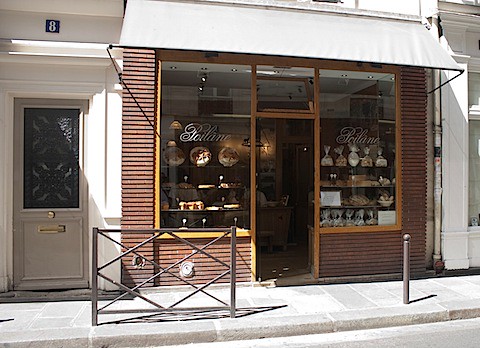
After breakfast we took the Metro to Père Lachaise, as we had planned, and visited Proust, Ernst, Wilde, Callas and Piaf. After the disappointment of the other bakery, we took the Metro to St. Sulpice. Rue Cherche-Midi was odd. It seemed like it was hidden away, and just as we turned the corner onto the street, I thought, this can't be it. I was going to check the address again when I looked up and saw it, just across the street.

20090815_MG_2581.jpg

Immediately upon entering, I cheerily, but politely said "Bonjour" in my best french accent and smiled. My eyes grew wide at all the loaves of huge loaves of bread. Just before I could say anything further, we were each rewarded with a Punition! I thanked the shopkeeper and gazed around at all the bread. I asked, again, in my best French accent, "Vous parlais Anglais?" making sure to carry over the final "s" onto "Anglais". The shopkeeper said shyly, "un peu."

Though I knew I could switch to English, the entire trip I had tried my best to keep to my minimal French. Because of this, people were super friendly. Even the ones whose English was atrocious kept apologizing. Later, I even got into a conversation in four languages with a waiter in Montmartre, after he said something in French I didn't understand. I switched to English, then German, then Spanish.

My original plan had been to buy some bread as well as a pillow of bread to keep on the couch, but in all my excitement, I completely forgot about the pillow. Later, during a quiet moment away from the bread excitement, I would recall the numerous loaves of bread on the right hand side of the shop, and wonder why they were there, above all the bags and knives and stuff. Of course. Those were the bread pillows!

20090817_MG_2882.jpg

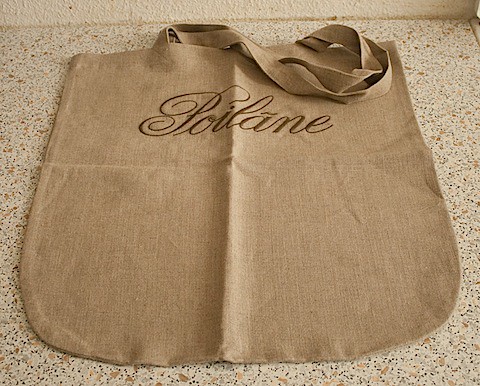
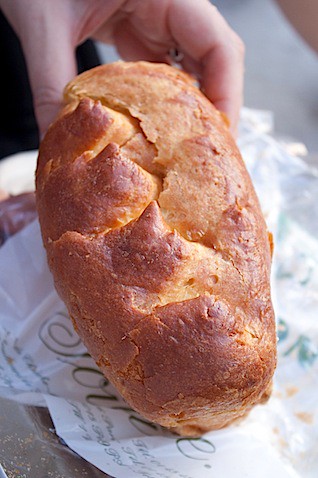
Instead, I ended up getting a linen bag embroidered with the Poilâne logo, which they very kindly packed in one of their beautiful white paper bags. I also got a half loaf. They weighed an 800g half for me and asked if it was enough. I asked if I could get a whole kilo, and before I could say anything further, a whole loaf was taken from its place and halved in what looked like one of those dangerous paper cutters with a single sharp blade, but for bread. We also got a few rolls to sample as well as a loaf of the most delicious brioche I have ever had.Later that afternoon, loaded with other food goodies, we took the Metro to our picnic spot, an artificial island in the middle of the Seine. On the way there, I was looking out the train window, and spotted the other Poilâne bakery in Paris as we rumbled forth.

20090815_MG_2591.jpg

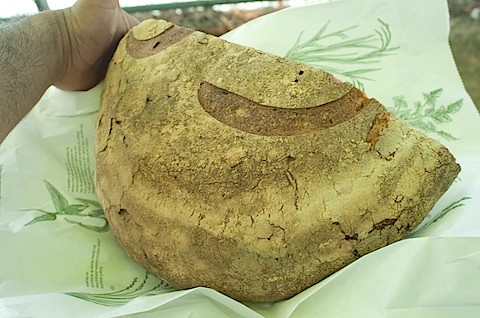
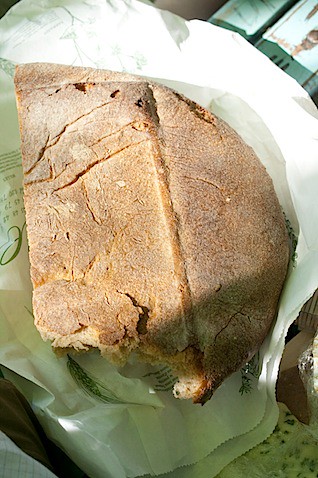
The bread was marvelous, fresh and crusty. After snapping this picture, I immediately took a chunk out of the crust. Wonderful. Sour and light and dense and just everything perfect about bread. I loved the color, the scoring, and the flour dusting the loaf. We had eaten a good chunk of the bread before I turned it over and discovered what has puzzled me since.

20090815_MG_2596.jpg

There was some sort of odd line on the bottom of the bread. The strange thing was that it formed part of a larger square that was slightly higher than the rest of the crust, as though the bread was placed atop a part of the oven that had a dimple. I've actually encountered similar odd formations on the other loaves of Poilâne bread I've eaten.

Now, you're probably asking "Is that it? Did you have the picnic and then get back on a plane to Berlin?" Well, not quite. We were only able to devour a third of the half loaf before we were full. After all, cheese and eggplant caviar as well as blue potato chips also need their place in one's stomach. After the picnic we walked around with a the remaining chunk of bread, taking turns carrying it on our adventures that day. Though it was a bit inconvenient, I loved knowing that I could just reach in and break a chunk off any time I wanted.

That evening, after a boat ride on the Seine, we took the train to La Défense and sat on the side of the Great Arch facing away from Paris. On the way there, I had joked that it would be funny if the city abruptly ended there, giving way to a sudden forest.

20090815_MG_2695.jpg

Strangely enough, on the far end of the arch, facing away from the modern business center, Paris ends and gives way to a highway and lots of trees. Though not an abrupt end to the city, it was closer to my expectations than I had truly expected.

Brioche from Poilane

On the steps, watching the sun set, we devoured the brioche we had bought that afternoon, before heading back into the heart of the city for dinner.


Where to find it:

In Berlin, Das Poilâne Brot is available at Galeries Lafayette- Friedrichstrasse on the corner of Französische Strasse. (U-Bhf Französische Strasse.) Note that the bread arrives fresh from Paris every Wednesday and Friday except for French holidays, and if you get there too late, they might have already cut the whole loaves into halves and quarters.

Paris is lucky enough to have two Poilâne bakeries, at 8 Rue Cherche-Midi and 49 Boulevard de Grenelle.

London also has a Poilâne bakery, at 46 Elizabeth Street in Belgravia, conveniently located between the Underground stops of Victoria Station and Sloane Square. This bakery is notable not only because it is the first bakery outside of Paris, but also because it has the first wood-fired oven in London since the Great Fire of 1666.

Further Reading:

If you haven't clicked on a link already: Poilâne's very beautiful website

La Punition from the wonderful Chocolate and Zucchini

A recipe for Punitions from the incredible Smitten Kitchen

Du Pain et Des Idees from Serve it Forth

An amazing behind-the-scenes post from Ann Mah

Tomostyle's trip to Poilâne and the next door Cuisine de Bar

Not Quite Nigella's look at some of their baked goods

A video of Martha Stewart visiting the bakery

A 2007 Slideshow from Business Week

A 2001 Article from Fast Company

Small Update: Dorie Greenspan has just posted an amazing video of the late, great Lionel Poilâne making Punitions. Her recipe, from the man himself, is on her essential post on Butter.


20090815_MG_2580.jpg

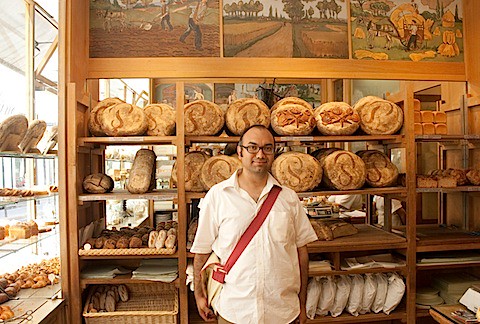
And, last, here's me, in the shop, standing in front of the breads.

Here's Part Two

Wednesday, September 23, 2009

Rosemary Tisane


The summer before eight grade, my mother and sisters and I spent a summer in Juanchorrey, Mexico. It's a small town near Tepetongo, which, in turn, is near Jerez, which is near Zacatecas in the state of Zacatecas. If you're guessing it was in the middle of nothing, you would probably be right.

I remember many things about that summer, particularly the heat, as well as swimming in the rivers there. Most of all, though, I remember all of the pigs. In certain parts of Mexico, there are stray dogs that just, well, run free, as strays do. In Juanchorrey, however, it wasn't dogs that we were worried about, it was pigs.

From what I can remember, there were more pigs than dogs, and even though I can hardly believe that they were stray, they were just running all over the place.

The one thing, however, that has stuck with me, is my mom making us Te de Salvia, and how she just went outside, picked the sage leaves off the plants and just boiled them in water. I remember it tasting so good, even though I have no recollection of how exactly it tasted.

Oddly enough, herbal teas have been like a red thread through my life. My favorite tea before I left for college was Te de Manzanilla. Unfortunately for me, I couldn't find it anywhere. It would take two years before I looked in an English-Spanish Dictionary and discovered that it was called Chamomille. I looked it up before I left for Berlin. It's called Kamillentee here.

Now, I've had a lot of experience with drinking Sage Tea, which I do every now and again, even though it's really not my thing anymore. And I have the occasional Chamomille tea. Lately, though, my tastes have been drifting toward Peppermint, though.

Until.

Amy and I went to Paris in mid-August. We were armed with Clotilde's Edible Adventures in Paris and were cross-referencing with the small mapbook Paris Pratique, a must for any visitor to the city. L'Indispensable, indeed.

We ended up at La Ferme Opera, which was about a ten minute walk from the Musée des Arts Décoratifs. Deciding on a menu was easy, but looking at the drinks, it was either water or...


I had never encountered the word Romarin before, though I know Rosmarin, Romero, and Rosemary. I snatched it up and enjoyed it with my veggie tart.


The day after we got home, I went to the Galeries Lafayette here in Berlin to see if I could find some of the things we had eaten in Paris, and there I found another bottle of Romarin Tisane. However, my excitement was soon smothered by the price: 2,50€. For a small bottle.


Of course, this was not going to be a regular drink for me. Or was it? For some reason, many ingredients in the EU have their ingredients listed on the side with percentages given for some ingredients. In this case, we had water, rosemary, raspberry juice, and lemon juice. Oh, hold on, that's 8 percent raspberry juice to be exact.


Armed with this knowledge, I raced to the nearest Bio-laden to get 100% pure raspberry juice. Unfortunately, none was to be had, so I had to make do with second best. Pure blueberry juice, which was very pricey, a mixture of fruit juices with honey, and red grape juice, which was not so pricey.


I began by steeping about 30g fresh Rosemary leaves in about a liter of just boiled hot water. The Erlenmeyer Flask is just for show. Rather, I have it around for making beer, so you don't have to run out and buy one for making this. A four cup or even a two cup Pyrex glass will also do the trick. Important is that you can pour it out.


Let it steep for about an hour. The rosemary flavor will actually increase the longer you steep it, and I have done it overnight for a big rosemary punch. Then again, I love leaving teabags in my cup in order to have very strong tea.


I used a cheesecloth held to the flask with a rubber band in order to strain the cooled tea into another container such as a clean water bottle.

Next, measure out 8% of juice in relation to the final amount of tea. That is, if you want a liter of tea, you will add 80mL of juice. If you want a liter and a half, which is what I did, you add 120mL of juice. Last, add a squirt of lemon juice. Just enough that you can taste a bit of sourness, but not enough that it overwhelms the tea. Perhaps about 1% to offset the Rosemary.


The results? The original Romarin Tisane is on the left. The juice and honey mix yielded a light color and tasted only so-so. The next one with the grape was a bit closer to the color, but the one with the Blueberry juice was too dark. Still, it was the best tasting, with the tartness contrasting with the strong Rosemary flavor.


Chill well before serving. It tastes awesome at room temperature, but even better chilled.

These days, however, I use a mix of half grape juice and half blueberry juice. Alas, I still cannot find 100% raspberry juice, but have been eyeing the Pomegranates that are just coming into season. Perhaps a new mix is in order?

Here's a recipe for those of you who want to follow one down to the last milliliter:


Rosemary Tisane
Yield: 1 Liter

20g fresh Rosemary
80mL slightly tart 100% juice such as Raspberry or Pomegranate (not cranberry, though- you have been warned!)
5mL lemon Juice
1L Water, plus a bit more to top up at the end.

Take about 30g fresh Rosemary and steep in a full liter of hot, nearly boiling water. After 4 hours, strain the tea into a liter pitcher or container. Add the Raspberry and lemon juices and mix well. Add enough water to yield exactly 1L. Serve Chilled.

Saturday, August 29, 2009

France and BBA Challenge #14: French Bread

I have to confess that I was looking forward to this bread until we went to Paris.

And then we went to Paris.

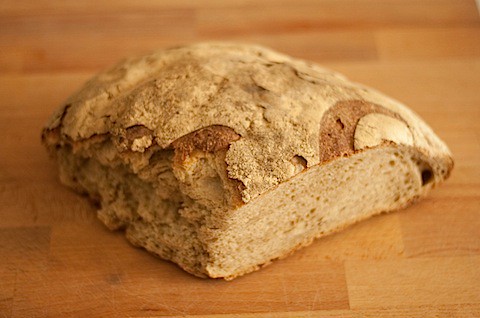
While some of the bread was passable, other was heavenly, and the half loaf of Poilâne Miche we got was absolutely divine. I wanted to eat it by itself, but it also tasted so good with the cheese and the Eggplant Caviar. Here's a picture of the picnic we had on a well-worn bench.


We had Manchengo Cheese, Perrier, Blue Potato Chips, two small bottles of Champagne (the only cold ones in the store), a bottle of Lemonade, a bottle of Trappistes Rochefort 10, a salad, crudite, Eggplant Caviar, a half Poilâne Miche from the boulangerie on rue du Cherche Midi, new Sporks because we forgot to bring our old ones, plus this awesome disposable wooden silverware, strawberry yogurt, raspberries, a cheese plate, and a nice tube of Dijon mustard.

I particularly liked the eggplant caviar. I'd had eggplant pâté before, but this was even more spreadable and even more yummy. Atop cheese, on a slice of the miche. It was just heavenly.

Which prompted us to remember the German saying: "Heute essen wir wie Gott in Frankreich"- Today we eat like God in France. Which, if you are familiar at all with German cuisine, makes way too much sense. There's a great German-language blog written by a Frenchwoman in Germany that takes the name and turns it around: Wie Gott in Deutschland.

On Sunday, everything is supposed to be closed. In Berlin, there are very few places that are still open. Usually, if you want anything, you have to go to a Bahnhof and pay inflated prices for food. Our last day in Paris was on a Sunday, spent walking around Montmartre, so we encountered many closed places, particularly because it was the day after the Assumption. Thanks to Clotilde's Edible Adventures in Paris by the very talented Clotilde from Chocolate and Zucchini fame, we found a boulangerie in Montmarte that was open. And how!


This is the baguette I carried under my arm and in my hand for a few hours on the Metro and the bus before biting into it on the way back to the airport. We kept tearing off bits of it before stashing it in the carry-on bag just before boarding.

If you are even thinking about going to Paris, you must buy Clotilde's book. We kept referencing it in trying to find places to eat. This, cross-referenced with the little Paris Pratique mapbook, available at most newsstands, and you are all set for gastronomic adventures.

So, this is where we get back to Peter Reinhart's French Bread.

In short. I was spoiled.

So spoiled that I didn't want to make the bread. Nevertheless, the day after we came back, I took a look in the book. French Bread. Oh, god. The last time I made baguettes they were a huge fail.


But after reading many of the Baguette posts from others, I decided to do them anyways. No skipping of recipes, and do them all in order, right Nicole? Here's the pâté fermentée.


One of the things I looked for and actually found was grey sea salt from Brittany. I remembered it from the Miche section in the book. I later found out that I can easily get this in Berlin.


For absolutely no reason other than I thought it would be funny, I stretched out the pâté fermentée strands. Maybe I should have folded them over, but they went into the DLX almost immediately.


Because the DLX works through the magical power of friction, I got a big mess when I added the pre-ferment in with the water.


Thankfully, adding in the rest of the flour was able to bring it back into a sticky ball.


And then a doughy one.


European flours have no malt flour added to them, they're pure flour. Peter Reinhart suggests adding some diastatic malt powder to this recipe if using flour without the added barley flour. I'm a homebrewer, so I have tons malt extract, which is virtually the same thing, kicking around. This is three kilos of the stuff left over from the last brew day. I added it in at the end, but I have the feeling that it didn't get kneaded in all the way.


And like one of those television chefs that prepare a dish and bring out an already pre-made dish seconds later, here is the risen dough, turned over onto a floured board.


And here I am shaping mini-batards into baguettes. The recommendation is to use a light hand and a heavy hand at the same time. This makes me think of the Daniel Clowes' comic "Like a Velvet Glove Cast In Iron". In any case, handle the dough gently and delicately, but don't let it own you. You are the master of the baguette.


I found some kitchen towels in the pantry that were half linen and half cotton. My eyes grew wide when I saw them. I had been consciously avoiding using them because they looked so new. Well, not anymore. They made wonderful couches for the free form loaves.


Unfortunately, my oven stone is only 30cm by 30cm, and I didn't think I would be able to fit all the baguettes in at one time, so I sort of overproofed these, as you can tell by the scores. Maybe I was a bit too heavy-handed on this.


Still, they came out rather nice, even though I thought they were a bit dark.


Speaking of dark, these don't even hold a candle to the baguettes we had in Paris.


The two on the right were baked first, with uncertainty in the slashing, which is why they look so odd. The ones on the left were baked afterwards, so they were most definitely overproofed. The slashes ran deep into them when they came out of the oven, so there was hardly any oven spring on them, except to return to their original, unslashed, shape.


The crumb was pretty tight, but they were okay, much better than my first attempt last spring, but nowhere near as awesome as- ah, now I'm sounding like a broken record.

Maybe Mr. Reinhart should have put this recipe in the beginning under Baguettes, so that we would have had made them already, and I wouldn't be complaining. Still, I love this Challenge, so, as I type right now, I am making the French Bread again, hoping to improve on the ones above.

If you have a moment, check out some better looking French Bread from:

Mags from The Other Side of Fifty
Deb from Italian Food Forever
Kelly from Something Shiny
Chris from eating is the hard part
Frieda from Lovin' from the Oven

And of course, none of this goodness would have been possible without Nicole from Pinch My Salt.