Tuesday, January 12, 2010

BBA Challenge #27: Portuguese Sweet Bread


I never experienced "Hawaiian Bread" growing up. For us it was either the store-brand loaf of soft white bread, or it was the long family-size loaf of brownish bread. Every now and then, however, my father would buy a loaf of wheat bread with a split down the top which promised to have been brushed with butter. Though I always bit off that part of the bread first, it never really fulfilled its promise. The thing I hated the most as a child was that my father had a passion for Pineapple-Apricot Preserves, and while I don't remember explicitly detesting it as a child, I was always happy when he brought home Strawberry Preserves.

Nowadays, I don't eat much jam, and when I do, I prefer the Belgian fruit syrups on a slice of anything toasted. The crunch of a good slice of bread followed by the intense sweetness of 700% fruit just cannot be matched for me. I know this is a bit sacrilicious, but I'm one of those few people who rarely butter bread. I usually do it out of boredom or if the bread is so bad that I need to do something to it. Plus, there is this weird habit of buttering sandwiches here that I just cannot get used to. When I spread mustard on bread people nearly gasp in horror. And when I spread fig jam on the opposite slice of bread- well, you would think I was going against nature!


That all having come out, though, it distracted me from the Hawaiian bread, also known as Portuguese Sweet Bread. The first picture, above, is of this weird sponge made with water, flour, sugar, and yeast. I actually had a false start with one sponge, not because it didn't work, but because I had no extracts. I had to toss it before trying again this time.

Above, as always, the mise en place, with the vanilla extract separating out and sinking away from the oily citrus extracts.


One thing that I am always amazed of is how dough just comes together after a bit of mixing. Of course it always comes together faster in the machine, even when I put it on the lowest setting.


The other thing I love is the way dough looks when it has developed. Not that it actually pulsates, but it has this life to it. The kind of way it feels almost solid but still soft. Warm and inviting. You just want to curl up atop it.


My friend K. brought these pie plates back during a trip to the lovely country of Canada. I do wish they were not non-stick because they will inevitably get scratched from heavy pie eating, but they're from Chicago Metallic, so I really can't argue with that.


The dough is formed into a ball and placed in the precise center of the pie plate. I didn't measure, but I do have a good eye for these things.


Even before I began this recipe, I knew it wouldn't fill the pan. Other bloggers who baked before me confirmed this. I did have my fingers crossed, or, as they say here, my thumbs pressed- but, alas, it was the same.


What came out of the oven was something I was not at all expecting. Two, count them, two loaves of the most beautiful mahogany brown. When I pulled them out, I remember thinking that they looked like pillows made out of wood.


Even the bottoms were perfectly browned.


Plus they were as shiny as can be. I really can't remember the last time I did an egg wash- mostly hearth breads take up my time, and then they're usually covered with a dusting of flour.


The weirdest thing, though, was that they were not soft at all. Perhaps because my oven heats primarily from the top, the crust got a bit too dry. I'll have to bake them at a lower temperature or for a few minutes less. Or maybe just stick them in plastic bags for a few days to soften up.

The interior, however, was very moist. And toasted, the bread was just heavenly. It reminded me of my time in Providence, RI and the bread we would buy there. The Portuguese Sweet Bread was always a mystery to me, partly because it had this funny shape that is explained by the pie plate. Those breads always filled the pie plate, and thus, weren't really properly boule-shaped, but more like boule-in-a-pie-plate-shaped.

Because this was one of the last breads of 2009, I can't remember much about it! Too much time has passed. i know that we gave one of the loaves away- yes, we are a small household of two, so bread is always being given away.

Other Sweet Portuguese Bakers include:

Cindy from Salt and Serenity

Kelly from Something Shiny

Chris from Eating Is The Hard Part

Angela from Gourmet Hotdish Disasters

txfarmer's blog (in chinese, but with lots of pictures)

Thursday, January 7, 2010

My Bread Year: 1-2-3 Sourdough Bread


This year I have decided to blog every bread I make, even if I have to double up on the breads per post, post breads multiple times or even just post only pictures as proof. Why you ask? Why not, I say. Though I really don't have time for the endeavor, I want to prove to myself that the failures (and there are always failures) are as instructive as the successes.

We begin with the first success: This bread is called 1-2-3 Sourdough Bread after this post from The Fresh Loaf, one of my favorite bread resources. Way back, a hundred years ago, in April, I was trying to get the hang of my Electrolux Assistent N26 (aka DLX) stand mixer and stumbled across the formula for the bread. Of course, this actually predates my purchasing the Bread Baker's Apprentice, and predates my knowledge of Baker's Percentages. I did have a scale from beer brewing, so off I went.

People always mention a learning curve when using the Electrolux Mixer. In my case, I never had a Kitchen-Aid, so my learning curve was on how to use a mixer in the first place. Back then, my first doughs baked into very flat bricks that never rose. Even the yeasted ones. I was actually thinking maybe I had made a mistake in buying the machine.


But from what I had read, people initially hated the machine. I was determined that the machine would work for me.

I quickly realized that I the advice I had read- let the machine run by itself for 12 minutes- was valid, but for larger batches of whole wheat bread. Plus no one had mentioned the speed of the mixer, and I also realized that the machine had likely overmixed the bread, thereby ruining the structure of the gluten.

My breakthrough came when I did two simple things: 1) I watched the dough being mixed from start until it was ready. Don't ask me how long this takes, but from my previous experience I know what dough looks like when it is ready, so watching the process helped me a ton. Reaching in and feeling the dough also helped determine when it was ready. All those years of hand kneading have really paid off! 2) I resisted the urge to add more flour. Also known as Add 90 percent of the flour and reserve the remaining 10 percent in order to curb this urge. The thing is that the dough looks like it will never come together. Eventually, like me now, you will just dump the measured flour and walk away.


The funny thing is, every time I pull a loaf of bread from the oven, I don't jump up for joy. I don't really get excited about things when they happen. But when I reach into the bread box at work and pull out a half loaf of my own bread, I smell it and can't believe I made the bread. It's like a twin version of me made the bread and gave it to me. I cut a slice, toast it, and just think about how good the bread tastes.


1-2-3 Sourdough Bread from this post on The Fresh Loaf
Recipe:
230g Sourdough Starter @100%- I keep mine fed with Type 1050 flour
460g Water
690g Type 1050 flour
14g Sel de Guérande

Formula:
33% Sourdough Starter
66% Water
100% Type 1050 Flour
2% Sea salt

Baked in tiny oven with baking stone and oven steam. Results in a 71% Hydration loaf.

Monday, January 4, 2010

BBA Challenge #26: Poolish Baguettes

First of all, I'm apologizing for the gap inbetween posts. I began this post in early December, and tried to finish it the week before we left for vacation, but the week became too busy. I did manage to write it on the airplane on the way over thanks to the Apple MagSafe Airplane Adapter and seatguru.com's advice. However, I was sick for about 12 of those 14 vacation days and am still now recovering. I'll have a full report on what I ate, including, I hope, a post on churros, unless I burn my fingers off attempting to make them.

So here we go, Bread #26 of the Bread Baker's Apprentice Challenge.

When I lived in Brooklyn I tended to avoid French Bread. The bread was always had a bone dry but crispy crust with the whitest interior I'd ever seen. I tended to avoid it because I, after all, made far superior bread. No, no baguettes for me.

The very first time I attempted making French Bread, as in, bread shaped like a baguette was in university. Unknown to me at the time, but actually fairly evident, was the high hydration. I remember stirring the dough. Not kneading, mind you, but actually stirring until my arm hurt. The dough eventually came together, but I thought it was going to pull my arm off with it.

Everyone loved the bread, and even said it tasted like French Bread, though I can imagine that everyone was using store-bought French Bread as a comparison. At the time, I hadn't been to very few good bakeries. And even then, what had interested me more were the baked goods- muffins and cookies in particular. So, of course I was paying no attention to the bread, so even I didn't have a marker on which to base my failure or success with the recipe. Because of this experience, I decided to stick to my basic bread recipe.

So after the near failure of the French Bread and the success of re-doing it, as well as the consistent awesomeness of the Pain a l'Ancienne, you would think that I would have an easy time making Poolish Baguettes. Well, yeah, sort of.


I always place the liquid into the DLX first, then proceed with the mixing. Here is the water, flour, and poolish in the bowl of the mixer. The formula utilizes a large portion of poolish as well as a bit of whole wheat flour. As a comparison, Daniel Leader, in his very excellent Local Breads, gives his secret ingredient as corn flour. Not corn meal, mind you, but corn flour, which is finely ground and apparently turns the bread golden.


The dough came together fairly quickly, but still needed a bit to go. I actually want to make a video of the kneading action of the DLX just to show how the bread comes together. Then again, never having seen a video or real life demo of a complete knead in any machine, maybe my methods are completely wrong.


Eventually, the bread comes together into a ball and there you have it. Windowpane (not shown) and all.


The dough rose beautifully.


And then I decided to try my hand at stretch and folds. It is often described in the bread community as stretching the bread one side over itself like a letter, though whenever I think of a letter fold, I think of folding paper to make an envelope, not the fold up and fold down that is characteristic of this fold.


Here's the dough turned 90 degrees and folded again.

Also, in Germany it is customary to use window envelopes in DIN Lang size (equivalent to business size envelopes) and fold the piece of paper in thirds like a "Z" so that the address, on the letter, is showing through the window. It's rare, even for small businesses, not to use this type of fold.


I put it back in the bowl and let it rise again.


I think I might have erred in this in that I did the stretch and folds not in steps, but only once in the middle of the rise. Recently, I made a double batch of the Pain de Campagne using stretch and fold throughout the rise. The dough rose beautifully and the gluten structure was stronger than I've ever experienced it.


So here. Maybe here is when everything began to go horribly wrong. You see what I did? I began as any normal baker would. With a batard. Except they were too thick in the middle and too tapered at the ends. If I were making batards- and I really should have stopped here- they would have come out marvelously.


But no! I went fearlessly forward and decided to do as the recipe said, despite the size of my oven and the conditions I was working with.


I actually wanted them pointy, but it didn't really work, as they were a bit too pointy and thus too long. In the end, some of the points were hanging off the baking sheets, and I had to smoosh them back so that they would still be on the sheet.


As the shaped loaves were rising, I also made a different bread. I know I've mentioned this over and over again, but on my trip to Paris I became obsessed with the Poilâne miche. So I decided to make this recipe over and over so that when the real one came, I'd be ready.


This also dovetailed with my experiments using sourdough. Even I was astounded by the crumb. In the past, with a store-bought starter I had very flat very thick bread. This was the second loaf of many to come that I made with Beatrice.


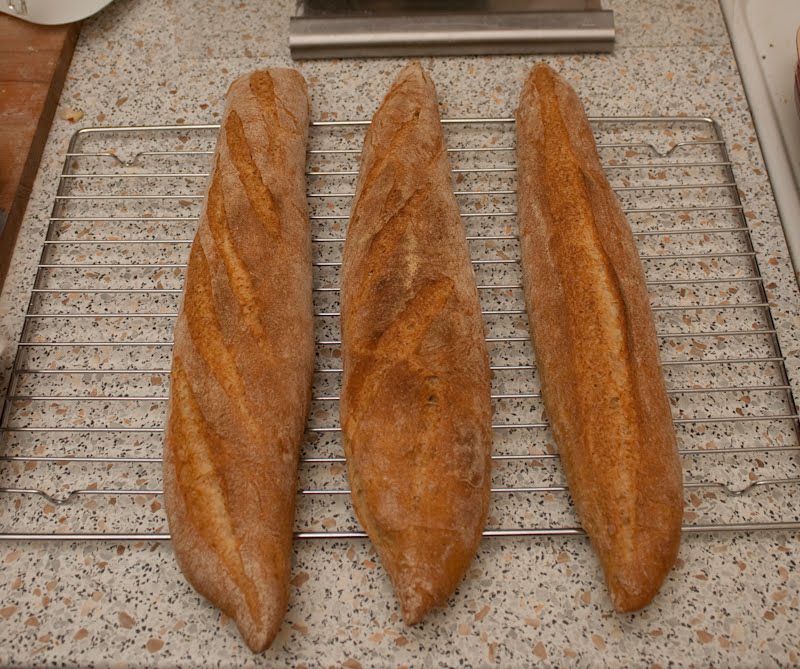
Now, you might look at the results and say, "Mon dieu! those baguettes look amazing." But- and here's where my perfectionist streak comes out- I didn't like them. Not because they didn't have the wonderful flavor or aroma of the Pain a l'Ancienne baguettes. Not because of that. And not because the flavor was very reminiscent of the Pain de Campagne. I mean, it was a similar recipe, no?


No. What I didn't like was the crust. Somehow I used too much flour when dusting the couche and not enough water in the hearth baking. Or maybe the linen wicked too much moisture from the crust. The crust was too dry and too crunchy.


Or maybe it was because I had to bake them on a blue steel baking sheet instead of directly on the stone itself. My oven is a city oven, and is relatively small, so I can fit a 30x40cm baking stone in there but with poor air circulation. Also, the rack in the oven is only 30 cm deep, so I'd have some stone hanging off the rack and fears that chunks of the stone would collapse under the weight of the bread.


Still, if you look at the crumb there are very decent holes.

Though this bread might be authentic somewhere, it was not what I wanted- a shiny crust with no flour on it. Looking back, I should have misted the breads. Or increased the hydration. Yeah. No.

I'll try these again, but perhaps when I began baking out of Leader's Local Breads. Then I'll get everything right.

I really can't argue with the flavor, though. Since this formula included some whole wheat, the bread had a much richer wheat flavor. Still, the bread was not as good as the Pain de Campagne, which is slowly becoming my go-to bread when making breads out of yeast.