Showing posts with label bread. Show all posts

Saturday, April 16, 2011

Garlic Soup and Walnut Bread


I used to love garlic as much as the next person, that is to say, not particularly. But it was this dish I can still remember, in an old Italian restaurant on Fifth Avenue in Brooklyn that changed my mind. I was hanging out with my friend Michael in his old neighborhood. We stopped at this restaurant where he had occasionally eaten after school. It was weird because, for me, growing up, I usually did the cooking after school for anything I wanted to eat. But he had grown up in Brooklyn, where he didn't have to go far in his explorations. In comparison, I had to walk 10 minutes to the nearest mini mart in order to get milk or chocolate.

The dish I ordered in that restaurant was called Chicken Garlissimo (back in my omnivore days). I would love to say that I had become a convert to garlic by that point, and that's why I ordered it, but, in truth, it was the name, the "issimo" that really made me order the dish. That, and the challenge of 27 roasted cloves of garlic in the description. It might have been gluttony, that drew me in, but what I took out of the experience, as I bit into every sweet, delicious, caramelized clove was that garlic is fantastic.

It wasn't until about a year later that I tried roasting my own garlic. I kept coming across it in restaurants, and every time I tasted it, I loved it. The weird thing is that, growing up, we very rarely had garlic. My mom actually had one of those long garlic braids, but we never used it. Actually, she probably still has it! Although I was conceptually aware of garlic, I never really considered that we might have used the garlic in the braid to use in food.


A few weeks ago, Kelly of Something Shiny mentioned something about garlic on Twitter. I no longer remember what it was, but I countered saying that I also love garlic, and Rebecca of Grongar blog chimed in that she also loved garlic. In order to see how far their love of garlic went, I mentioned this Garlic Soup on the wonderful 101 Cookbooks blog. I had been hankering to make for over a year, but only brought it up, half kidding, wondering if they would balk at a soup made out of garlic. Somehow, in the idle chatter, we decided to make it and our choice of walnut bread (as mentioned in the recipe) in the weeks that followed and post on the same day.

Now, this is one of the things I love about Twitter. I had met Kelly and Rebecca over Twitter during the Bread Baker's Apprentice Challenge, and they remain two of my favorite people in my Twitter stream. And this is one of the things I most dislike about Twitter. These two friends live an ocean away, thousands of miles even from each other! Which means, that, as much as I would love to meet and bake with them, it remains a far-fetched dream. But even so, it is an honor to have made their acquaintance and to be able to look at their breads (and cheeses!), even if it is only online.


It's a very simple soup, starting with a cool dozen cloves of garlic, some fresh thyme, a bay leaf, two sage leaves, and a teaspoon of sea salt. I didn't have fresh thyme, so I just added a few sprigs of thyme I dried myself. We usually get a big bunch of fresh at the market, and since we don't go through it fast enough, I just hang it up, let it dry, and use it as we go along.

You let the mixture simmer for 40 minutes, sieve the broth out, remove the sage and bay leaves, and then add the garlic back to the broth.


The  strangest thing of the soup is that it has a whole egg, two egg yolks, an obscene amount of oil (a quarter cup), 42 grams of freshly shaved Parmesan, and a dash of freshly ground pepper. You mix this up (pouring the oil in a drizzle) and then add some of the broth back to the emulsion, constantly whisking. Then, you add the whole mixture into the broth to create the soup.


Unfortunately for me, despite having successfully made zabaglione, I either didn't whisk fast enough, or I was too distracted with taking photos, or I let it go for too long. In any case, the soup separated a bit, but it was still freakin' delicious, full of this vegetal garlic flavor without being too harsh.


Oh, but you didn't think I was going to let you read all that and not mention the bread? My choice was a walnut bread from Dan Lepard's The Handmade Loaf that I had also been eying for about a year. It's made with sourdough and fresh yeast. Included in the bread is a delicious walnut paste that yields slightly more than you need in order to have some left over to spread on the bread.


The dough itself was a bit dry, but it came thogether rather quickly, which was lucky for me since I had to rush to work. I let it rise in the refrigerator, and left it to warm up on the stove while baking another loaf in the oven before letting it have its turn in the heat. Even though the recipe is supposed to yield two loaves, I was happy with it as a large single loaf.


Even though the crumb was a little tight, it has streaks of purple from the walnuts, and made an excellent foil for the garlic soup.


The last thing I wanted to mention is that we're moving. Which sucks when you realize you've collected a lifetime of things in five short years, including two of everything in the kitchen. But it promises a new start, and with it, much hope for happier and brighter tomorrows. And the promise of many delicious meals with old and new friends.

Kelly and Rebecca, I hope to meet you both one day in person.

Here's the link to Kelly's post on Something Shiny.
And the link to Rebecca's post on Grongar Blog will be forthcoming.

Wednesday, December 22, 2010

BBA Challenge #43: Roasted Onion and Asiago Miche

 
So. Here we are. Shredded Asiago.


I've really been dragging my feet towards the end of the challenge. Not just because I didn't want it to end, but mostly because I couldn't find Asiago in Berlin. True, I was only half-heartedly trying.

The thing is, finishing the Bread Baker's Apprentice Challenge meant finishing a significant part of my baking education. Before I started the challenge bread for me meant measuring in cups, and always forgetting if I already had five or six cups. It meant a tablespoon of yeast and a tablespoon of salt. It meant baking bread either as a boule or in loaf pans, with no other possibilities.

But even as early as Brioche or Ciabatta, bread became transcendental. It might have been baking the Casatiello, which remains my favorite bread of the book. I remember slicing the first piece off the mushroom shaped loaf and just thinking about how much crust this piece had. In fact, it might have been all crust. It might also have been when I made my own starter in anticipation of the sourdough section. Or when I began baking 2 kilo sourdough miches as "practice" for the Poilane-Style Miche.

This bread, as well as the last one are included in the Gracenote section of the book, and are cheese-laden celebrations of what bread can be. For this bread, I really wanted to make everything as in the recipe. No changes, no shortcuts.

The Asiago was not easy to find. I asked at several cheese counters and shops in the city, and in an act of desperation, I posed my question on Twitter. In hindsight, I could have asked at KaDeWe, but it's not usually a place where you can find anything easily unless you shop there regularly, which, really, should not turn into a habit. I really only go there when I'm desperate or can't find something anywhere else, and I guess I wasn't at that point yet.

Despite her initial suggestion to use Parmesan cheese, as she had done for her bread, AP269 was the first to suggest Centro Italia. Further recommendations followed from Peggy at Multikulinarisch.es and Küchenlatein. Poking around on Centro Italia's website, I discovered that they have two locations (Now they have three, one just opened in Prenzlauer Berg). There's one near the Schloss in Charlottenburg, and one in the middle of nowhere in Marienfelde. Luckily for me, the one in Marienfelde was about ten minutes closer, and only required a single train. So, I decided to go to that one the following weekend.

That weekend, I looked up the train schedule, double-checked Google Maps and noted the hours. I left for the Marienfelde location.

It was closed.

Somehow, in the rush that defines the weekend, I had only written down the hours of the Charlottenburg location, which is open two hours longer on the weekend. So, Marienfelde? Closed. When I got home, I checked the train schedules for when I would have to leave for Centro Italia on Monday morning with enough time to get to work. I was determined to get this cheese.

On Monday, I arrived at Centro Italia two minutes before nine. There were three guys smoking just outside the entrance, and I just assumed they were also waiting for the store to open. Of course, I thought it was normal that people would be waiting in front of a large Italian supermarket waiting for it to open in the early morning. After about a half-minute of talking amongst themselves, one of the guys told me that I could go in.

I should have gone directly to the cheese counter and fled. But, instead, I went down every aisle. Zucchini spread, Linguine (!), nine thousand different kinds of tomato sauce. It was amazing how much stuff they managed to pack into such a small space.

I walked out of there with two kinds of olive oil, as well as assorted Italian groceries. When I was at their very extensive cheese counter, I asked about the Asiago and the guy didn't even flinch when I told him I needed a half kilo.

When I finally got home that night, I went to work measuring flour, but when I read down to the rest of the ingredients, I quickly realized we had neither chives nor green onions. So much for starting the bread. I had to wait until that Thursday to pop over to the grocery store after work and nab the last two bunches of green onions. I was looking everywhere for fresh chives in the pot (many fresh herbs are sold in a little pot in Germany, in case you want to try to grow them). No dice. I settled for a small box of frozen chives.

And then. I was able to start the last bread in the Challenge.


I've actually been meaning to write an entire post about this device. It's a Mouli-Julienne from Moulinex. I first heard of it on David Lebovitz's wonderful post about Celeriac salad, he pretty much raved about it, and after a bit of quick googling, I found a picture of it, and then, finally, found one on ebay. Amy refers to it as the "Eiffel Tower" which was puzzling until one day I took it out of the cabinet and the long part was on top, which made it look just like the tower. Take a second to look at it closer, and tilt your neck if you have to.


Asiago is a strange cheese. Not sharp like cheddar or some of the drier Italian Cheeses, and not as mild as say, aged Mozzarella.


As I was peeling the wax and paper from the cheese, I discovered these traces of the name. They were probably there just to make sure I hadn't accidentally bought a different cheese. Then again, it could have been "Asiag" cheese, and not Asiago.


And in under a minute, with the help of the "Eiffel Tower" I was done.


I set up my mise en place for the challenge one last time. The thing about having all your ingredients at the ready is that it is so convenient. You're not searching for the salt, and then measuring it out, cursing the spoon scale for being in two pieces- the spoon part on the drying rack, and the scale part in your baking drawer.


As usual, I used my Electrolux DLX/N26/AKM4110W. Just Add Water. And then everything else. It's odd how I haven't really mixed dough by hand ever since I got it at the beginning of last year. And to think that I bought it because I wanted to make pizza. I've made more bread than all the pizzas I've eaten since then.


Of course, when you have an ingredient that is a bit rare, you tend to go overboard with hoarding it until you need to use it. This was a warning for Amy and I, just in case we decide to make grilled cheese with the precious Asiago.


And then, as quickly as the shredding, the dough was done. Normally, I just walk away and then check on the dough periodically, eyeballing it to see how done it is. This is actually easier when I'm doing periodical stretch-and-folds, since the more difficult the dough is to fold, the closer it is to the end of the first rise.


After the allotted three hours, it had risen to between one-and-a-half and double. Perfect.


Despite what the book said (to do it the night before), I roasted the onions as I was making the bread. Yes, that is a quarter sheet pan, only because a half-sheet pan doesn't fit in the oven if I want the door to close.


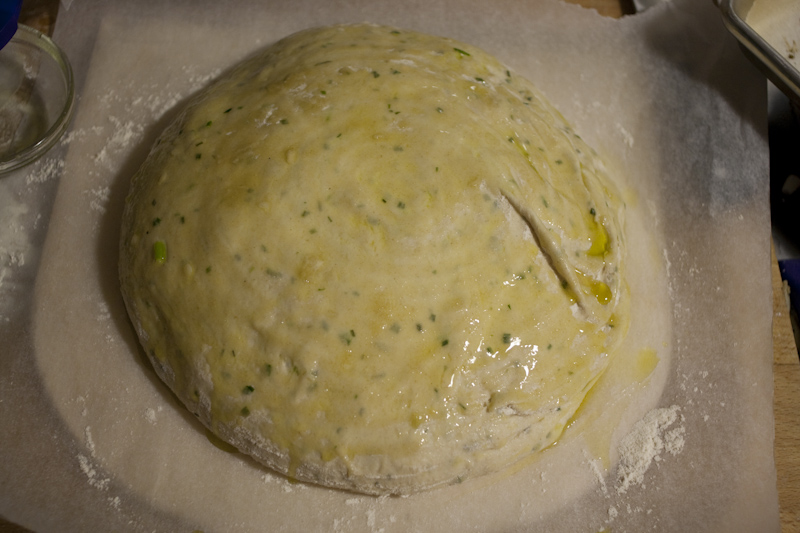
After the second rise, the bread is flipped over onto the peel and brushed with olive oil.


Then dimpled just like Foccacia.


And, like any good Foccacia, topped with the ingredients. Except that this time they were cheese and onions.


Normally, I just put flour on the peel and flop the bread onto it, score it and immediately load it into the oven using quick jerking motions to get the loaf from peel onto stone. The difficulty is compounded because the breads I love baking are actually the same diameter as the width of the stone. So I have to make sure that the bread is not falling off the back of the peel, and that I've approached the oven symmetrically, so that the sides fit on the peel. If I've done enough stretch-and-folds, the dough tends to just sit on the stone and not move. With doughs with considerably less structure and strength, the dough tends to melt to the edge before oven spring kicks in with its rising power.

With all that in mind, I decided on parchment paper for these loaves. I had a bad experience with a pizza sort of sticking to the peel and going onto the stone half-up and half-down, so I didn't want to chance it, especially with all these toppings and the very rare cheese!


I only remembered afterward that many in the Challenge had written about their onions burning in the oven, atop the bread. I also have the tendency to bake my loaves much darker than most others I know. Perhaps it's because I use darker flour, or because my electric oven has an exposed heating element at the top. Or maybe because I crank up the oven to the max and forget to turn it down. I'm not sure.


The crumb was absolutely lovely, with irregular holes, as well as tons of moisture. Perhaps because I kept to the recommended baking times and didn't overbake it to get it browner.


I was a bit disappointed that the onions burned, but they weren't so burnt that I had to pick them off.


When sliced, the bread took on a near-magical quality. All that cheese! It certainly added flavor to the bread, but you could barely recognize it in the crumb itself.


Though this was supposed to be a three-day bread, the bread sort of somehow started overproofing in the fridge during the last rise after only an hour, so I just took it out and baked it. This is the second loaf, just before going into the oven.


And the bottom of the second one the next morning. I froze half of the first loaf as soon as it came out. The other half we inhaled that evening with soup. I also froze half of the second loaf, and snuck slices from the non-frozen half. Note the smoothness of the bottom. Usually, I love the wrinkled flour dusted bottom of loaves, but for this one, I didn't mind.

It was perfect.

I have enjoyed baking with these other finishers of the BBA Challenge. I hope to be able to add your name soon!

Sally from Bewitching Kitchen
Phyl from Of Cabbages and King Cakes
Cindy from Salt and Serenity
Oggi from I can do that!
Sarah from My Runchey Life
Paul from Yumarama
txfarmer's blog (in chinese)
Abby from Stir it! Scrape it! Mix it! Bake it!
ap269 from Family and Food
Anne Marie from Rosemary and Garlic

If I've forgotten you, please send me an email or a comment with a link to your post and I'll include you in the blogroll.

Thursday, October 28, 2010

Berlin Honey


Once Is Happenstance

Earlier this year, I had read a German article about beekeeping on the roof of the Paris Opera. The honey was then sold at the Opera gift shop. I thought this was rather clever, but wondered what the honey would taste like. Other than a trip back to Paris, which is continually in the pre-planning stages, it was unlikely that I would be able to taste honey that came from there, and only from there.
Twice Is Coincidence
About two months later, the tweeters I follow were all abuzz with a video of Tim Hayward making bread with Richard Bertinet. While the video was pretty awesome, another one caught my eye. Urban beekeeping in London. The thing that really got me was that the bees were being kept on the roof of Fortnum and Mason, where we had afternoon tea, after stumbling about London in a mad rush to see everyone we knew. We were trying to find a tea place across the street from an Audi dealership, and, in the end, I remembered the name Fortnum and Mason. As we entered the fourth floor, we were ushered into an empty room to leave our luggage, and then to a table at the back of the restaurant, right next to the kitchen. I didn't mind. After I saw the video, I thought about the London honey that I could have bought.
Three Times... You Pay Attention
I had come across the Berlin Honey website once before, and had contemplated buying some, but in the end, I didn't. I'm not sure why. It wasn't until Peggy of Multikulinarisch.es wrote an article about them that I realized I had to get some. Now, I didn't order any right away, though I really wanted to. Honey from Berlin, I wouldn't have thought that possible if I hadn't read about Paris and London. And why not? With one quarter of Berlin being lakes and forest, it is a perfect environment for bees. In any case, I liked the way it sounded: Paris Honey, London Honey, Berlin Honey.
My History With Honey
I had never really consciously thought about honey. I knew that it came from bees, and also knew that it was stored in honeycombs. A few times, during our trips to Mexico, my parents would buy some honey with a piece of honeycomb floating in it. Sometimes they would only buy a honeycomb filled with honey. We would pop the cells and empty out the honey, chewing the wax like gum. Other than that, we had the occasional honeybear full of clover honey. I never gave a second thought about why it was called clover honey except in the rare case that I bought orange blossom honey. Which tasted slightly of oranges. That I could understand. But clover?


My first conscious experience with honey as a food, as something that wasn't just plain clover honey, or, in Germany, Akazienhonig (as common here as clover honey is over there) was when I bought a very small, and very expensive jar of Tannenhonig (pine honey) at a Bioladen. It was dark and woodsy, aromatic and full of rich forest flavor. I would drizzle it on wonderfully tart fresh goat cheese, taking up a habit, just so I could have the two flavors together.


When we visited Paris last year, Amy discovered a listing in the in-flight magazine for the Maison du Miel. It took a while to find it, we were re-checking the address in the pocket notebook where we had made our notes. When I saw the address, I realized that the address wasn't Rue Vignon 9, but rather Rue Vignon in the 9th arrondissement.


After much consideration, and fully aware that I already had two heavy blue steel baking sheets in my luggage, I chose a small jar of the Rosemary honey, and one of the Bruyère Blanche (tree heath). For our friend, who was housesitting for us, we chose a small jar of coffee honey, produced by bees that hang around coffee plants, getting their pollen fix. I also noticed two bars of honey soap (I have a thing for natural soaps), and snapped them up to complete our purchase.

Then, last spring, on our hiking vacation, we stopped in a small German Deli in Prerow. They had tons of sausages, and best of all, cheese. When I asked which cheese was local, the woman behind the counter quickly answered- "We're in the wrong Bundesland for cheese. That's Schleswig-Holstein. We're in MeckPomm." Fair enough. "I'll take that semi-hard cheese, then".
I don't remember what cheese we ended up having that night, but I do remember coming across a small jar of Buckwheat honey. When I picked it up and put it in the basket, the saleswoman asked me if I had tasted it before, as many people buy it without tasting it, and try to return it. She motioned to a small table with tasting crackers, honey, and a some olive tapenade. I tried the honey.


Buckwheat.

Buckwheat honey tastes the way a barn smells. Musky and dark, and extraordinarily earthy. You get notes of bitter grass and hay, and it's particularly flavorful when paired with some really tangy goat cheese. But then again, which honey doesn't?

Berliner Honig

After coming back from a whirlwind four days in London, Amy and I were invited to a Berlin food blogger picnic by the very lovely Anette and Jemi of Berliner Honig. Oh, wait, say what? Me? A food blogger. I was invited to a food blogger picnic? But I'm not a food blogger. I sent an RSVP, and kept waiting for the follow-up email where they'd realize they had made a mistake. It never came, instead, the next email had more details about the event. So I slowly realized that, yes, I do blog, as infrequently as it seems to be nowadays, and that I do write about food, bread in particular.

The event was held on August 28 at Berliner Honig Headquarters in Friedrichshain. It was originally intended to be held outside in Volkspark Friedrichshain, but bad weather, combined with rain the night before, had pushed it indoors. The office was really white and had huge beautiful windows with blinds. We began with introductions, and a glass of Sekt as a greeting drink.


The night before, I had mixed together a dough using a technique I've named "Overnight Sourdough". Basically, I mix together a dough as close to midnight as I can, do stretch and folds until I go to sleep, then put the dough on the balcony for the bulk rise. This works great in summer, when it's warm enough to sleep with the balcony doors open, but cool enough that a batch of sourdough won't overrise and lose its structure. I usually wake up at six, shape the bread, turn on the oven with the stone in, and sleep for an additional two hours while the bread does a final rise atop the warm stove. I put the bread in at eight, and it's ready by nine. Unfortunately, I'm usually not, so the day of the picnic, the bread was ready before we were.


In attendance were our hosts, Anette and Jemi, Karin from Geniesser Zeit, Peggy from Multikulinarisch.es, Anne from Kekstester, and Suzan from Foodie In Berlin. I was also looking forward to meeting other Berlin Food Bloggers, but they shall remain nameless until I do actually get to meet them. There were some last-minute cancellations, all for very good reasons, I later found out. However, I did wish more of them had been able to attend, because there are a lot of great Berlin Blogs out there. Of course, nearly all of them in German.

Although I was starving, I held on, and snuck a slice of bread while Anette and Jemi talked about honey, bees and beekeeping. In Germany, as in the rest of the world, about 30% of bees die out every year due to Colony Collapse disorder. The thing is, this happens mostly in the countryside, where more crops are farmed. I know, you would think more crops would equal more pollen, but because our agricultural system has evolved into a monoculture system, bees that live around agriculture (and especially industrial agriculture) don't get as much a variety of food as they would have in the past when farms grew a bit of everything. Also to blame are pesticides, which can wreak havoc both on the bees' immune systems as well as their natural navigation systems.

On the other hand, cities have a huge variety of flora. Home gardeners don't just plant one variety, they plant tons, and cities usually plant many different types of trees for aesthetic purposes. Plus, you have a relatively low incidence of pesticides. And you have a rich environment in which bees can thrive. Think about it, if New York can have its own beekeepers association, then surely Berlin, one of the greenest cities in Europe, can be a playground for bees.

And, so, Berliner Honig is produced. The company is a sort of collective/distributor for the various beekeepers in Berlin. Although the average age of beekeepers in Germany is about 80 years, all the beekeepers from Berliner Honig are quite young. Beekeeping itself is not a hobby you can do every other month, as the bees do require weekly maintenance. So, it's usually something that retired people usually take up as a hobby.


Anette (with Jemi chiming in) gave us an explanation on how honey is produced, how the hive works- the social structure and all, and let us touch some of the hive related material she and Jemi had brought. Here's she's holding two frames, though I'm pretty sure they were the ones that hadn't been built upon. Note the brown hive on the left. In a country that has a whole system of standards (DIN), there isn't any real hive standardization. So, there's a wide variety of hive structures. After all our questions, she asked if we were ready to meet the bees, and opened up the hive.


When she and Jemi opened the hive, I gasped. When I was younger, a couple of bees had set themselves up in a hollow part of one of our walls, so I knew well enough to ignore them, and they would mind their own beeswax. Still, I hadn't been around multiple bees in quite a while. Luckily, the hive itself was under glass. In the above picture, the dark areas correspond to the brood- the places where new bees are born and raised, and the honeycombs that are covered are the reserve food, the honey, if you will.


Seeing the bees up close was pretty awesome. They were buzzing and crawling about like crazy. Though she's out of the depth of focus in the above shot, the queen bee was painted with a blue dot, so you could spot her easily. Well, if you looked closely, you could also find her by her size- she was at least two times as big as any of the worker bees.


Holding all the various bee-related things was my favorite part of the day. This is part of a frame, after it has been emptied of its delicious honey.


After all that, we were ready eat and sample the honey. I'm actually kicking myself because I didn't take more pictures of the food- Anette and Jemi had spread out a large table with figs, goat cheese, Gruyere and bread. They also had coffee, and hot water for tea. The funny thing is, Germans usually don't get the concept of a potluck party, but I guess that whenever I have people over, I don't really expect them to bring anything either. Still, there was tons of great stuff on offer. I did manage to snap some of the Eierkuchen and Honey ice cream.


The bread gods had actually blessed me on that day- Usually, I shape the bread in the morning, after a bulk rise in the refrigerator, but this time, I had shaped the bread, then put it in the fridge. So when I did take it out, it was already pretty huge. So, when I baked it, the bread was perfectly risen, with not much oven spring (since it was perfectly risen, haha), but with an awesome crumb.


Suzan from FoodieInBerlin, brought a plum tart, which you can see in the upper right background. Forgive the bread shot, but I usually take photos of my own bread for reference. The plums were all picture perfect, sliced and with no signs of the pits.


When I asked what she did with the middle parts of the plums (where the pits were) she sort of looked at me all puzzled and said, "I ate them." I guess I asked because I would have baked with all the parts of the plums, and wouldn't have even thought of making it aesthetically pleasing, or saving the leftovers for breakfast.


I loved the thinness of the plum tart- I even had a second piece. The plums were laid on a layer of marzipan, which in turn rested on the pastry crust. I was quite shocked when Suzan mentioned that she had used rye flour in the crust, since I didn't know you could to that. Well, you actually can, but she only did because she had run out of other flour. I really should not have been surprised. Since then I've kept an eye out, and noticed that many of the better Berlin bakeries are making their crusts out of spelt.


Also in attendance was Anne from Kekstester, one of my favorite German blogs. The name literally means "cookie tester" and she focuses on cookies and other desserts. While we were all expecting her to bring cookies, she brought Arabic Almond-Honey squares instead. I had two, or, at least two. I think I might have had two and a half. They weren't as honey sweet as most honey and dough desserts that you sometimes find. The cake was a great base for the almonds and honey, and was understated with the real treat being the almond-honey topping. You can find the recipe, as well as her account of the picnic, here (in German).

Peggy from Multikulinarisch.es brought a beet-peanut spread that was simply delicious. It was sweet beets, combined with peanuts and lots of garlic. I don't remember when I began eating beets, but once they crept into my salads, I knew there was no going back. The beet texture with the fat and flavor of the peanuts and the overwhelming yumminess of the peanuts. Even if you're not a beet fan, this pink mix was simple and simply delicious. You can find the recipe here, though, it's only in German.

Tasting Notes


I know that by now you are all dying to know how the honey tasted.

My first impressions were that the spring honey, the Berliner Frühling (on the left) just tasted like honey. Very subtle honey, but without that overt "HONEY" flavor that you sometimes get from clover honey. It was good. It tasted fresh and the way you expect a light honey to taste. I think the problem with the tasting, though was that we went back and forth between the honeys instead of concentrating on one, then on the other. Because the Haupstadtlinde (on the right) was so awesome during the tasting, it overshadowed the Berliner Frühling. Later, I opened the jar of the Berliner Frühling, and it was a revelation. The lightest taste of beeswax with the full roundness of it, and a delicate honey flavor without being cloyingly sweet.

The Haupstadtlinde (Capitol Linden) comes from bees that frequent Linden trees in Berlin. The flavor of this one is just spectacular. Maybe it's not a desired flavor, but you can taste the beeswax. You can taste the beeswax! It has a light citrus-floral flavor that gives way to a full mouth of just lovely beeswax. It's almost like biting into a hive. On sourdough bread, however, the wax flavor is overtaken but the flavor is- well, it's the flavor of simply delicious raw honey.

Wherever you might be, I urge you to find local honey. Either through Local Harvest or the National Honey Board's Honey Locator in the States. In the UK, you can search BeeData's Local Honey Database.

If you are lucky enough to live in Germany, you can order Berlin Honey from Berliner Honig's online shop, or you can buy it in person from selected places in Berlin.

Tuesday, July 13, 2010

BBA Challenge #38: Tuscan Bread


I guess this is the moment when it all went sensationally wrong, way back when.

Somehow, intentionally making a salt-free bread seems to have wronged the delicate balance of the bread universe, so it had to strike back somehow. This is the bread that made me realize something was wrong with the oven.

When I first started baking, I would religiously measure six cups of flour. Oh, wait. is that four or five? Hold on, I have to pour everything back into the bag of flour. One. Two. Three. Four. Whenever my concentration would waver, I would measure out the cups of flour into different parts of the bowl in order to have a visible mark of having the complete six cups of flour.

I would then pour in one tablespoon of yeast, because I couldn't be bothered to measure out 2 1/2 teaspoons. I thought- what's an extra half teaspoon of yeast? Then, two cups of warm water between 105F and 115F. I'd knead the bread by hand, let it rise exactly an hour and a half, punch it down and let it rise another 45 minutes before baking it for 15 minutes at 400F and an addition 25 at 250F.

And there you have it. The bread recipe that I baked quite seldom, and never intentionally. That is, when I would take a bite of the bread, it tasted like water. Lifeless. Beautiful loaves with no flavor. Which, if you're paying attention, would mean I had forgotten the salt. I know, I know, in the confusion of measuring out six, and exactly six, cups of flour, I had somehow forgotten the salt.

The recipe above, with the inclusion of a tablespoon of salt, that is, was the recipe I baked from for about nine years before joining the Bread Baker's Apprentice Challenge. And since then, I have never baked a loaf of bread without the salt. Until now.


Note the absence of salt, the inclusion of an absurd amount of olive oil as well as- um- cooked flour paste, the kind that you used to get in kindergarten, but made with a darker flour.


Into the machine it goes. Note the general lack of counter space. Fruit is in the heart-shaped bowls we picked up second-hand in Belgium, and a stray cake pan is sitting atop the basket we use for potatoes.


So here's where it all starts going awry. Well, not to say that the paste wasn't awry enough. After a very fast bulk rise, I pack the entire thing into an undersized brotform, and forget about it for an hour. Okay, or two. Without the salt, the monster grew quite fast, and expanded to look like a dough-brain.


I flipped it onto the peel, and, not wanting to chance the bread collapsing when sliding it into the oven, I took the easy way out and used parchment paper, which I rarely do, even for pizza.

And what happened? The bread collapsed. Sort of. I noticed that it wasn't baking properly on the bottom, so I attempted to flip it, and stuck half of my mitt into the bottom of the loaf. That's why the picture at the top has that raw, sunken-in look.


So when it came out, it was already mauled. As for the flavor? Well, I would have said inedible. Many others who baked this bread found it tasteless, or tasting like flour paste (but in a good way).


I wasn't too convinced. After all, this bread with no salt. No one intentionally makes bread without salt.

The bread did have this nice sweetness, though, from the flour paste and the flavor of the olive oil. In fact, with this bread, good olive oil is a must, since, without salt, it is one of the prominent flavors.

Oddly enough, Amy said it was the best bread I had ever baked. Which I found strange, but not strange enough to stop me from making sandwiches on the bread. The flavor was complementary to whatever was put on it- mustard and cheese- but, in the end, I know I won't be making this one again.

Other Tuscan bakers include:

Anne Marie of Rosemary and Garlic

Chris from Eating Is The Hard Part

Phyl from Of Cabbages and King Cakes

Oggi from I can do that!