
Showing posts with label bba. Show all posts

Wednesday, December 22, 2010

BBA Challenge #43: Roasted Onion and Asiago Miche

 
So. Here we are. Shredded Asiago.


I've really been dragging my feet towards the end of the challenge. Not just because I didn't want it to end, but mostly because I couldn't find Asiago in Berlin. True, I was only half-heartedly trying.

The thing is, finishing the Bread Baker's Apprentice Challenge meant finishing a significant part of my baking education. Before I started the challenge bread for me meant measuring in cups, and always forgetting if I already had five or six cups. It meant a tablespoon of yeast and a tablespoon of salt. It meant baking bread either as a boule or in loaf pans, with no other possibilities.

But even as early as Brioche or Ciabatta, bread became transcendental. It might have been baking the Casatiello, which remains my favorite bread of the book. I remember slicing the first piece off the mushroom shaped loaf and just thinking about how much crust this piece had. In fact, it might have been all crust. It might also have been when I made my own starter in anticipation of the sourdough section. Or when I began baking 2 kilo sourdough miches as "practice" for the Poilane-Style Miche.

This bread, as well as the last one are included in the Gracenote section of the book, and are cheese-laden celebrations of what bread can be. For this bread, I really wanted to make everything as in the recipe. No changes, no shortcuts.

The Asiago was not easy to find. I asked at several cheese counters and shops in the city, and in an act of desperation, I posed my question on Twitter. In hindsight, I could have asked at KaDeWe, but it's not usually a place where you can find anything easily unless you shop there regularly, which, really, should not turn into a habit. I really only go there when I'm desperate or can't find something anywhere else, and I guess I wasn't at that point yet.

Despite her initial suggestion to use Parmesan cheese, as she had done for her bread, AP269 was the first to suggest Centro Italia. Further recommendations followed from Peggy at Multikulinarisch.es and Küchenlatein. Poking around on Centro Italia's website, I discovered that they have two locations (Now they have three, one just opened in Prenzlauer Berg). There's one near the Schloss in Charlottenburg, and one in the middle of nowhere in Marienfelde. Luckily for me, the one in Marienfelde was about ten minutes closer, and only required a single train. So, I decided to go to that one the following weekend.

That weekend, I looked up the train schedule, double-checked Google Maps and noted the hours. I left for the Marienfelde location.

It was closed.

Somehow, in the rush that defines the weekend, I had only written down the hours of the Charlottenburg location, which is open two hours longer on the weekend. So, Marienfelde? Closed. When I got home, I checked the train schedules for when I would have to leave for Centro Italia on Monday morning with enough time to get to work. I was determined to get this cheese.

On Monday, I arrived at Centro Italia two minutes before nine. There were three guys smoking just outside the entrance, and I just assumed they were also waiting for the store to open. Of course, I thought it was normal that people would be waiting in front of a large Italian supermarket waiting for it to open in the early morning. After about a half-minute of talking amongst themselves, one of the guys told me that I could go in.

I should have gone directly to the cheese counter and fled. But, instead, I went down every aisle. Zucchini spread, Linguine (!), nine thousand different kinds of tomato sauce. It was amazing how much stuff they managed to pack into such a small space.

I walked out of there with two kinds of olive oil, as well as assorted Italian groceries. When I was at their very extensive cheese counter, I asked about the Asiago and the guy didn't even flinch when I told him I needed a half kilo.

When I finally got home that night, I went to work measuring flour, but when I read down to the rest of the ingredients, I quickly realized we had neither chives nor green onions. So much for starting the bread. I had to wait until that Thursday to pop over to the grocery store after work and nab the last two bunches of green onions. I was looking everywhere for fresh chives in the pot (many fresh herbs are sold in a little pot in Germany, in case you want to try to grow them). No dice. I settled for a small box of frozen chives.

And then. I was able to start the last bread in the Challenge.


I've actually been meaning to write an entire post about this device. It's a Mouli-Julienne from Moulinex. I first heard of it on David Lebovitz's wonderful post about Celeriac salad, he pretty much raved about it, and after a bit of quick googling, I found a picture of it, and then, finally, found one on ebay. Amy refers to it as the "Eiffel Tower" which was puzzling until one day I took it out of the cabinet and the long part was on top, which made it look just like the tower. Take a second to look at it closer, and tilt your neck if you have to.


Asiago is a strange cheese. Not sharp like cheddar or some of the drier Italian Cheeses, and not as mild as say, aged Mozzarella.


As I was peeling the wax and paper from the cheese, I discovered these traces of the name. They were probably there just to make sure I hadn't accidentally bought a different cheese. Then again, it could have been "Asiag" cheese, and not Asiago.


And in under a minute, with the help of the "Eiffel Tower" I was done.


I set up my mise en place for the challenge one last time. The thing about having all your ingredients at the ready is that it is so convenient. You're not searching for the salt, and then measuring it out, cursing the spoon scale for being in two pieces- the spoon part on the drying rack, and the scale part in your baking drawer.


As usual, I used my Electrolux DLX/N26/AKM4110W. Just Add Water. And then everything else. It's odd how I haven't really mixed dough by hand ever since I got it at the beginning of last year. And to think that I bought it because I wanted to make pizza. I've made more bread than all the pizzas I've eaten since then.


Of course, when you have an ingredient that is a bit rare, you tend to go overboard with hoarding it until you need to use it. This was a warning for Amy and I, just in case we decide to make grilled cheese with the precious Asiago.


And then, as quickly as the shredding, the dough was done. Normally, I just walk away and then check on the dough periodically, eyeballing it to see how done it is. This is actually easier when I'm doing periodical stretch-and-folds, since the more difficult the dough is to fold, the closer it is to the end of the first rise.


After the allotted three hours, it had risen to between one-and-a-half and double. Perfect.


Despite what the book said (to do it the night before), I roasted the onions as I was making the bread. Yes, that is a quarter sheet pan, only because a half-sheet pan doesn't fit in the oven if I want the door to close.
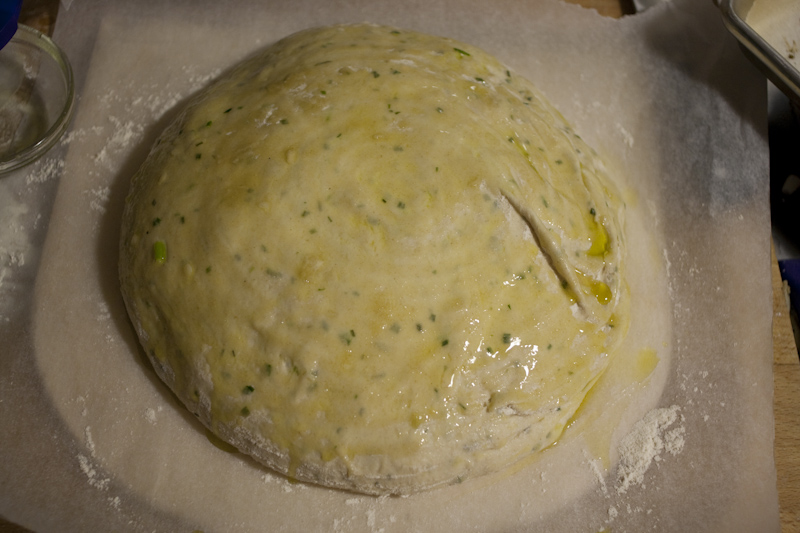

After the second rise, the bread is flipped over onto the peel and brushed with olive oil.


Then dimpled just like Foccacia.


And, like any good Foccacia, topped with the ingredients. Except that this time they were cheese and onions.


Normally, I just put flour on the peel and flop the bread onto it, score it and immediately load it into the oven using quick jerking motions to get the loaf from peel onto stone. The difficulty is compounded because the breads I love baking are actually the same diameter as the width of the stone. So I have to make sure that the bread is not falling off the back of the peel, and that I've approached the oven symmetrically, so that the sides fit on the peel. If I've done enough stretch-and-folds, the dough tends to just sit on the stone and not move. With doughs with considerably less structure and strength, the dough tends to melt to the edge before oven spring kicks in with its rising power.

With all that in mind, I decided on parchment paper for these loaves. I had a bad experience with a pizza sort of sticking to the peel and going onto the stone half-up and half-down, so I didn't want to chance it, especially with all these toppings and the very rare cheese!


I only remembered afterward that many in the Challenge had written about their onions burning in the oven, atop the bread. I also have the tendency to bake my loaves much darker than most others I know. Perhaps it's because I use darker flour, or because my electric oven has an exposed heating element at the top. Or maybe because I crank up the oven to the max and forget to turn it down. I'm not sure.


The crumb was absolutely lovely, with irregular holes, as well as tons of moisture. Perhaps because I kept to the recommended baking times and didn't overbake it to get it browner.


I was a bit disappointed that the onions burned, but they weren't so burnt that I had to pick them off.


When sliced, the bread took on a near-magical quality. All that cheese! It certainly added flavor to the bread, but you could barely recognize it in the crumb itself.


Though this was supposed to be a three-day bread, the bread sort of somehow started overproofing in the fridge during the last rise after only an hour, so I just took it out and baked it. This is the second loaf, just before going into the oven.


And the bottom of the second one the next morning. I froze half of the first loaf as soon as it came out. The other half we inhaled that evening with soup. I also froze half of the second loaf, and snuck slices from the non-frozen half. Note the smoothness of the bottom. Usually, I love the wrinkled flour dusted bottom of loaves, but for this one, I didn't mind.

It was perfect.

I have enjoyed baking with these other finishers of the BBA Challenge. I hope to be able to add your name soon!

Sally from Bewitching Kitchen
Phyl from Of Cabbages and King Cakes
Cindy from Salt and Serenity
Oggi from I can do that!
Sarah from My Runchey Life
Paul from Yumarama
txfarmer's blog (in chinese)
Abby from Stir it! Scrape it! Mix it! Bake it!
ap269 from Family and Food
Anne Marie from Rosemary and Garlic

If I've forgotten you, please send me an email or a comment with a link to your post and I'll include you in the blogroll.

Tuesday, July 13, 2010

BBA Challenge #38: Tuscan Bread


I guess this is the moment when it all went sensationally wrong, way back when.

Somehow, intentionally making a salt-free bread seems to have wronged the delicate balance of the bread universe, so it had to strike back somehow. This is the bread that made me realize something was wrong with the oven.

When I first started baking, I would religiously measure six cups of flour. Oh, wait. is that four or five? Hold on, I have to pour everything back into the bag of flour. One. Two. Three. Four. Whenever my concentration would waver, I would measure out the cups of flour into different parts of the bowl in order to have a visible mark of having the complete six cups of flour.

I would then pour in one tablespoon of yeast, because I couldn't be bothered to measure out 2 1/2 teaspoons. I thought- what's an extra half teaspoon of yeast? Then, two cups of warm water between 105F and 115F. I'd knead the bread by hand, let it rise exactly an hour and a half, punch it down and let it rise another 45 minutes before baking it for 15 minutes at 400F and an addition 25 at 250F.

And there you have it. The bread recipe that I baked quite seldom, and never intentionally. That is, when I would take a bite of the bread, it tasted like water. Lifeless. Beautiful loaves with no flavor. Which, if you're paying attention, would mean I had forgotten the salt. I know, I know, in the confusion of measuring out six, and exactly six, cups of flour, I had somehow forgotten the salt.

The recipe above, with the inclusion of a tablespoon of salt, that is, was the recipe I baked from for about nine years before joining the Bread Baker's Apprentice Challenge. And since then, I have never baked a loaf of bread without the salt. Until now.


Note the absence of salt, the inclusion of an absurd amount of olive oil as well as- um- cooked flour paste, the kind that you used to get in kindergarten, but made with a darker flour.


Into the machine it goes. Note the general lack of counter space. Fruit is in the heart-shaped bowls we picked up second-hand in Belgium, and a stray cake pan is sitting atop the basket we use for potatoes.


So here's where it all starts going awry. Well, not to say that the paste wasn't awry enough. After a very fast bulk rise, I pack the entire thing into an undersized brotform, and forget about it for an hour. Okay, or two. Without the salt, the monster grew quite fast, and expanded to look like a dough-brain.


I flipped it onto the peel, and, not wanting to chance the bread collapsing when sliding it into the oven, I took the easy way out and used parchment paper, which I rarely do, even for pizza.

And what happened? The bread collapsed. Sort of. I noticed that it wasn't baking properly on the bottom, so I attempted to flip it, and stuck half of my mitt into the bottom of the loaf. That's why the picture at the top has that raw, sunken-in look.


So when it came out, it was already mauled. As for the flavor? Well, I would have said inedible. Many others who baked this bread found it tasteless, or tasting like flour paste (but in a good way).


I wasn't too convinced. After all, this bread with no salt. No one intentionally makes bread without salt.

The bread did have this nice sweetness, though, from the flour paste and the flavor of the olive oil. In fact, with this bread, good olive oil is a must, since, without salt, it is one of the prominent flavors.

Oddly enough, Amy said it was the best bread I had ever baked. Which I found strange, but not strange enough to stop me from making sandwiches on the bread. The flavor was complementary to whatever was put on it- mustard and cheese- but, in the end, I know I won't be making this one again.

Other Tuscan bakers include:

Anne Marie of Rosemary and Garlic

Chris from Eating Is The Hard Part

Phyl from Of Cabbages and King Cakes

Oggi from I can do that!

Tuesday, June 22, 2010

BBA Challenge #37: Swedish Rye (LImpa)


Molasses.

Is impossible to find in Germany.

So I exaggerate, but this is the ingredient that has given me the most grief in my short German baking career. I knew that any normal store would definitely not have this in their baking department, and yet I persisted. I asked for "Melasse" at every big supermarket, and at every Bio-laden I could find. Yet, I knew I would probably not find it. A few salespeople even referred me to Zuckerrubensirup, but it's not the same. See here (in German).

Molasses are a basically stronger form of the weak beet sugar syrup. Okay, it's pretty much just a weaker version of molasses. But the flavor is different. I assure you. Molasses is heavy and tastes as dark and as rich as it is black. Whereas Zuckerrübensirup is- well, it's not as heavy but still tastes pretty sweet and rich. Kind of like molasses but without those kicking blackstraps in the back of your tongue.

This bread, however, must have been adapted from a Swedish recipe. So, it's fully possible that the original had no molasses, but, rather, the other beet syrup.

After much to-do, and searching of Bioläden- organic food stores- I went to the one place I had found molasses about two years earlier. I actually used those molasses, shortly before their expiration date, for the first bread in the Challenge- the Andama Bread. The store was called a Reformhaus, which is a chain of Health Food stores that carries the odd off-beat products like flax seeds, oat bran, whole hibiscus flowers, coffee substitutes, and organic candy bars.


So.

Bread #37 of the Bread Baker's Apprentice Challenge is Swedish Rye, also known as Limpa, which, according to Google Translate, simply means "loaf".

On the first day you make a sponge, though, in truth, you probably also need an extra day beforehand in order to get your sourdough starter ready.


By the end, the whole thing looks black and really, really ugly. Still, the molasses should do the wild yeasties some good, since molasses contains not just sugar, but tons other minerals. After four hours, you refrigerate it and take it out the next day.


I don't always follow the directions in the recipe, though. Sometimes I'll make the starter or sponge early in the morning, and then start the bread later on in the day, when the starter looks like it's begun to stir. Of course, my disregard of directions has, on occasion, caused me to miss ingredients or steps.


This particular bread has a high percentage of rye flour- about 30%- so you can't mix it too much, lest the rye become gummy. Despite all the practice with rye in the sourdough section, I still have problems with rye. I don't want to mix it too much, but I also have trouble recognizing when I've mixed it enough.


In this case, the dough held well, and was pretty firm. When the delicate gluten in rye breaks down from overkneading, the dough has a tendency to become sticky. And by then, no amount of stretch and folds can save the bread. Thankfully, this time, it was not the case.


After a very modest first rise, I shaped the loaf and placed it on the quarter-sheet baking pan. The loaves are slashed before the second rise and the whole thing is left to proof until it is time to bake.


Despite all my precautions, however, the bread turned out disastrous. I think this is the period of time when the oven started conking out, way back in March.


Or maybe I didn't steam, the oven- which very well could be, since the loaf has all the tell-tale markings of a loaf whose crust formed first, and then begin to rise after the crust set. The bread looked like a beetle.


And the slices turned into mushrooms. This indicates that the crust baked and set before the rest of the bread. Having nowhere else to expand, the rest of the dough expanded under the bread, broke on the sides, and lifted the whole thing up.

As for the flavor? I didn't really like it despite it's licorice-y flavor. I just couldn't wrap my head around it. The bread all dense and bursting with this flavor I just don't associate with bread. I guess now I can understand people who don't like fruit and nuts in their bread. For them, it's not bread. For me, though, this bread could have been very much improved by a healthy dose of scotch-soaked fruit.

Alas, half of the loaf went into the freezer, and the other half I stuck in the breadbox at work. I recently re-discovered it in there, sealed in a Zip-loc bag, looking about the same as it did months ago when I baked it.

Other bakers who have Limpa'd along with this bread are:

Abby from Stir it! Scrape it! Mix it! Bake it!

Oggi from I can do that!

Phyl from Of Cabbages and King Cakes

Sally from Bewitching Kitchen

Wednesday, June 9, 2010

BBA Challenge #36: Stollen


It now seems like a lifetime ago.

I used to live in Brooklyn. Why there, and not Manhattan? The simplest and foremost reason was the sky. I grew up in California where you have nothing but sky. The highest buildings in my area were about two-stories high, and even then, they were a rarity. So Brooklyn was an obvious choice. Most buildings weren't over four stories and the sky- oh, the sky.

Much to my chagrin, though, most people I knew who lived in Manhattan would very rarely come to Brooklyn. When I would throw parties, they would sort of look at me funny like "You expect me to go where?" and then confess that they had been to Brooklyn only once or twice. Me, on the other hand, I preferred to stay in Brooklyn, and would try, as much as I could, to spend time all my there. My favorite bars were in Brooklyn and I just loved the way it looked. Though I have to confess that I did do most of my food shopping at the Union Square Farmer's Market and Whole Foods in Union Square. Chalk it up to convenience.

Still, I was always on the lookout for shops to visit, and without the infrastructure of Twitter and food blogs- which I never knew existed until I found The Smitten Kitchen- I had to pretty much hear of them through word-of-mouth or random walking.

I don't remember how I discovered Schaller und Weber on the Upper East Side. Perhaps I was visiting my only friend that lived up there, or maybe I just stumbled up on it on the crazy mammoth walks I would undertake just to look at the different architecture. I once walked about 12 miles through three boroughs, just for fun. My favorite thing to do while visiting said friend was to pop into Schaller und Weber and just inhale the smell of the sausages. I know, I know, being a vegetarian and all, what was I thinking? But I just loved the way the place smelled, all meaty and salty and cured.

The thing I most remember about the store was looking at the strange products in German, before I could read and write it. Mustards and Tomato Paste in tubes, strange boxes full of potato powder ready to be made into Kartoffelklöße. Well, the same things that you can get in any good supermarket here.

One cold January morning, I picked up something heavy. It was Stollen, and a kilo of it, at that, all wrapped in a plastic bag with a best by date of March. I don't remember where I had heard of Stollen before, but I seemed to have seen it somewhere before. I picked it up, put it in the basket along with various mustards and German candy.


As part of the Bread Baker's Apprentice Challenge as hosted by the lovely Nicole of Pinch My Salt, stollen would be showing up on the schedule sometime after Christmas, which is a bit funny because most Germans avoid Stollen anyhow, so I thought I'd have a tough time trying to get rid of it.

Here's the mise en place. Just in case you're wondering, I did the same as with the Panettone and soaked the candied fruit in some Macallan single malt Scotch. It was amazing in that, so I decided to do it again.


Once again, the Electrolux Assistent comes to the rescue. I wish I could make a video of how it works just to show people how amazing this thing really is.


Here's the mixture with the almonds and the fruit included.


And as a ball together. The dough was pretty wet on this one for some reason. Perhaps I didn't mix it enough before I added the rest of the bits.


After the first rise, it's not as pillowy as the Panettone, but it's still on this side of firm.


I rolled it out into a rough rectangle. Rough here being a very key word.


Sprinkled the almonds. Actually, I wanted to spread some marzipan in the middle just like the Marzipan Stollen you get here.


I folded it over and...


Um. No, wait. I folded it over and folded the other part over. Somehow I got really confused with the shaping, wanting to make it like the ones here. The funny thing is that many recipes I've found here call for a Stollen pan in order to make that perfect Stollen.


I did no such thing, but thought it came out pretty good.


I sort of winged it with the almonds and just stuffed them into the "mouth" of the Stollen.

Now, you might ask when exactly I made the Stollen. Well, it was three months ago in March. Some friends had been trying to pin us down for the Christmas get-together we never had, and, well, Stollen had been the next bread in the book so it all worked perfectly to plan.


Or, it would have. Somehow in my haste and in trying to get ready to leave the house I sort of... burnt it. Not wanting to trash it and not wanting to re-do the Stollen, I decided to do something I thought I'd never do.


Once we got to the party, I decided to cut off the bad parts of the Stollen and move forward.


I decorated it with powdered sugar and brought it out. The thing is that the Stollen was so delicious, I couldn't help but shave off slices. Among the four of us, we polished off half of the thing. I cut half of what remained and left it there.


One of the things you can do with Stollen is to leave it out for weeks to dry it out. Unfortunately for this one. It didn't even last another day. It was that good.

Just for comparison, though. I'm very much used to Stollen that is pretty dry. When the first ones start appearing in early October, I usually buy a mini-Stollen- for the sake of research, of course. They're pretty dry, but not dry enough that a glass of milk can't make it better. As the season progresses, I get to sample all kinds of Stollen. But once Christmas is over, it's gone. As though they know they won't be able to move the loaves of sugary coated goodness once the holiday season is over.

Most people I know here hate Stollen. I have no idea why. Though, if you look at the Christmas Bread situation in the States it's no better: Fruitcake. We once received one and it was awful. All candied fruit and dense. I vowed never to touch it again. But something dawned on me when eating a similar and very small loaf of fruit bread here. Fruitcake, the kind you get in the US would be so much better swimming in some kind of scotch or rum. I can just imagine it now.

Other Stollen Bakers include:

Phyl from Of Cabbages and King Cakes

Sally from Bewitching Kitchen

ap269 from Family and Food

Oggi from I can do that!