This is the second of a three-part series on my experiences with Poilâne bread. You can find the first part
here.
A short while after we got back from Paris, I was poking around the
Poilâne website checking the price of shipping a loaf to Berlin (about 36€, shipping included), when I noticed that
Galeries Lafayette on Friedrichstrasse was one of their international distributors. Almost immediately I headed over there and scoped out the bread counter. They not only sold huge, round whole loaves in their signature white bags, but they also sold half and quarter loaves in small plastic bags.
Because I still had a third of a loaf left over from Paris, I didn't need to buy any just yet. I held off, thinking that I could whip up a batch of flour, sourdough and water and bake my own loaf. I mean, how hard could it be? I put all ten digits on my
blank keyboard and tirelessly researched Discussion Forums, brushed up on the German flours available to me, and even bought whole Spelt Flour based on what I had read.

This was the first
miche I ever baked.
Somehow intoxicated by the idea, I baked another one. On the same day. Okay, I didn't just decide to bake this one, I also baked the following one. For some crazy reason, I decided I should bake two at the same time.

For these two breads, I used Fred, the sourdough starter that I had bought from the store. I actually think this might have been my first experience with Sourdough, because, even though the loaves look okay from above...

They were completely flat from the side.
I was crushed. Disappointed. I thought I would never be able to master sourdough bread, and in turn, never be able to reach the standards set by the late, great Monsieur Poilâne.

The second loaf was a bit flatter, everyone who got a piece of the bread ate it up. Literally. Flattish, moist, almost gummy rye breads are common in Germany, and most people are easily deceived by the nice scoring at the top. If I had told everyone that this was a loaf of rye bread they would have believed me. Well, aside from the taste.

Instead, I snuck back over to
Galeries Lafayette. So started my dirty little secret. Well, my flour-dusted little secret. I wouldn't buy a half or quarter loaf...

I would buy a whole loaf.

The coating of flour on the loaves is amazing. The flour coats the top surface of the bread and even forms cracks. The scoring is also quite amazing. The "P" is scored with attention to detail. The tail shows how the bread is scored ever so lightly on the tail of the letter.

Again, the mystery line appears. A fine coat of ash dusts the bottom of every loaf.

The crumb is just beautiful, with larger holes along the edges of the bread, and the crust is thick. The brown edges line every slice, providing a generous chew, or a crunch when the bread is toasted.

Here's my next attempt at making a
miche. For this one I used Type 1050 German flour, which would become my standard flour for these loaves. Type 1050 flour is flour with an ash content of 1050mg per 100g. In Germany, it's basically one step down from whole wheat, and is generally used in breads where the color doesn't matter, and in breads where rye is mixed in.

The crumb is still tight, but at least I was making progress.

Despite being able to bake 2kg loaves, there is nothing like taking the
U-Bahn home with a huge white bag inside an even bigger red bag with the Lafayette logo. People look at you like you've just bought the latest coat from Paris, when all you really have is the most amazing bread in the world.

The crumb is always random.

And the loaves themselves are never the same as the one from two weeks before. They're irregular- measured by diameter, they usually range from 28-23cm.

As for my adventures, it wasn't until I started making loaves from my own cultivated sourdough starter that I began having success with larger breads. Here's one of the early test breads that wasn't as wide, but definitely rose higher than I had expected.

Unfortunately, I'm terrible at thinking up scoring designs. I try to be creative but it all ends up crooked.

The other thing I love doing is baking the breads until the flour dusting turns brown, and the breads themselves are a dark, rich mahogany. I'm unfortunate enough to have an electrical oven, but fortunate to have direct heat from the top.

By this point, I was getting pretty good at making the monster loaves. The line, or tear, on the left side is where I plunged the thermometer into the loaf to take a reading. It was mere coincidence that I happened to cut it along the same line.

The bags are one of my favorite things about the bread. They usually come double bagged. I take the bread out, carefully smooth out the bags and then put the bread into older bags that I keep. Thus far, I've only had to toss one bag that was torn from overuse. Aside from the beautiful logo, The bags themselves are plain paper bags that soften after repeated use, and are printed with descriptions of grains (in French) that are used in making bread.

Again, note the scoring of the loaf. The "P" is different, but no less elegant, on this loaf.

This particular loaf is actually quite round, in comparison to some of the other loaves I've bought. However, no loaf has been any less delicious because of its shape, though. Note the cracks and grooves in the base of the bread.

The very first thing I do (after I take photos) is cut the loaf in half and immediately freeze one half. I wrap it in plastic wrap, then aluminum foil, then stick it in a huge Ziploc bag, the likes of which are quite rare in Germany. For reheating, I leave it wrapped in foil for an hour in a 180C oven. Of course, it's difficult to keep your hands off one when warm.

On some loaves, the dusting of flour can be as thick as a millimeter, and the scoring always varies. Every loaf is essentially hand-made, with the only automation being the mixer used to develop the dough.

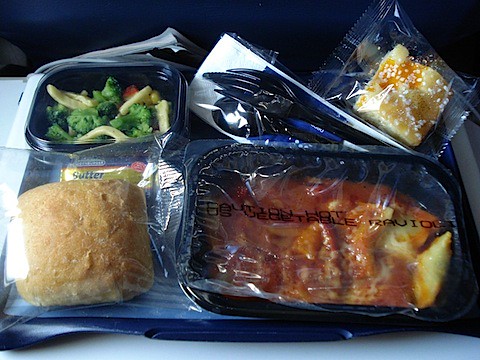
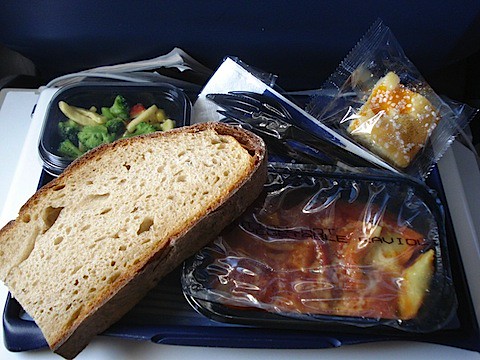
Two days after buying the loaf above, we were on a plane to visit my sister and her family. On the plane I noticed that the bread was packed inside of a plastic pillow. I had pre-sliced a chunk of the bread to take with us on the plane ride, and thought it would be funny to photograph the meal with the Pain Poilâne.

I was right! The ravioli was amazing with the bread, and the vegetable salad had a certain
je ne sais quoi.Okay, I jest. Although, as a vegetarian, I find most vegetarian plane food rather decent, but that might just be because I have no other choice, or maybe because I almost always get served first. Still, it was quite an experience to have good bread during a day in which all one could do was sit still and watch movies. Imagine if all bread on airplanes was freshly cut from a massive loaf!
In early February, I headed over again to
Galeries Lafayette. This time, though, I got there five minutes too late. The saleslady at the bread counter had just cut the very last loaf into four quarters. She mentioned that the price was the same for one whole loaf or four quarters. I stared at them in their perfect plastic bags, but I could just not bring myself to do it. There's something just magical about having such a huge chunk of bread. Instead, I decided on two halves, which I later found out were mismatching!

This is the most recent loaf I bought. Half is still sitting in my freezer, and I'm already planning my next visit to buy another giant loaf. It doesn't hurt that it's only a 10 minute detour on the way home.

One of the things I love most about the packaging and presentation is the twist on one side to close the bag. It forms what looks like an ear as well as a handle.

The irregularity of the holes, is astounding, particularly around the outer crust. The first and last few slices of any half are usually almost completely filled with holes. Well, that is, if holes can fill something.

One of the most distinct flavors of the bread, which is missing from my own loaves, is a certain smokiness. It's not there in every slice, but when it is, it's usually very faint. This makes sense, as the bread is baked in a wood-fired oven. If you look closely, you'll notice an ever-so-delicate dusting of ash from the oven, which probably contributes to the amazing flavor profile.
My Torn Miche:
One of the things I learned in my research, and one of the things Peter Reinhart simulates in
The Bread Baker's Apprentice is the use of a piece of old dough as leavening agent. For a while I actually had a starter at 65% hydration, with 2% sea salt. However, measuring minute amounts of sea salt proved too difficult for me.
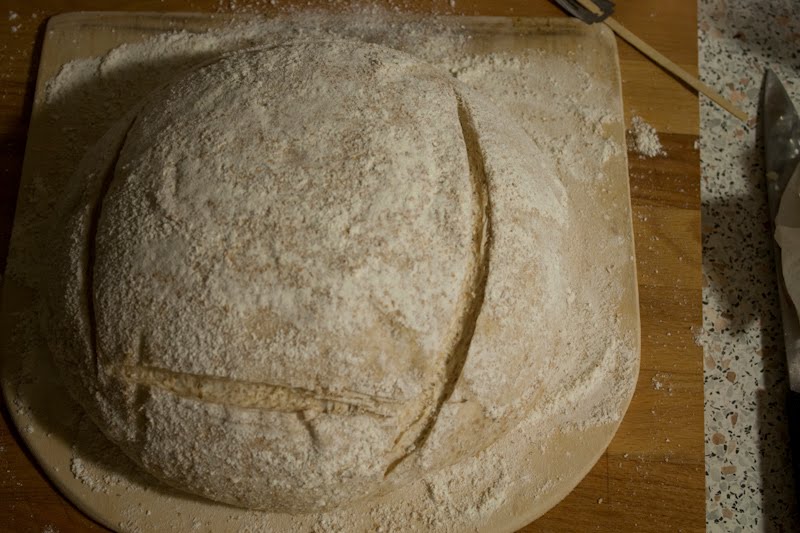
This time, however, bad luck fell upon me and I was able to quickly turn it into good luck: I was dabbling with spelt flour, and had even formulated a recipe that had a final amount of 25% whole spelt. Another 25% of the flour came from a 100% Sourdough Starter. Somehow, I goofed and let the bread rise too long. How long is too long? Oh, about 14 hours at room temperature. I think it might have had something to do with me going to sleep without putting the dough in the fridge, then forgetting about it the next morning until noon. That dough was terrible. There was no structure left when I got back to it. It rose high enough to just be able to brush the firmament with a feather, so that when I got to it, the gluten immediately fell apart when I degassed it. I used that fallen-apart-unstructured dough and made this bread.
The loaf is torn in the middle because it stuck to the linen rather than coming out, and the dough folded over onto itself. In the oven, however, it realized it was the weakest point and burst forth through the crevice. Note my crazy scoring. At least that is consistent.

I really can't complain, though. The flavor is great, though not amazing- I think I'll have to have the second rise overnight in the refrigerator to get my desired sourness.
In case you're still breathing after all those bread pictures, here's the recipe for the above bread. I've gotten to a point where I can bake this type of loaf with my eyes nearly closed, which comes in handy when the dough has risen overnight and the loaf has to go into the oven fairly early.
Recipe: Poilâne-style Torn Miche(Note that I actually made 3kg of what is now the Old Dough starter, so I've backtracked and reformulated that part to reflect what I actually ended up using.)
Old Dough:
160g Sourdough Starter at 100% (80g Flour, 80g Water)
80g Whole Spelt Flour (You can substitute Sifted Whole Wheat Flour)
170g Sifted Whole Wheat Flour
134g Water
6g Sea Salt
This basically gets you a dough with a final hydration of 65%, and 2% Sea Salt.
Knead as you would for a bread and let rise until it has doubled, or for about 6-12 hours. You can also put this in the fridge, but be sure to give it a head-start of at least 4 hours before you refrigerate it, and at least 4 afterwards to let it come back to room temperature.
Final Dough:
550g old dough (from above)
1000g Sifted Whole Wheat Flour
650g Water at room temperature
25g Sea Salt
Note that the old dough is already at 65%, so the final dough will basically just be a threefold batch based on the first dough. The final weight of the dough will be just about 2,2kg.
Again, knead until the dough looks almost right. Stretch and fold every thirty minutes for the first two of the 4-6 hour rise. Shape and refrigerate in linen-covered colander.
Take out of fridge two hours before baking time to let it warm up.
Turn onto floured bread peel and allow the middle of the bread to stick to the fabric. After some prodding, take your hand and scrape out the dough that won't come out, making sure that some is left behind to create a tear in the bread.
Arrange the torn dough one piece atop the other so as to hide the mistake.
Score the sides of the loaf like a crazed baker and load onto a baking stone in the oven. Dump about a cup or a half cup of water into the pan you always keep at the bottom of the oven.
Bake for about an hour at 230C.
Cool on a wire rack.
Photograph. Post. Repeat.
Further Reading:In case you missed the small update to my last post:
Dorie Greenspan just posted an amazing video of the late, great
Lionel Poilâne making Punitions. Her recipe, from the man himself, is on her
essential post on Butter.
The Bread Baking Babes tackled this bread in May 2008. Here's the
roundup post at
What Did You EatHere's
Sherry's post on this wonderful bread at
What Did You EatAnother one from
Apple Pie, Patis, PâtéBake my Day's Poilâne post
Petra's Brotkasten five-grain-flour variation (in German)
Another recipe courtesy of tengby.com
Kenneth's Poilâne on
Kitchencookingrecipes.comA post on
Kenneth's Poilâne-style Miche at the very excellent and very fresh,
Fresh LoafRecreating the miche in Australia at
Brasserie BreadStay Tuned for Part Three!