Showing posts with label awesome. Show all posts

Saturday, April 16, 2011

Garlic Soup and Walnut Bread


I used to love garlic as much as the next person, that is to say, not particularly. But it was this dish I can still remember, in an old Italian restaurant on Fifth Avenue in Brooklyn that changed my mind. I was hanging out with my friend Michael in his old neighborhood. We stopped at this restaurant where he had occasionally eaten after school. It was weird because, for me, growing up, I usually did the cooking after school for anything I wanted to eat. But he had grown up in Brooklyn, where he didn't have to go far in his explorations. In comparison, I had to walk 10 minutes to the nearest mini mart in order to get milk or chocolate.

The dish I ordered in that restaurant was called Chicken Garlissimo (back in my omnivore days). I would love to say that I had become a convert to garlic by that point, and that's why I ordered it, but, in truth, it was the name, the "issimo" that really made me order the dish. That, and the challenge of 27 roasted cloves of garlic in the description. It might have been gluttony, that drew me in, but what I took out of the experience, as I bit into every sweet, delicious, caramelized clove was that garlic is fantastic.

It wasn't until about a year later that I tried roasting my own garlic. I kept coming across it in restaurants, and every time I tasted it, I loved it. The weird thing is that, growing up, we very rarely had garlic. My mom actually had one of those long garlic braids, but we never used it. Actually, she probably still has it! Although I was conceptually aware of garlic, I never really considered that we might have used the garlic in the braid to use in food.


A few weeks ago, Kelly of Something Shiny mentioned something about garlic on Twitter. I no longer remember what it was, but I countered saying that I also love garlic, and Rebecca of Grongar blog chimed in that she also loved garlic. In order to see how far their love of garlic went, I mentioned this Garlic Soup on the wonderful 101 Cookbooks blog. I had been hankering to make for over a year, but only brought it up, half kidding, wondering if they would balk at a soup made out of garlic. Somehow, in the idle chatter, we decided to make it and our choice of walnut bread (as mentioned in the recipe) in the weeks that followed and post on the same day.

Now, this is one of the things I love about Twitter. I had met Kelly and Rebecca over Twitter during the Bread Baker's Apprentice Challenge, and they remain two of my favorite people in my Twitter stream. And this is one of the things I most dislike about Twitter. These two friends live an ocean away, thousands of miles even from each other! Which means, that, as much as I would love to meet and bake with them, it remains a far-fetched dream. But even so, it is an honor to have made their acquaintance and to be able to look at their breads (and cheeses!), even if it is only online.


It's a very simple soup, starting with a cool dozen cloves of garlic, some fresh thyme, a bay leaf, two sage leaves, and a teaspoon of sea salt. I didn't have fresh thyme, so I just added a few sprigs of thyme I dried myself. We usually get a big bunch of fresh at the market, and since we don't go through it fast enough, I just hang it up, let it dry, and use it as we go along.

You let the mixture simmer for 40 minutes, sieve the broth out, remove the sage and bay leaves, and then add the garlic back to the broth.


The  strangest thing of the soup is that it has a whole egg, two egg yolks, an obscene amount of oil (a quarter cup), 42 grams of freshly shaved Parmesan, and a dash of freshly ground pepper. You mix this up (pouring the oil in a drizzle) and then add some of the broth back to the emulsion, constantly whisking. Then, you add the whole mixture into the broth to create the soup.


Unfortunately for me, despite having successfully made zabaglione, I either didn't whisk fast enough, or I was too distracted with taking photos, or I let it go for too long. In any case, the soup separated a bit, but it was still freakin' delicious, full of this vegetal garlic flavor without being too harsh.


Oh, but you didn't think I was going to let you read all that and not mention the bread? My choice was a walnut bread from Dan Lepard's The Handmade Loaf that I had also been eying for about a year. It's made with sourdough and fresh yeast. Included in the bread is a delicious walnut paste that yields slightly more than you need in order to have some left over to spread on the bread.


The dough itself was a bit dry, but it came thogether rather quickly, which was lucky for me since I had to rush to work. I let it rise in the refrigerator, and left it to warm up on the stove while baking another loaf in the oven before letting it have its turn in the heat. Even though the recipe is supposed to yield two loaves, I was happy with it as a large single loaf.


Even though the crumb was a little tight, it has streaks of purple from the walnuts, and made an excellent foil for the garlic soup.


The last thing I wanted to mention is that we're moving. Which sucks when you realize you've collected a lifetime of things in five short years, including two of everything in the kitchen. But it promises a new start, and with it, much hope for happier and brighter tomorrows. And the promise of many delicious meals with old and new friends.

Kelly and Rebecca, I hope to meet you both one day in person.

Here's the link to Kelly's post on Something Shiny.
And the link to Rebecca's post on Grongar Blog will be forthcoming.

Wednesday, March 31, 2010

Eating Pain Poilâne. Baking miches.


This is the second of a three-part series on my experiences with Poilâne bread. You can find the first part here.

A short while after we got back from Paris, I was poking around the Poilâne website checking the price of shipping a loaf to Berlin (about 36€, shipping included), when I noticed that Galeries Lafayette on Friedrichstrasse was one of their international distributors. Almost immediately I headed over there and scoped out the bread counter. They not only sold huge, round whole loaves in their signature white bags, but they also sold half and quarter loaves in small plastic bags.

Because I still had a third of a loaf left over from Paris, I didn't need to buy any just yet. I held off, thinking that I could whip up a batch of flour, sourdough and water and bake my own loaf. I mean, how hard could it be? I put all ten digits on my blank keyboard and tirelessly researched Discussion Forums, brushed up on the German flours available to me, and even bought whole Spelt Flour based on what I had read.


This was the first miche I ever baked.

Somehow intoxicated by the idea, I baked another one. On the same day. Okay, I didn't just decide to bake this one, I also baked the following one. For some crazy reason, I decided I should bake two at the same time.


For these two breads, I used Fred, the sourdough starter that I had bought from the store. I actually think this might have been my first experience with Sourdough, because, even though the loaves look okay from above...


They were completely flat from the side.

I was crushed. Disappointed. I thought I would never be able to master sourdough bread, and in turn, never be able to reach the standards set by the late, great Monsieur Poilâne.


The second loaf was a bit flatter, everyone who got a piece of the bread ate it up. Literally. Flattish, moist, almost gummy rye breads are common in Germany, and most people are easily deceived by the nice scoring at the top. If I had told everyone that this was a loaf of rye bread they would have believed me. Well, aside from the taste.


Instead, I snuck back over to Galeries Lafayette. So started my dirty little secret. Well, my flour-dusted little secret. I wouldn't buy a half or quarter loaf...


I would buy a whole loaf.


The coating of flour on the loaves is amazing. The flour coats the top surface of the bread and even forms cracks. The scoring is also quite amazing. The "P" is scored with attention to detail. The tail shows how the bread is scored ever so lightly on the tail of the letter.


Again, the mystery line appears. A fine coat of ash dusts the bottom of every loaf.


The crumb is just beautiful, with larger holes along the edges of the bread, and the crust is thick. The brown edges line every slice, providing a generous chew, or a crunch when the bread is toasted.


Here's my next attempt at making a miche. For this one I used Type 1050 German flour, which would become my standard flour for these loaves. Type 1050 flour is flour with an ash content of 1050mg per 100g. In Germany, it's basically one step down from whole wheat, and is generally used in breads where the color doesn't matter, and in breads where rye is mixed in.


The crumb is still tight, but at least I was making progress.


Despite being able to bake 2kg loaves, there is nothing like taking the U-Bahn home with a huge white bag inside an even bigger red bag with the Lafayette logo. People look at you like you've just bought the latest coat from Paris, when all you really have is the most amazing bread in the world.


The crumb is always random.


And the loaves themselves are never the same as the one from two weeks before. They're irregular- measured by diameter, they usually range from 28-23cm.


As for my adventures, it wasn't until I started making loaves from my own cultivated sourdough starter that I began having success with larger breads. Here's one of the early test breads that wasn't as wide, but definitely rose higher than I had expected.


Unfortunately, I'm terrible at thinking up scoring designs. I try to be creative but it all ends up crooked.


The other thing I love doing is baking the breads until the flour dusting turns brown, and the breads themselves are a dark, rich mahogany. I'm unfortunate enough to have an electrical oven, but fortunate to have direct heat from the top.


By this point, I was getting pretty good at making the monster loaves. The line, or tear, on the left side is where I plunged the thermometer into the loaf to take a reading. It was mere coincidence that I happened to cut it along the same line.


The bags are one of my favorite things about the bread. They usually come double bagged. I take the bread out, carefully smooth out the bags and then put the bread into older bags that I keep. Thus far, I've only had to toss one bag that was torn from overuse. Aside from the beautiful logo, The bags themselves are plain paper bags that soften after repeated use, and are printed with descriptions of grains (in French) that are used in making bread.


Again, note the scoring of the loaf. The "P" is different, but no less elegant, on this loaf.


This particular loaf is actually quite round, in comparison to some of the other loaves I've bought. However, no loaf has been any less delicious because of its shape, though. Note the cracks and grooves in the base of the bread.


The very first thing I do (after I take photos) is cut the loaf in half and immediately freeze one half. I wrap it in plastic wrap, then aluminum foil, then stick it in a huge Ziploc bag, the likes of which are quite rare in Germany. For reheating, I leave it wrapped in foil for an hour in a 180C oven. Of course, it's difficult to keep your hands off one when warm.


On some loaves, the dusting of flour can be as thick as a millimeter, and the scoring always varies. Every loaf is essentially hand-made, with the only automation being the mixer used to develop the dough.

DSC04694.JPG
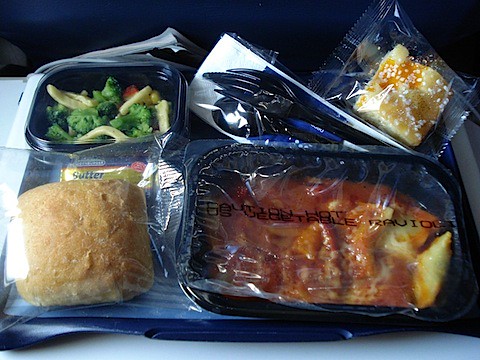
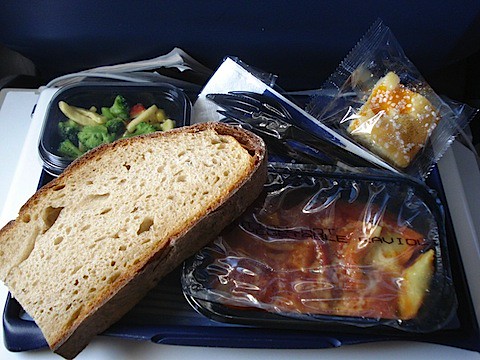
Two days after buying the loaf above, we were on a plane to visit my sister and her family. On the plane I noticed that the bread was packed inside of a plastic pillow. I had pre-sliced a chunk of the bread to take with us on the plane ride, and thought it would be funny to photograph the meal with the Pain Poilâne.

DSC04695.JPG
I was right! The ravioli was amazing with the bread, and the vegetable salad had a certain je ne sais quoi.

Okay, I jest. Although, as a vegetarian, I find most vegetarian plane food rather decent, but that might just be because I have no other choice, or maybe because I almost always get served first. Still, it was quite an experience to have good bread during a day in which all one could do was sit still and watch movies. Imagine if all bread on airplanes was freshly cut from a massive loaf!

In early February, I headed over again to Galeries Lafayette. This time, though, I got there five minutes too late. The saleslady at the bread counter had just cut the very last loaf into four quarters. She mentioned that the price was the same for one whole loaf or four quarters. I stared at them in their perfect plastic bags, but I could just not bring myself to do it. There's something just magical about having such a huge chunk of bread. Instead, I decided on two halves, which I later found out were mismatching!


This is the most recent loaf I bought. Half is still sitting in my freezer, and I'm already planning my next visit to buy another giant loaf. It doesn't hurt that it's only a 10 minute detour on the way home.


One of the things I love most about the packaging and presentation is the twist on one side to close the bag. It forms what looks like an ear as well as a handle.


The irregularity of the holes, is astounding, particularly around the outer crust. The first and last few slices of any half are usually almost completely filled with holes. Well, that is, if holes can fill something.


One of the most distinct flavors of the bread, which is missing from my own loaves, is a certain smokiness. It's not there in every slice, but when it is, it's usually very faint. This makes sense, as the bread is baked in a wood-fired oven. If you look closely, you'll notice an ever-so-delicate dusting of ash from the oven, which probably contributes to the amazing flavor profile.


My Torn Miche:


One of the things I learned in my research, and one of the things Peter Reinhart simulates in The Bread Baker's Apprentice is the use of a piece of old dough as leavening agent. For a while I actually had a starter at 65% hydration, with 2% sea salt. However, measuring minute amounts of sea salt proved too difficult for me.

This time, however, bad luck fell upon me and I was able to quickly turn it into good luck: I was dabbling with spelt flour, and had even formulated a recipe that had a final amount of 25% whole spelt. Another 25% of the flour came from a 100% Sourdough Starter. Somehow, I goofed and let the bread rise too long. How long is too long? Oh, about 14 hours at room temperature. I think it might have had something to do with me going to sleep without putting the dough in the fridge, then forgetting about it the next morning until noon. That dough was terrible. There was no structure left when I got back to it. It rose high enough to just be able to brush the firmament with a feather, so that when I got to it, the gluten immediately fell apart when I degassed it. I used that fallen-apart-unstructured dough and made this bread.

The loaf is torn in the middle because it stuck to the linen rather than coming out, and the dough folded over onto itself. In the oven, however, it realized it was the weakest point and burst forth through the crevice. Note my crazy scoring. At least that is consistent.


I really can't complain, though. The flavor is great, though not amazing- I think I'll have to have the second rise overnight in the refrigerator to get my desired sourness.

In case you're still breathing after all those bread pictures, here's the recipe for the above bread. I've gotten to a point where I can bake this type of loaf with my eyes nearly closed, which comes in handy when the dough has risen overnight and the loaf has to go into the oven fairly early.


Recipe: Poilâne-style Torn Miche

(Note that I actually made 3kg of what is now the Old Dough starter, so I've backtracked and reformulated that part to reflect what I actually ended up using.)

Old Dough:
160g Sourdough Starter at 100% (80g Flour, 80g Water)
80g Whole Spelt Flour (You can substitute Sifted Whole Wheat Flour)
170g Sifted Whole Wheat Flour
134g Water
6g Sea Salt

This basically gets you a dough with a final hydration of 65%, and 2% Sea Salt.

Knead as you would for a bread and let rise until it has doubled, or for about 6-12 hours. You can also put this in the fridge, but be sure to give it a head-start of at least 4 hours before you refrigerate it, and at least 4 afterwards to let it come back to room temperature.


Final Dough:
550g old dough (from above)
1000g Sifted Whole Wheat Flour
650g Water at room temperature
25g Sea Salt

Note that the old dough is already at 65%, so the final dough will basically just be a threefold batch based on the first dough. The final weight of the dough will be just about 2,2kg.

Again, knead until the dough looks almost right. Stretch and fold every thirty minutes for the first two of the 4-6 hour rise. Shape and refrigerate in linen-covered colander.

Take out of fridge two hours before baking time to let it warm up.

Turn onto floured bread peel and allow the middle of the bread to stick to the fabric. After some prodding, take your hand and scrape out the dough that won't come out, making sure that some is left behind to create a tear in the bread.

Arrange the torn dough one piece atop the other so as to hide the mistake.

Score the sides of the loaf like a crazed baker and load onto a baking stone in the oven. Dump about a cup or a half cup of water into the pan you always keep at the bottom of the oven.
Bake for about an hour at 230C.

Cool on a wire rack.

Photograph. Post. Repeat.


Further Reading:


In case you missed the small update to my last post:
Dorie Greenspan just posted an amazing video of the late, great Lionel Poilâne making Punitions. Her recipe, from the man himself, is on her essential post on Butter.

The Bread Baking Babes tackled this bread in May 2008. Here's the roundup post at What Did You Eat

Here's Sherry's post on this wonderful bread at What Did You Eat

Another one from Apple Pie, Patis, Pâté

Bake my Day's Poilâne post

Petra's Brotkasten five-grain-flour variation (in German)

Another recipe courtesy of tengby.com

Kenneth's Poilâne on Kitchencookingrecipes.com

A post on Kenneth's Poilâne-style Miche at the very excellent and very fresh, Fresh Loaf

Recreating the miche in Australia at Brasserie Bread

Stay Tuned for Part Three!

Tuesday, March 23, 2010

Le Pain Poilâne

20090817_MG_2884.jpg

We almost didn't make it.

I had ticked off the Poilâne bakery on Rue Cherche-Midi as one of the stops on our Paris trip last August, but it looked like the list of things we wanted to see and do would outweigh the list of things we would actually do. The only thing that was a must-see on my list was La Défense, the big modern complex outside of the Paris Peripherique with the humongous Grand Arch that announces the triumph of modernism over the old, traditional Paris.

We had been warned more than once not to visit Paris in August, since everyone would be away on vacation. Also, we were told that and that the dates we had chosen were the worst dates to be there. The fifteenth of August is the Assumption of Mary, so in addition to most Parisians being away, we were going to be there on a holiday which fell on a Saturday, so already it seemed as though two of our four days were going to be spent hitting shops which would be closed.

20090815_MG_2567.jpg

Luckily, or, unluckily for us, it only happened once. On the morning of the fifteenth, we tried going to Du Pain et Des Idees but they were closed, and my high school French could not even begin to decipher the cryptic note taped to the inside of the glass door. We peeked in the windows- it was a beautiful bakery, even when closed.
I had Poilâne on my maybe list, knowing that if we didn't visit that one, or if it was closed, we could just visit Gosselin, whose bread inspired Peter Reinhart's Pain a l'Ancienne recipe. But something was just pulling me there. I wanted to go.

That morning, even before trying to visit Du Pain et Des Idees, we were planning our day at the hotel during breakfast, and Amy asked about the bakeries. She wanted to have a picnic somewhere, and if I knew whereabouts the bakery was, couldn't we get some bread?Immediately, I opened up Clotilde's Culinary Adventures in Paris, and crossed referenced the address with Paris Pratique. 8 Rue Cherche-Midi.

(Here I have to take pause and wholeheartedly endorse Clotilde's wonderful volume. Not only did we refer to it more often than the DK Guide to Paris, but we found some amazing places within its pages. One of the best thing is that she also lists the closest Metro stop. Unfortunately, there is one single map of the Arrondissements, but you can easily cross reference with your very practical copy of Paris Pratique, a small booklet of maps with a street index. It's available at most newsstands for about 5 Euros, and allows you to avoid the "I am a Tourist" maps flying into your face with every breeze. These two books are the most important ones you can pack for your upcoming trip to Paris.)

After breakfast we took the Metro to Père Lachaise, as we had planned, and visited Proust, Ernst, Wilde, Callas and Piaf. After the disappointment of the other bakery, we took the Metro to St. Sulpice. Rue Cherche-Midi was odd. It seemed like it was hidden away, and just as we turned the corner onto the street, I thought, this can't be it. I was going to check the address again when I looked up and saw it, just across the street.

20090815_MG_2581.jpg

Immediately upon entering, I cheerily, but politely said "Bonjour" in my best french accent and smiled. My eyes grew wide at all the loaves of huge loaves of bread. Just before I could say anything further, we were each rewarded with a Punition! I thanked the shopkeeper and gazed around at all the bread. I asked, again, in my best French accent, "Vous parlais Anglais?" making sure to carry over the final "s" onto "Anglais". The shopkeeper said shyly, "un peu."

Though I knew I could switch to English, the entire trip I had tried my best to keep to my minimal French. Because of this, people were super friendly. Even the ones whose English was atrocious kept apologizing. Later, I even got into a conversation in four languages with a waiter in Montmartre, after he said something in French I didn't understand. I switched to English, then German, then Spanish.

My original plan had been to buy some bread as well as a pillow of bread to keep on the couch, but in all my excitement, I completely forgot about the pillow. Later, during a quiet moment away from the bread excitement, I would recall the numerous loaves of bread on the right hand side of the shop, and wonder why they were there, above all the bags and knives and stuff. Of course. Those were the bread pillows!

20090817_MG_2882.jpg

Instead, I ended up getting a linen bag embroidered with the Poilâne logo, which they very kindly packed in one of their beautiful white paper bags. I also got a half loaf. They weighed an 800g half for me and asked if it was enough. I asked if I could get a whole kilo, and before I could say anything further, a whole loaf was taken from its place and halved in what looked like one of those dangerous paper cutters with a single sharp blade, but for bread. We also got a few rolls to sample as well as a loaf of the most delicious brioche I have ever had.Later that afternoon, loaded with other food goodies, we took the Metro to our picnic spot, an artificial island in the middle of the Seine. On the way there, I was looking out the train window, and spotted the other Poilâne bakery in Paris as we rumbled forth.

20090815_MG_2591.jpg

The bread was marvelous, fresh and crusty. After snapping this picture, I immediately took a chunk out of the crust. Wonderful. Sour and light and dense and just everything perfect about bread. I loved the color, the scoring, and the flour dusting the loaf. We had eaten a good chunk of the bread before I turned it over and discovered what has puzzled me since.

20090815_MG_2596.jpg

There was some sort of odd line on the bottom of the bread. The strange thing was that it formed part of a larger square that was slightly higher than the rest of the crust, as though the bread was placed atop a part of the oven that had a dimple. I've actually encountered similar odd formations on the other loaves of Poilâne bread I've eaten.

Now, you're probably asking "Is that it? Did you have the picnic and then get back on a plane to Berlin?" Well, not quite. We were only able to devour a third of the half loaf before we were full. After all, cheese and eggplant caviar as well as blue potato chips also need their place in one's stomach. After the picnic we walked around with a the remaining chunk of bread, taking turns carrying it on our adventures that day. Though it was a bit inconvenient, I loved knowing that I could just reach in and break a chunk off any time I wanted.

That evening, after a boat ride on the Seine, we took the train to La Défense and sat on the side of the Great Arch facing away from Paris. On the way there, I had joked that it would be funny if the city abruptly ended there, giving way to a sudden forest.

20090815_MG_2695.jpg

Strangely enough, on the far end of the arch, facing away from the modern business center, Paris ends and gives way to a highway and lots of trees. Though not an abrupt end to the city, it was closer to my expectations than I had truly expected.

Brioche from Poilane

On the steps, watching the sun set, we devoured the brioche we had bought that afternoon, before heading back into the heart of the city for dinner.


Where to find it:

In Berlin, Das Poilâne Brot is available at Galeries Lafayette- Friedrichstrasse on the corner of Französische Strasse. (U-Bhf Französische Strasse.) Note that the bread arrives fresh from Paris every Wednesday and Friday except for French holidays, and if you get there too late, they might have already cut the whole loaves into halves and quarters.

Paris is lucky enough to have two Poilâne bakeries, at 8 Rue Cherche-Midi and 49 Boulevard de Grenelle.

London also has a Poilâne bakery, at 46 Elizabeth Street in Belgravia, conveniently located between the Underground stops of Victoria Station and Sloane Square. This bakery is notable not only because it is the first bakery outside of Paris, but also because it has the first wood-fired oven in London since the Great Fire of 1666.

Further Reading:

If you haven't clicked on a link already: Poilâne's very beautiful website

La Punition from the wonderful Chocolate and Zucchini

A recipe for Punitions from the incredible Smitten Kitchen

Du Pain et Des Idees from Serve it Forth

An amazing behind-the-scenes post from Ann Mah

Tomostyle's trip to Poilâne and the next door Cuisine de Bar

Not Quite Nigella's look at some of their baked goods

A video of Martha Stewart visiting the bakery

A 2007 Slideshow from Business Week

A 2001 Article from Fast Company

Small Update: Dorie Greenspan has just posted an amazing video of the late, great Lionel Poilâne making Punitions. Her recipe, from the man himself, is on her essential post on Butter.


20090815_MG_2580.jpg

And, last, here's me, in the shop, standing in front of the breads.

Here's Part Two