
Showing posts with label amazing. Show all posts

Wednesday, December 22, 2010

BBA Challenge #43: Roasted Onion and Asiago Miche

 
So. Here we are. Shredded Asiago.


I've really been dragging my feet towards the end of the challenge. Not just because I didn't want it to end, but mostly because I couldn't find Asiago in Berlin. True, I was only half-heartedly trying.

The thing is, finishing the Bread Baker's Apprentice Challenge meant finishing a significant part of my baking education. Before I started the challenge bread for me meant measuring in cups, and always forgetting if I already had five or six cups. It meant a tablespoon of yeast and a tablespoon of salt. It meant baking bread either as a boule or in loaf pans, with no other possibilities.

But even as early as Brioche or Ciabatta, bread became transcendental. It might have been baking the Casatiello, which remains my favorite bread of the book. I remember slicing the first piece off the mushroom shaped loaf and just thinking about how much crust this piece had. In fact, it might have been all crust. It might also have been when I made my own starter in anticipation of the sourdough section. Or when I began baking 2 kilo sourdough miches as "practice" for the Poilane-Style Miche.

This bread, as well as the last one are included in the Gracenote section of the book, and are cheese-laden celebrations of what bread can be. For this bread, I really wanted to make everything as in the recipe. No changes, no shortcuts.

The Asiago was not easy to find. I asked at several cheese counters and shops in the city, and in an act of desperation, I posed my question on Twitter. In hindsight, I could have asked at KaDeWe, but it's not usually a place where you can find anything easily unless you shop there regularly, which, really, should not turn into a habit. I really only go there when I'm desperate or can't find something anywhere else, and I guess I wasn't at that point yet.

Despite her initial suggestion to use Parmesan cheese, as she had done for her bread, AP269 was the first to suggest Centro Italia. Further recommendations followed from Peggy at Multikulinarisch.es and Küchenlatein. Poking around on Centro Italia's website, I discovered that they have two locations (Now they have three, one just opened in Prenzlauer Berg). There's one near the Schloss in Charlottenburg, and one in the middle of nowhere in Marienfelde. Luckily for me, the one in Marienfelde was about ten minutes closer, and only required a single train. So, I decided to go to that one the following weekend.

That weekend, I looked up the train schedule, double-checked Google Maps and noted the hours. I left for the Marienfelde location.

It was closed.

Somehow, in the rush that defines the weekend, I had only written down the hours of the Charlottenburg location, which is open two hours longer on the weekend. So, Marienfelde? Closed. When I got home, I checked the train schedules for when I would have to leave for Centro Italia on Monday morning with enough time to get to work. I was determined to get this cheese.

On Monday, I arrived at Centro Italia two minutes before nine. There were three guys smoking just outside the entrance, and I just assumed they were also waiting for the store to open. Of course, I thought it was normal that people would be waiting in front of a large Italian supermarket waiting for it to open in the early morning. After about a half-minute of talking amongst themselves, one of the guys told me that I could go in.

I should have gone directly to the cheese counter and fled. But, instead, I went down every aisle. Zucchini spread, Linguine (!), nine thousand different kinds of tomato sauce. It was amazing how much stuff they managed to pack into such a small space.

I walked out of there with two kinds of olive oil, as well as assorted Italian groceries. When I was at their very extensive cheese counter, I asked about the Asiago and the guy didn't even flinch when I told him I needed a half kilo.

When I finally got home that night, I went to work measuring flour, but when I read down to the rest of the ingredients, I quickly realized we had neither chives nor green onions. So much for starting the bread. I had to wait until that Thursday to pop over to the grocery store after work and nab the last two bunches of green onions. I was looking everywhere for fresh chives in the pot (many fresh herbs are sold in a little pot in Germany, in case you want to try to grow them). No dice. I settled for a small box of frozen chives.

And then. I was able to start the last bread in the Challenge.


I've actually been meaning to write an entire post about this device. It's a Mouli-Julienne from Moulinex. I first heard of it on David Lebovitz's wonderful post about Celeriac salad, he pretty much raved about it, and after a bit of quick googling, I found a picture of it, and then, finally, found one on ebay. Amy refers to it as the "Eiffel Tower" which was puzzling until one day I took it out of the cabinet and the long part was on top, which made it look just like the tower. Take a second to look at it closer, and tilt your neck if you have to.


Asiago is a strange cheese. Not sharp like cheddar or some of the drier Italian Cheeses, and not as mild as say, aged Mozzarella.


As I was peeling the wax and paper from the cheese, I discovered these traces of the name. They were probably there just to make sure I hadn't accidentally bought a different cheese. Then again, it could have been "Asiag" cheese, and not Asiago.


And in under a minute, with the help of the "Eiffel Tower" I was done.


I set up my mise en place for the challenge one last time. The thing about having all your ingredients at the ready is that it is so convenient. You're not searching for the salt, and then measuring it out, cursing the spoon scale for being in two pieces- the spoon part on the drying rack, and the scale part in your baking drawer.


As usual, I used my Electrolux DLX/N26/AKM4110W. Just Add Water. And then everything else. It's odd how I haven't really mixed dough by hand ever since I got it at the beginning of last year. And to think that I bought it because I wanted to make pizza. I've made more bread than all the pizzas I've eaten since then.


Of course, when you have an ingredient that is a bit rare, you tend to go overboard with hoarding it until you need to use it. This was a warning for Amy and I, just in case we decide to make grilled cheese with the precious Asiago.


And then, as quickly as the shredding, the dough was done. Normally, I just walk away and then check on the dough periodically, eyeballing it to see how done it is. This is actually easier when I'm doing periodical stretch-and-folds, since the more difficult the dough is to fold, the closer it is to the end of the first rise.


After the allotted three hours, it had risen to between one-and-a-half and double. Perfect.


Despite what the book said (to do it the night before), I roasted the onions as I was making the bread. Yes, that is a quarter sheet pan, only because a half-sheet pan doesn't fit in the oven if I want the door to close.
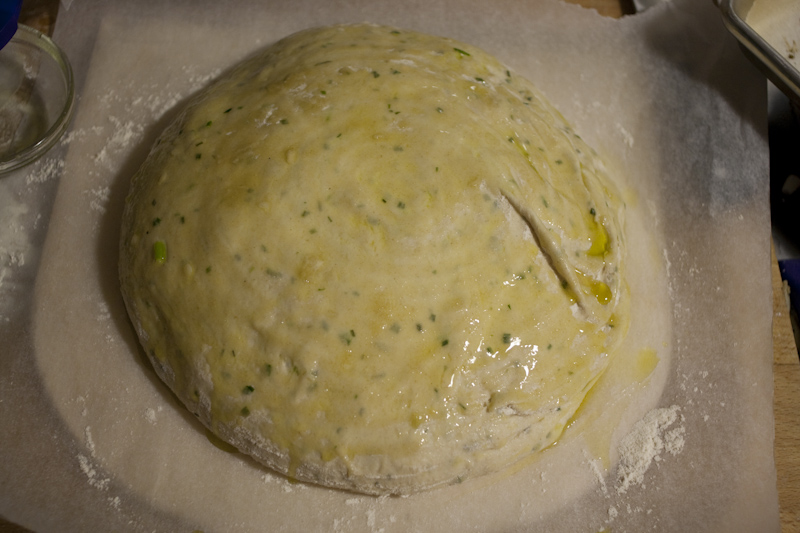

After the second rise, the bread is flipped over onto the peel and brushed with olive oil.


Then dimpled just like Foccacia.


And, like any good Foccacia, topped with the ingredients. Except that this time they were cheese and onions.


Normally, I just put flour on the peel and flop the bread onto it, score it and immediately load it into the oven using quick jerking motions to get the loaf from peel onto stone. The difficulty is compounded because the breads I love baking are actually the same diameter as the width of the stone. So I have to make sure that the bread is not falling off the back of the peel, and that I've approached the oven symmetrically, so that the sides fit on the peel. If I've done enough stretch-and-folds, the dough tends to just sit on the stone and not move. With doughs with considerably less structure and strength, the dough tends to melt to the edge before oven spring kicks in with its rising power.

With all that in mind, I decided on parchment paper for these loaves. I had a bad experience with a pizza sort of sticking to the peel and going onto the stone half-up and half-down, so I didn't want to chance it, especially with all these toppings and the very rare cheese!


I only remembered afterward that many in the Challenge had written about their onions burning in the oven, atop the bread. I also have the tendency to bake my loaves much darker than most others I know. Perhaps it's because I use darker flour, or because my electric oven has an exposed heating element at the top. Or maybe because I crank up the oven to the max and forget to turn it down. I'm not sure.


The crumb was absolutely lovely, with irregular holes, as well as tons of moisture. Perhaps because I kept to the recommended baking times and didn't overbake it to get it browner.


I was a bit disappointed that the onions burned, but they weren't so burnt that I had to pick them off.


When sliced, the bread took on a near-magical quality. All that cheese! It certainly added flavor to the bread, but you could barely recognize it in the crumb itself.


Though this was supposed to be a three-day bread, the bread sort of somehow started overproofing in the fridge during the last rise after only an hour, so I just took it out and baked it. This is the second loaf, just before going into the oven.


And the bottom of the second one the next morning. I froze half of the first loaf as soon as it came out. The other half we inhaled that evening with soup. I also froze half of the second loaf, and snuck slices from the non-frozen half. Note the smoothness of the bottom. Usually, I love the wrinkled flour dusted bottom of loaves, but for this one, I didn't mind.

It was perfect.

I have enjoyed baking with these other finishers of the BBA Challenge. I hope to be able to add your name soon!

Sally from Bewitching Kitchen
Phyl from Of Cabbages and King Cakes
Cindy from Salt and Serenity
Oggi from I can do that!
Sarah from My Runchey Life
Paul from Yumarama
txfarmer's blog (in chinese)
Abby from Stir it! Scrape it! Mix it! Bake it!
ap269 from Family and Food
Anne Marie from Rosemary and Garlic

If I've forgotten you, please send me an email or a comment with a link to your post and I'll include you in the blogroll.

Tuesday, March 23, 2010

Le Pain Poilâne

20090817_MG_2884.jpg

We almost didn't make it.

I had ticked off the Poilâne bakery on Rue Cherche-Midi as one of the stops on our Paris trip last August, but it looked like the list of things we wanted to see and do would outweigh the list of things we would actually do. The only thing that was a must-see on my list was La Défense, the big modern complex outside of the Paris Peripherique with the humongous Grand Arch that announces the triumph of modernism over the old, traditional Paris.

We had been warned more than once not to visit Paris in August, since everyone would be away on vacation. Also, we were told that and that the dates we had chosen were the worst dates to be there. The fifteenth of August is the Assumption of Mary, so in addition to most Parisians being away, we were going to be there on a holiday which fell on a Saturday, so already it seemed as though two of our four days were going to be spent hitting shops which would be closed.

20090815_MG_2567.jpg

Luckily, or, unluckily for us, it only happened once. On the morning of the fifteenth, we tried going to Du Pain et Des Idees but they were closed, and my high school French could not even begin to decipher the cryptic note taped to the inside of the glass door. We peeked in the windows- it was a beautiful bakery, even when closed.
I had Poilâne on my maybe list, knowing that if we didn't visit that one, or if it was closed, we could just visit Gosselin, whose bread inspired Peter Reinhart's Pain a l'Ancienne recipe. But something was just pulling me there. I wanted to go.

That morning, even before trying to visit Du Pain et Des Idees, we were planning our day at the hotel during breakfast, and Amy asked about the bakeries. She wanted to have a picnic somewhere, and if I knew whereabouts the bakery was, couldn't we get some bread?Immediately, I opened up Clotilde's Culinary Adventures in Paris, and crossed referenced the address with Paris Pratique. 8 Rue Cherche-Midi.

(Here I have to take pause and wholeheartedly endorse Clotilde's wonderful volume. Not only did we refer to it more often than the DK Guide to Paris, but we found some amazing places within its pages. One of the best thing is that she also lists the closest Metro stop. Unfortunately, there is one single map of the Arrondissements, but you can easily cross reference with your very practical copy of Paris Pratique, a small booklet of maps with a street index. It's available at most newsstands for about 5 Euros, and allows you to avoid the "I am a Tourist" maps flying into your face with every breeze. These two books are the most important ones you can pack for your upcoming trip to Paris.)

After breakfast we took the Metro to Père Lachaise, as we had planned, and visited Proust, Ernst, Wilde, Callas and Piaf. After the disappointment of the other bakery, we took the Metro to St. Sulpice. Rue Cherche-Midi was odd. It seemed like it was hidden away, and just as we turned the corner onto the street, I thought, this can't be it. I was going to check the address again when I looked up and saw it, just across the street.

20090815_MG_2581.jpg

Immediately upon entering, I cheerily, but politely said "Bonjour" in my best french accent and smiled. My eyes grew wide at all the loaves of huge loaves of bread. Just before I could say anything further, we were each rewarded with a Punition! I thanked the shopkeeper and gazed around at all the bread. I asked, again, in my best French accent, "Vous parlais Anglais?" making sure to carry over the final "s" onto "Anglais". The shopkeeper said shyly, "un peu."

Though I knew I could switch to English, the entire trip I had tried my best to keep to my minimal French. Because of this, people were super friendly. Even the ones whose English was atrocious kept apologizing. Later, I even got into a conversation in four languages with a waiter in Montmartre, after he said something in French I didn't understand. I switched to English, then German, then Spanish.

My original plan had been to buy some bread as well as a pillow of bread to keep on the couch, but in all my excitement, I completely forgot about the pillow. Later, during a quiet moment away from the bread excitement, I would recall the numerous loaves of bread on the right hand side of the shop, and wonder why they were there, above all the bags and knives and stuff. Of course. Those were the bread pillows!

20090817_MG_2882.jpg

Instead, I ended up getting a linen bag embroidered with the Poilâne logo, which they very kindly packed in one of their beautiful white paper bags. I also got a half loaf. They weighed an 800g half for me and asked if it was enough. I asked if I could get a whole kilo, and before I could say anything further, a whole loaf was taken from its place and halved in what looked like one of those dangerous paper cutters with a single sharp blade, but for bread. We also got a few rolls to sample as well as a loaf of the most delicious brioche I have ever had.Later that afternoon, loaded with other food goodies, we took the Metro to our picnic spot, an artificial island in the middle of the Seine. On the way there, I was looking out the train window, and spotted the other Poilâne bakery in Paris as we rumbled forth.

20090815_MG_2591.jpg

The bread was marvelous, fresh and crusty. After snapping this picture, I immediately took a chunk out of the crust. Wonderful. Sour and light and dense and just everything perfect about bread. I loved the color, the scoring, and the flour dusting the loaf. We had eaten a good chunk of the bread before I turned it over and discovered what has puzzled me since.

20090815_MG_2596.jpg

There was some sort of odd line on the bottom of the bread. The strange thing was that it formed part of a larger square that was slightly higher than the rest of the crust, as though the bread was placed atop a part of the oven that had a dimple. I've actually encountered similar odd formations on the other loaves of Poilâne bread I've eaten.

Now, you're probably asking "Is that it? Did you have the picnic and then get back on a plane to Berlin?" Well, not quite. We were only able to devour a third of the half loaf before we were full. After all, cheese and eggplant caviar as well as blue potato chips also need their place in one's stomach. After the picnic we walked around with a the remaining chunk of bread, taking turns carrying it on our adventures that day. Though it was a bit inconvenient, I loved knowing that I could just reach in and break a chunk off any time I wanted.

That evening, after a boat ride on the Seine, we took the train to La Défense and sat on the side of the Great Arch facing away from Paris. On the way there, I had joked that it would be funny if the city abruptly ended there, giving way to a sudden forest.

20090815_MG_2695.jpg

Strangely enough, on the far end of the arch, facing away from the modern business center, Paris ends and gives way to a highway and lots of trees. Though not an abrupt end to the city, it was closer to my expectations than I had truly expected.

Brioche from Poilane

On the steps, watching the sun set, we devoured the brioche we had bought that afternoon, before heading back into the heart of the city for dinner.


Where to find it:

In Berlin, Das Poilâne Brot is available at Galeries Lafayette- Friedrichstrasse on the corner of Französische Strasse. (U-Bhf Französische Strasse.) Note that the bread arrives fresh from Paris every Wednesday and Friday except for French holidays, and if you get there too late, they might have already cut the whole loaves into halves and quarters.

Paris is lucky enough to have two Poilâne bakeries, at 8 Rue Cherche-Midi and 49 Boulevard de Grenelle.

London also has a Poilâne bakery, at 46 Elizabeth Street in Belgravia, conveniently located between the Underground stops of Victoria Station and Sloane Square. This bakery is notable not only because it is the first bakery outside of Paris, but also because it has the first wood-fired oven in London since the Great Fire of 1666.

Further Reading:

If you haven't clicked on a link already: Poilâne's very beautiful website

La Punition from the wonderful Chocolate and Zucchini

A recipe for Punitions from the incredible Smitten Kitchen

Du Pain et Des Idees from Serve it Forth

An amazing behind-the-scenes post from Ann Mah

Tomostyle's trip to Poilâne and the next door Cuisine de Bar

Not Quite Nigella's look at some of their baked goods

A video of Martha Stewart visiting the bakery

A 2007 Slideshow from Business Week

A 2001 Article from Fast Company

Small Update: Dorie Greenspan has just posted an amazing video of the late, great Lionel Poilâne making Punitions. Her recipe, from the man himself, is on her essential post on Butter.


20090815_MG_2580.jpg

And, last, here's me, in the shop, standing in front of the breads.

Here's Part Two

Tuesday, January 26, 2010

BBA Challenge #29: Pugliese


I never did get to say good-bye to 2009, particularly since we were flying when the time changed over. We had no party on the plane, drinks were not handed out, and the pilot barely announced "Ladies and Gentlemen, it is now 12:06 in Frankfurt" as we speeded over the Atlantic. When we landed, all of our suitcases were with us, and after two layovers, we were completely beat. Still, we attempted our best to stay up despite sleeping only three hours on the plane and three the night before the flight.

On January First, after two weeks of mostly cold weather in California and Nevada, we landed to a winter paradise in Berlin. Snow, white and resplendent. Snow that hadn't been seen here for two years covered the city. The city was covered in clouds that made cast everything blue, and riding home in the taxi, I was happy to be home.

The very first things I unpacked were the bottles. Hennepin is my second favorite beer (after Saison Dupont), and I brought back one bottle of that, one bottle of Ommegang Abbey ale from the same brewery, one bottle of the Stone Brewing Company XI Anniversary Ale, which was the inspiration for their

The last bottle I opened is the most special. Hitachino Nest is the only Japanese Beer imported into the US from Japan. Put down your bottles, Asahi and Kirin are probably brewed in Canady in order to allow them to put "Imported" on the label. In addition, they brew interesting ales, in comparison to the light lagers that most world breweries make.

This is their classic ale- a plain pale ale aged in cedar casks. It is amazing. Amazing like only really special beers are. Amazing in the way Matilda from Goose Island or Trappistes Rochefort 10 are. Amazing in the way you think you've discovered a secret that no one else knows.

Unfortunately, the sore throat that I had been cultivating for most of the vacation decided to go at me with full force, and that night I fell into a deep slumber filled with the strangest dreams I have ever encountered. I had actually wanted to start bread the day after we landed, but, it took until the third of January. With barely enough strength, I took out the flour and began to measure.


As with all baking, there must always be something that goes wrong. In my case, it was a small mistake. I had made the full suggested amount of biga pre-ferment for this dough, figuring I'd keep the left over for pizza or ciabatta or something. I measured out the Semolina flour. Oops. I was going to use a 50/50 mix of semolina and flour, but measured out the whole thing in semolina. No matter, I thought. I measured out an equal amount of Type 812 flour. I'll just make the mise en place, I figured, and then just use half of it in the recipe after I photograph it.

Did you follow? Yes, no? Basically, I measured out twice the amount of flour. Tossed the entire thing into the mixer and... Yes. The dough was too dry and here I am trying to figure out why.

I forgot to only add half the flour. I thought about tossing the dough and starting over for less than the split second it took me to add the rest of the biga, measure out more water, yeast and salt, and throw it all into the mixer, thumbs pressed. (You press your thumbs here instead of crossing your fingers, though, really, I just cross my fingers and say I'm pressing my thumbs.)


I know, you are all calling foul for not having a mixer picture that you can all drool over. I'm sorry. I wasn't feeling too good, and just sort of decided not to take too many photos.


But, hey, the bread came out great, no? A little- no, a lot pale in color, unlike Kelly's deliciously golden loaf and rolls.


There is a very special place in my heart that is now reserved for Italian Breads. First the Casatiello, then the Ciabatta, then the eponymous Italian Bread, the surprisingly excellent Pane Sicilano, and now the Pugliese.

Without Peter Reinhart and the Bread Baker's Apprentice Challenge, I probably never would have baked any of these breads. I probably would have stuck to the French Breads. Hey, I hear the Miche is coming up.

Other Pugliesers are:

Mags from The Other Side of Fifty

Angela from Gourmet Hotdish and Other Culinary Disasters

Carolyn from Two Skinny Jenkins

Janice from Round the Table