It now seems like a lifetime ago.
I used to live in Brooklyn. Why there, and not Manhattan? The simplest and foremost reason was the sky. I grew up in California where you have nothing but sky. The highest buildings in my area were about two-stories high, and even then, they were a rarity. So Brooklyn was an obvious choice. Most buildings weren't over four stories and the sky- oh, the sky.
Much to my chagrin, though, most people I knew who lived in Manhattan would very rarely come to Brooklyn. When I would throw parties, they would sort of look at me funny like "You expect me to go where?" and then confess that they had been to Brooklyn only once or twice. Me, on the other hand, I preferred to stay in Brooklyn, and would try, as much as I could, to spend time all my there. My favorite bars were in Brooklyn and I just loved the way it looked. Though I have to confess that I did do most of my food shopping at the Union Square Farmer's Market and Whole Foods in Union Square. Chalk it up to convenience.
Still, I was always on the lookout for shops to visit, and without the infrastructure of Twitter and food blogs- which I never knew existed until I found The Smitten Kitchen- I had to pretty much hear of them through word-of-mouth or random walking.
I don't remember how I discovered Schaller und Weber on the Upper East Side. Perhaps I was visiting my only friend that lived up there, or maybe I just stumbled up on it on the crazy mammoth walks I would undertake just to look at the different architecture. I once walked about 12 miles through three boroughs, just for fun. My favorite thing to do while visiting said friend was to pop into Schaller und Weber and just inhale the smell of the sausages. I know, I know, being a vegetarian and all, what was I thinking? But I just loved the way the place smelled, all meaty and salty and cured.
The thing I most remember about the store was looking at the strange products in German, before I could read and write it. Mustards and Tomato Paste in tubes, strange boxes full of potato powder ready to be made into Kartoffelklöße. Well, the same things that you can get in any good supermarket here.
One cold January morning, I picked up something heavy. It was Stollen, and a kilo of it, at that, all wrapped in a plastic bag with a best by date of March. I don't remember where I had heard of Stollen before, but I seemed to have seen it somewhere before. I picked it up, put it in the basket along with various mustards and German candy.

As part of the Bread Baker's Apprentice Challenge as hosted by the lovely Nicole of Pinch My Salt, stollen would be showing up on the schedule sometime after Christmas, which is a bit funny because most Germans avoid Stollen anyhow, so I thought I'd have a tough time trying to get rid of it.
Here's the mise en place. Just in case you're wondering, I did the same as with the Panettone and soaked the candied fruit in some Macallan single malt Scotch. It was amazing in that, so I decided to do it again.

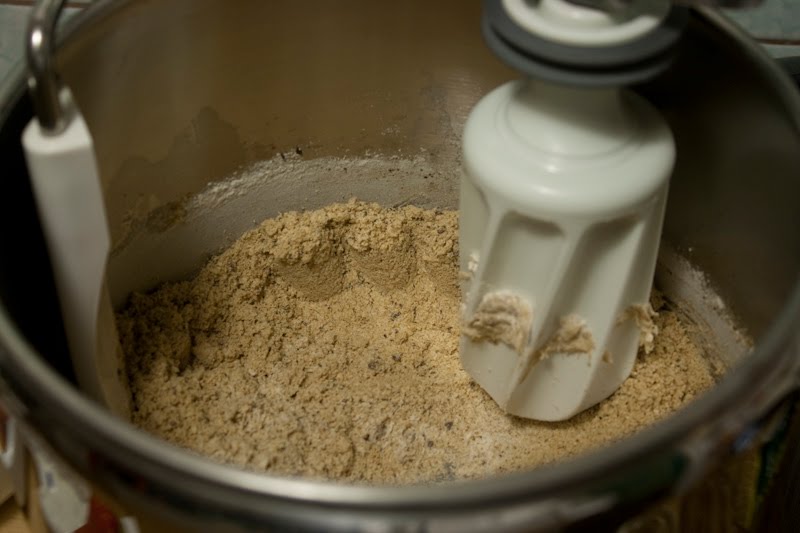
Once again, the Electrolux Assistent comes to the rescue. I wish I could make a video of how it works just to show people how amazing this thing really is.

Here's the mixture with the almonds and the fruit included.

And as a ball together. The dough was pretty wet on this one for some reason. Perhaps I didn't mix it enough before I added the rest of the bits.

After the first rise, it's not as pillowy as the Panettone, but it's still on this side of firm.

I rolled it out into a rough rectangle. Rough here being a very key word.

Sprinkled the almonds. Actually, I wanted to spread some marzipan in the middle just like the Marzipan Stollen you get here.

I folded it over and...

Um. No, wait. I folded it over and folded the other part over. Somehow I got really confused with the shaping, wanting to make it like the ones here. The funny thing is that many recipes I've found here call for a Stollen pan in order to make that perfect Stollen.

I did no such thing, but thought it came out pretty good.

I sort of winged it with the almonds and just stuffed them into the "mouth" of the Stollen.
Now, you might ask when exactly I made the Stollen. Well, it was three months ago in March. Some friends had been trying to pin us down for the Christmas get-together we never had, and, well, Stollen had been the next bread in the book so it all worked perfectly to plan.

Or, it would have. Somehow in my haste and in trying to get ready to leave the house I sort of... burnt it. Not wanting to trash it and not wanting to re-do the Stollen, I decided to do something I thought I'd never do.

Once we got to the party, I decided to cut off the bad parts of the Stollen and move forward.

I decorated it with powdered sugar and brought it out. The thing is that the Stollen was so delicious, I couldn't help but shave off slices. Among the four of us, we polished off half of the thing. I cut half of what remained and left it there.

One of the things you can do with Stollen is to leave it out for weeks to dry it out. Unfortunately for this one. It didn't even last another day. It was that good.
Just for comparison, though. I'm very much used to Stollen that is pretty dry. When the first ones start appearing in early October, I usually buy a mini-Stollen- for the sake of research, of course. They're pretty dry, but not dry enough that a glass of milk can't make it better. As the season progresses, I get to sample all kinds of Stollen. But once Christmas is over, it's gone. As though they know they won't be able to move the loaves of sugary coated goodness once the holiday season is over.
Most people I know here hate Stollen. I have no idea why. Though, if you look at the Christmas Bread situation in the States it's no better: Fruitcake. We once received one and it was awful. All candied fruit and dense. I vowed never to touch it again. But something dawned on me when eating a similar and very small loaf of fruit bread here. Fruitcake, the kind you get in the US would be so much better swimming in some kind of scotch or rum. I can just imagine it now.
Other Stollen Bakers include:
Phyl from Of Cabbages and King Cakes
Sally from Bewitching Kitchen
ap269 from Family and Food
Oggi from I can do that!