
Showing posts with label beer. Show all posts

Wednesday, October 13, 2010

Belgian (Beer) Vacation - Part Two

In case you missed part one, here's the link. I did get asked in my last post how long this vacation lasted, especially since we were trying all sorts of things. The entire trip lasted ten days, of which only nine were spent tasting beers. Of those days, these are only the beers that we had while we were out. Our friend's parent's house had a huge selection and the beers we had there were unfortunately not photographed.


Many beers in Belgium are bottle conditioned and often still have the yeast in the bottom of the bottle, something you really don't find in other alcoholic drinks. In the case of this beer, Hopus, the glass set includes a shot glass, not for a shot of Tequila and the beer as chaser, but as a holder for the yeast. These beers are poured into the glass slowly, being careful not to disturb the yeast that has settled on the bottom. However, some people prefer to have the yeast as well, often adding it to their beer at the beginning. For me, I sipped on the beer- a plain, smooth, malty ale, and then took the yeast as a shot at the end.


One of the biggest treats of the night was Tripel Karmeliet (careful, the website has music!). Take the description of Westmalle Tripel above, and double it, then add a bunch of flours in. I'm not saying that this was double as good as Westmalle. That would be impossible. However, this beer reeked of flowers. It was also served ice cold, and I had to use my hands to warm it up. Even then, you could tell the floral aroma. Almost like roses, but not quite overpowering. Maybe something akin to citrus flowers. Apparently, the beer is brewed with barley, wheat, and oats, giving it a full body and a smooth mouthfeel.


Again with the Iced Tea. I forgot who ordered it. Probably whoever was driving that night. The beer in the background is a Rochefort 10, made by Trappist monks at the Abbey of St. Remy at Rochefort. It is, again, one of my favorite beers, though I actually didn't have one until we came back to Berlin. I made sure to get 10 bottles, in order to age them.

Like wine, many beers benefit from aging or cellaring. Usually, this applies to beers that are refermented or bottle-conditioned, or beers over a certain percentage of alcohol. I use a minimum of 8% abv as a rule of thumb, though any beer with yeast at the bottom of the bottle will change, though not necessarily improve over time. Though there are examples of crazy aging- a bar in Belgium serves a 25-year-old Chimay- I don't think anyone has the will power to resist a beer that has been aging for more than two or three years.

About a year ago, I had a two-year old Rochefort 10 that I had saved from the last trip. The beer was amazing. All plums and figs and raisins and oh-so-very-smoooooooth. I could not get over how good it was. Since the beer has I still have a few bottles that I'm planning to take up to 10 years, though the beer is so good that I seriously doubt I will be able to hold out for that long. At 11,3%, this is a seriously complex beer that can hold its own up to maybe 10-15 years after it has been brewed. If you want to be astounded, surprised and convinced that world class beer exists, this is the one. Be sure to sip slowly, savoring it over the course of an evening.


I don't know how many 33cL bottles of Duvel I have drank in my lifetime, but it has been more than I can ever think to count. Duvel is one of those very drinkable beers with carbonation as fine as Champagne, and a smoothly sweet taste with a very pleasing spicy aftertaste. It is the embodiment of the Belgian Strong Golden Ale. I was once at the Knitting Factory in New York, and they had it amongst the mass-produced beers. After I offered a sip to a friend of a friend, he ordered it, and it cascaded until there were seven of us all having Duvel.

On one of the last days, we were in Bruges. I was trying to cross-reference the Good Beer Guide to Belgium with the small tourist map we bought at the train station. Unfortunately for us, the Beer Guide only provides the most rudimentary maps, which look nothing like the city itself. So we kept cross referencing. As luck would have it, however, we ended up stumbling across De Kuppe, in part because of their big signs advertising their selection of 100 beers.

After a scan of the beer list, I had a choice of about 15 that I really wanted to try. The one that really stood out was this one, from the Van Eecke brewery in nearby Watou. I have had this beer before, but it remains one of my favorites (I know, I know, I do say this quite a bit) because of its high hop content. All slight citrus and grapefruit with a fine carbonation. I absolutely love the flavor of hops, and wish they were used more often in European beers.

Amy opted for a local beer, Steen Brugge Dubbel, which we later found out, is brewed a hundred kilometers away in Steenhuffel. Still, it was malty and dark and barely chocolately, which is how Amy likes most of her beers.

Once had oriented ourselves, we looked for a place to have lunch. I don't remember where we ate, but I noticed that they had a lot of Trappist Beers on the menu, including Westvleteren. It was the only one without a price, though the others were about 4€ a bottle. I asked the waiter, "Is true that you have Westvleteren?" He gave me a funny look. He hadn't understood. I asked again, and pointed to the beer on the menu. "Ah, yes Westvleteren. Yes, we have it." I asked how much a bottle was, and he went in to check. When he came out he said, "25 Euros".

Now, the thing about Westvleteren is that it is brewed by monks who make a limited amount of beer. They say they make the beer in order to sustain their life as monks. In recent years, the beer's popularity has made the demand grow while the supply has remained exactly the same. Unlike other monasteries like Chimay, who are relatively huge businesses, Westvleteren prefers to stick with their monastic quietude. After their beer was named the best in the world, the monks got uncomfortable. The lines of cars waiting to buy beer stretched as long as 3km from the monastery, the only place where the beer could (legally) be bought.

Instead of dealing with it, the monks asked themselves- How can we maintain our monastic values, and save the town from the hassle of cars coming in and out all the time? Instead of the lines of cars, they set up a reservation system. The telephone line is open two hours every week, and there is only one monk answering one telephone, taking down names and license plate numbers in order to fill reservation slots to purchase the beer. For the monks, it makes life easier. For everyone else, it makes the beer more impossible to get, and that much more rare and desirable.

I've had the beer on two occasions. Once with my brother-in-law- we shared a dusty bottle I had found at a beer store. The second time was in Belgium at the home of a friend's uncle, out of the proper glass. It's good. Really good. But in truth, I'd rather avoid the hassle and get a St. Bernardus or a Rochefort 10. They're on par with the Westvleteren 12 without all the hassle.

So, why didn't I pay the 25 Euros for the beer? Not because I'm cheap, because I'm very rarely cheap when it comes to beer. It's because when you buy the beer at the monastery, you promise not to resell it. And while I think paying maybe double of what the beer cost- 2€ a bottle with deposit included- I don't think paying a 1000% markup is helping anyone but the cafe owner.


So, instead, I opted for a local beer, the Brugse Zot, which means, as you can deduce from the label, the Fool from Bruges. It's made by De Halve Maan brewery, the same brewery that makes Strafe Hendrik from the previous post. It was light both in color and body, with a delicate slightly grassy flavor with just a touch of sweetness. A good summer quencher, and the perfect accompaniment to the omelet I had for lunch.

After much walking around and exploring the city, we ended up at 't Bruges Beertje, one of the ultimate destinations in all the world for beer. Well, to be fair, it mostly has Belgian beers, but it has almost all of the good ones there, in one place.


After studying the menu (over 300 different beers, broken down by region) for several minutes, I decided on a Kriek from Boon from the Mariage Parfait (Perfect Marriage) series. Remember when I wrote about spontaneously fermented beers in my last post? Well, this is similar, but instead of blending three year old beer with one year old beer to make a Gueuze, you add cherries (with the stones) to the beer after a year and a half, and allow their sugars to ferment out.

You get a beer with a tart cherry flavor, and all the lactic sourness you can handle. The best thing about this beer, is that the Mariage Parfait series is no longer made for the Kriek, so the beer is rather rare. The second best thing is that the base beer for the Kriek is selected from the best tasting barrels of fermenting lambic, so this beer is pretty much the best of the best from this brewery. The beer was well rounded, not too sour, and not too tart, with just the right amount of full in-your-face cherry flavor. As the afternoon light faded, I took sip after sip.


Amy, on the other hand, somewhat overwhelmed by the huge selection of beer, asked me to pick something for her. I decided she should have one of the local beers, and in this case, picked a dark Brugge Zot, the companion to the blonde ale above.

It's odd how one beer can somehow create a thread that runs through an entire trip. On the very last day, we took an excursion to Hoboken, just outside of Antwerp to look at the statue of Nello and Patrasche from A Dog of Flanders. Patrasche is the name of the dog from the story, and also the name of the beer Amy had on the first Sunday that we were in Belgium. Unfortunately, the tourist office was closed, and the statue of Nello and Patrasche was actually quite small. Since the book is taught in Japanese schools, we were expecting to find a group of Japanese tourists milling about the statue, but I guess they only visit the Antwerp Cathedral.


So, after taking the required tourist pictures next to the statue, we looked around for a place that sold the Patrasche and Nello beers. Unfortunately, we couldn't find any. So much for Hoboken being a mecca for Patrasche lovers. Instead, we sat down at a typical Belgian cafe, and ordered typical Belgian beers. Amy, being the rebel in the group, ordered a "Scotch" which is what you call a Scottish-style beer. I thought it was funny that she was ordering a beer that was made in Scotland and imported for the Belgian market. I later found out that this dark and sweet beer with notes of dark caramel is now brewed in Belgium itself! What Amy didn't know is that Gordon's Scotch ale is pretty high in alcohol- 8% abv!


Our friend and host Ariana had a Hoegaarden Speciale, in one of my favorite glasses of all time (I'll say that quite a bit as well). She was shocked that it was available, since it is pretty much an autumn/winter beer. I've had this one before. It's like a deep witbier with an orangey flavor. Unfortunately, I really dislike witbiers, so I don't have very much to say about this one.


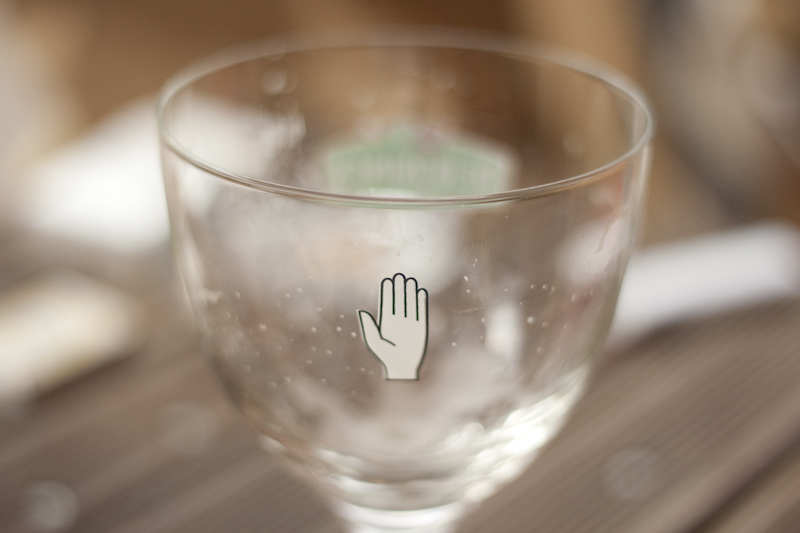
Last, I ordered a bolleke. I felt it was the most fitting beer for the trip. It was smooth and delicious, and just right. I sipped it in the warm summer air, and when it was done, photographed the hand on the glass that graced the beginning of the first post.

Tuesday, September 14, 2010

Belgian Beer (Vacation) - Part One


I know. I know.

I went about a month without posting a single thing in this space. But, can you blame me? Everyone in Europe takes vacation in August, and it was my first vacation this year. Well, not counting the seven days I had to take off in March to use up the vacation days I had left over from last year. The policy is, use them by 31 March or lose them forever.

August turned into a stress fest mostly because of the six work days we were taking off. Which meant we both had to work overtime to get the work of those six days done before we left.

It didn't happen. But we still went. I was barely able to check my email, and even then, only replied to those emails that couldn't wait. I even ignored my twitter stream for six days. And when I returned, all my replies were gone.

So it goes.

So, instead of boring you with pictures of my Belgian Vacation. I am going to bore you with pictures of the beers we drank during the vacation.


In case you think that Stella Artois is a true Belgian Beer- it's not. Yes, it is brewed in Belgium, but it has not been brewed since 1366 as the advertising seems to indicate. There has been a brewery on the site since then, but it was introduced in 1926 as a Christmas Beer. Even though everyone knows the name, the beer itself is rarely found in Belgium. Most of it is brewed directly for export.

Why do I mention this? Well, because the Belgians, actually do drink a similar beer, brewed by the same international conglomerate that brews Stella. It's called Jupiler, and while it is also a pilsner, it's actually a very decent beer. Despite the presence of maize in the mash, it's actually better than most German Reinheitsgebot-adhering pilsners found in Berlin. Despite the presence of some really great beers, Jupiler remains the best-selling Belgian beer in Belgium. It's kind of the same in the States: even though you have some really great beers, people insist on drinking fizzy yellow beer.


After a weekend of beautiful weather in the middle of August, it began to rain. On one of those rainy nights, we ended up at the Camargue in Antwerp-Berchem. I have no idea where the pub was, since we parked two blocks away and were trying to avoid all the muddy puddles left over from all the construction that seemed to have taken over the neighborhood.

Amy had this beer. It's named after the dog Patrasche in the story A Dog of Flanders. Apparently, there is a companion beer named Nello, after the dog's owner. Though the glass states that it's brewed at a brewery in Hoboken, it's not. There's no brewery in Hoboken. We were there. It's actually brewed at De Proef, which is a contract brewery.


My first beer was from one of my favorite breweries of all time, Het Anker, which means, The Anchor. We ended up walking by the brewery, but they've apparently been remodeling for months, so it was closed. Judging from the state of things, they've got many more months to go.

This beer was called Hopsinjoor, named after Mechelen's 17tn century wooden mascot, Opsinjoorke, a really ugly doll, judging from the postcards we bought. The beer was super-hoppy, just the way I like them, with very floral hop notes, a grapefruit-like bitterness, ending in a soft bitter hop grassiness.


My second beer was a Rodenbach Grand Cru, which is an Oud Bruin, a beer that has been aged on oak, and then blended back with younger beer. Though I've had this one before, I'm always surprised at the mouth-puckering lactic sourness. It's a very interesting beer, but Amy and our travelling companion Ariana both refused to try it after taking a whiff of it. This is one of those beers that defies description. It's like biting into a piece of oak that has been pickled with sour milk and vinegar. But in a good way.


This beer, made by the Slaghmuylder brewery in Ninove was a bit of a surprise. It's a blonde ale, but tastes more like a wit. I'm not sure if it's because the coriander is a bit heavy in this one, but it was definitely one that caught my eye, or, tongue, despite the fact that I don't like witbier.

Now, if you want to know about some of the beers that are my absolute favorites, you've got to include the Trappists. Yes, Trappist monks. Who make beer. Originally, the beer was brewed as a supplement to Lent fasting. Most monasteries allow the brothers to have a daily beer, but most of them only drink on special occasions.


However, the history of this particular beer, St. Bernardus Abt 12, is a bit more complex. The St. Bernardus brewery used to contract brew for the St. Sixtus monastery at Westvleteren. When the agreement ended, in 1992, St. Bernardus continued to brew its own beer. The pub we were at had one of the original St. Sixtus glasses, and served it in that. The Abt 12 is a very complex brew. Notes of plum and raisins, and at the forefront, this unmistakable taste of something like Christmas Bread. But bread it is, and, in many ways, this beer epitomizes the saying that beer is "liquid bread".

The funny thing was that we ended up at the bar, speaking to a man who was half-Flemish and half-Swiss. He, in turn, introduced us to the owners, who were apparently unaware that their little bar was in Tim Webb's Good Beer Guide to Belgium, our primary guidebook for the trip. For the introduction to the book, the owners rewarded me with a bottle of Avec Les Bons Voeux from Brasserie Dupont, one of my favorite breweries. I know. I have many favorite breweries.

Two days later, we found ourselves in Ghent, at Het Waterhuis Aan de Bierkant, "The Waterhouse on the Beerside". Despite the choice of 170 beers, with nary a dud in the bunch, I went straight for the jugular.

A while back, in my Basic Sourdough Bread post, I mentioned a bunch of beers that are spontaneously fermented by wild yeast, much in the way that sourdough is made up of wild yeasts and beasties that ferment bread dough. So, this is the sourdough of beer. Gueuze. It's made by blending young and old Lambic, which is basically, wheat beer fermented with wild yeasts, and aged in oak barrels bigger than most people's living rooms. It is stinky much in the same way that sourdough is stinky, some would say "horse blanket". It's true, this term is often used in the beer world to describe these beers.


Gueuze Girardin Unfiltered is the Black Label version of this beer, and one of the prime examples of the beer style. It is acidy, lactic, almost vinegary without any bite, but is very smooth. It's not like drinking a jar of pickle juice, but more akin to the tanginess of yogurt. Again, I can't describe this beer, other than to say it is earthy and milky sour. And very much near to perfection.


Amy had a beer named "Mammelokker" which refers to a bas relief on the side of the Cloth Hall in Ghent. It's actually made for this pub, and was pushed as a beer for women. I looked up the story behind it, and you can find it here, if you dare.


Ariana's sister's friend- whose name I have completely forgotten- was not a beer drinker. Shocking, considering beer in Belgium is as revered as wine is in France. But I don't know if she was a wine drinker either. Instead, she drank Lipton Iced Tea, which was served in a glass that echoed many of the beer glasses in Belgium. We can't get Lipton tea in Germany, though. I didn't try it.

Later on, after visiting many sights, we ended up at the Dulle Griet, named after a cannon in the city.


I had a Moinette, which is brewed by the Dupont Brewery, one of my favorites, mentioned above. While the Moinette is good, no- great- whenever I drink it I long for the complexity and smoothness of the Saison Dupont. Still, this was all malty and complex and with just a little bit of bitterness. Unfortunately, it was freezing cold, which killed much of the flavor.

Sometimes, when I get served an ice cold beer, I tend to warm it up with my hands. Of course, you're wondering why I would do such a thing. Well, it's because cold kills flavor. You know when you see commercials advertising an "ice cold one"? It's because the beer actually tastes bad, and if it's ice cold, you won't notice how bad it is, though you will be drawn in by the experience. I've cracked open beers at room temperature just to see how good they are. If the beer is halfway decent at room temperature, or, in the case of Imperial Stouts, awesome at room temperature, then it will be very nice when it's cool, but not too cold.


Amy's beer was a Slaapmutske (Nightcap) Bruin, also brewed by de Proef on behalf of the Slaapmutske Brewery. It was pretty decent. If I encounter this one, I'll try it.


Ariana's beer was a Tripel called Straffe Hendrik (Strong Hendrik) brewed by De Halve Maan (The Half-Man) in Bruges. I didn't try this one, but it did cause Amy to make funny jokes about it, and about her "Slap Me Silly" beer.


That night, we met up with one of Ariana's cousins who was soon to leave for the States. Unfortunately, I did not pick the place, so I had a slim choice in what I could drink. Fortunately, I can always find something. In this case it was the local beer, Caves. It's not actually brewed in the city, but I can forgive that. The beer was slighty sour, mixed with some syrupy sweetness, almost like a red lifesaver, in truth. Fruity, but not bold like the Rodenbach Grand Gru above. The carbonation was quite fine, so it did cut some of the sour and temper the sweet. I ended up buying two bottles later for the trip home.


Remember how I said that I can always find something? I drank so much Westmalle Tripel that I should now be unable to drink it. But guess what? I still can. This is one of the most delicious beers to grace this Earth. Bitter in that grassy way. Spicy like earth and smoothly sweet with a lingering hop aftertaste. Despite the high alcohol content (9,5% abv), this remains a highly drinkable beer. You can taste the alcohol usually in the background, but you don't really take it seriously until you try to get up and you've forgotten how to walk. So, you have to be a bit careful because its beguiling flavor may cause you to overindulge.

Usually, however, I drink this one slow, sipping it carefully, and making the sensation last as long as possible. These are not beers that you chug. On a hot summer's day even I will put away half a glass of Hefeweizen in one gulp. But with these beers, the glassware adds to the ceremony of the beer, and you really can't help but drink slowly, intent in every single sip.

Stay tuned for Part Two!

Tuesday, January 26, 2010

BBA Challenge #29: Pugliese


I never did get to say good-bye to 2009, particularly since we were flying when the time changed over. We had no party on the plane, drinks were not handed out, and the pilot barely announced "Ladies and Gentlemen, it is now 12:06 in Frankfurt" as we speeded over the Atlantic. When we landed, all of our suitcases were with us, and after two layovers, we were completely beat. Still, we attempted our best to stay up despite sleeping only three hours on the plane and three the night before the flight.

On January First, after two weeks of mostly cold weather in California and Nevada, we landed to a winter paradise in Berlin. Snow, white and resplendent. Snow that hadn't been seen here for two years covered the city. The city was covered in clouds that made cast everything blue, and riding home in the taxi, I was happy to be home.

The very first things I unpacked were the bottles. Hennepin is my second favorite beer (after Saison Dupont), and I brought back one bottle of that, one bottle of Ommegang Abbey ale from the same brewery, one bottle of the Stone Brewing Company XI Anniversary Ale, which was the inspiration for their

The last bottle I opened is the most special. Hitachino Nest is the only Japanese Beer imported into the US from Japan. Put down your bottles, Asahi and Kirin are probably brewed in Canady in order to allow them to put "Imported" on the label. In addition, they brew interesting ales, in comparison to the light lagers that most world breweries make.

This is their classic ale- a plain pale ale aged in cedar casks. It is amazing. Amazing like only really special beers are. Amazing in the way Matilda from Goose Island or Trappistes Rochefort 10 are. Amazing in the way you think you've discovered a secret that no one else knows.

Unfortunately, the sore throat that I had been cultivating for most of the vacation decided to go at me with full force, and that night I fell into a deep slumber filled with the strangest dreams I have ever encountered. I had actually wanted to start bread the day after we landed, but, it took until the third of January. With barely enough strength, I took out the flour and began to measure.


As with all baking, there must always be something that goes wrong. In my case, it was a small mistake. I had made the full suggested amount of biga pre-ferment for this dough, figuring I'd keep the left over for pizza or ciabatta or something. I measured out the Semolina flour. Oops. I was going to use a 50/50 mix of semolina and flour, but measured out the whole thing in semolina. No matter, I thought. I measured out an equal amount of Type 812 flour. I'll just make the mise en place, I figured, and then just use half of it in the recipe after I photograph it.

Did you follow? Yes, no? Basically, I measured out twice the amount of flour. Tossed the entire thing into the mixer and... Yes. The dough was too dry and here I am trying to figure out why.

I forgot to only add half the flour. I thought about tossing the dough and starting over for less than the split second it took me to add the rest of the biga, measure out more water, yeast and salt, and throw it all into the mixer, thumbs pressed. (You press your thumbs here instead of crossing your fingers, though, really, I just cross my fingers and say I'm pressing my thumbs.)


I know, you are all calling foul for not having a mixer picture that you can all drool over. I'm sorry. I wasn't feeling too good, and just sort of decided not to take too many photos.


But, hey, the bread came out great, no? A little- no, a lot pale in color, unlike Kelly's deliciously golden loaf and rolls.


There is a very special place in my heart that is now reserved for Italian Breads. First the Casatiello, then the Ciabatta, then the eponymous Italian Bread, the surprisingly excellent Pane Sicilano, and now the Pugliese.

Without Peter Reinhart and the Bread Baker's Apprentice Challenge, I probably never would have baked any of these breads. I probably would have stuck to the French Breads. Hey, I hear the Miche is coming up.

Other Pugliesers are:

Mags from The Other Side of Fifty

Angela from Gourmet Hotdish and Other Culinary Disasters

Carolyn from Two Skinny Jenkins

Janice from Round the Table