
Showing posts with label yeast. Show all posts

Wednesday, December 22, 2010

BBA Challenge #43: Roasted Onion and Asiago Miche

 
So. Here we are. Shredded Asiago.


I've really been dragging my feet towards the end of the challenge. Not just because I didn't want it to end, but mostly because I couldn't find Asiago in Berlin. True, I was only half-heartedly trying.

The thing is, finishing the Bread Baker's Apprentice Challenge meant finishing a significant part of my baking education. Before I started the challenge bread for me meant measuring in cups, and always forgetting if I already had five or six cups. It meant a tablespoon of yeast and a tablespoon of salt. It meant baking bread either as a boule or in loaf pans, with no other possibilities.

But even as early as Brioche or Ciabatta, bread became transcendental. It might have been baking the Casatiello, which remains my favorite bread of the book. I remember slicing the first piece off the mushroom shaped loaf and just thinking about how much crust this piece had. In fact, it might have been all crust. It might also have been when I made my own starter in anticipation of the sourdough section. Or when I began baking 2 kilo sourdough miches as "practice" for the Poilane-Style Miche.

This bread, as well as the last one are included in the Gracenote section of the book, and are cheese-laden celebrations of what bread can be. For this bread, I really wanted to make everything as in the recipe. No changes, no shortcuts.

The Asiago was not easy to find. I asked at several cheese counters and shops in the city, and in an act of desperation, I posed my question on Twitter. In hindsight, I could have asked at KaDeWe, but it's not usually a place where you can find anything easily unless you shop there regularly, which, really, should not turn into a habit. I really only go there when I'm desperate or can't find something anywhere else, and I guess I wasn't at that point yet.

Despite her initial suggestion to use Parmesan cheese, as she had done for her bread, AP269 was the first to suggest Centro Italia. Further recommendations followed from Peggy at Multikulinarisch.es and Küchenlatein. Poking around on Centro Italia's website, I discovered that they have two locations (Now they have three, one just opened in Prenzlauer Berg). There's one near the Schloss in Charlottenburg, and one in the middle of nowhere in Marienfelde. Luckily for me, the one in Marienfelde was about ten minutes closer, and only required a single train. So, I decided to go to that one the following weekend.

That weekend, I looked up the train schedule, double-checked Google Maps and noted the hours. I left for the Marienfelde location.

It was closed.

Somehow, in the rush that defines the weekend, I had only written down the hours of the Charlottenburg location, which is open two hours longer on the weekend. So, Marienfelde? Closed. When I got home, I checked the train schedules for when I would have to leave for Centro Italia on Monday morning with enough time to get to work. I was determined to get this cheese.

On Monday, I arrived at Centro Italia two minutes before nine. There were three guys smoking just outside the entrance, and I just assumed they were also waiting for the store to open. Of course, I thought it was normal that people would be waiting in front of a large Italian supermarket waiting for it to open in the early morning. After about a half-minute of talking amongst themselves, one of the guys told me that I could go in.

I should have gone directly to the cheese counter and fled. But, instead, I went down every aisle. Zucchini spread, Linguine (!), nine thousand different kinds of tomato sauce. It was amazing how much stuff they managed to pack into such a small space.

I walked out of there with two kinds of olive oil, as well as assorted Italian groceries. When I was at their very extensive cheese counter, I asked about the Asiago and the guy didn't even flinch when I told him I needed a half kilo.

When I finally got home that night, I went to work measuring flour, but when I read down to the rest of the ingredients, I quickly realized we had neither chives nor green onions. So much for starting the bread. I had to wait until that Thursday to pop over to the grocery store after work and nab the last two bunches of green onions. I was looking everywhere for fresh chives in the pot (many fresh herbs are sold in a little pot in Germany, in case you want to try to grow them). No dice. I settled for a small box of frozen chives.

And then. I was able to start the last bread in the Challenge.


I've actually been meaning to write an entire post about this device. It's a Mouli-Julienne from Moulinex. I first heard of it on David Lebovitz's wonderful post about Celeriac salad, he pretty much raved about it, and after a bit of quick googling, I found a picture of it, and then, finally, found one on ebay. Amy refers to it as the "Eiffel Tower" which was puzzling until one day I took it out of the cabinet and the long part was on top, which made it look just like the tower. Take a second to look at it closer, and tilt your neck if you have to.


Asiago is a strange cheese. Not sharp like cheddar or some of the drier Italian Cheeses, and not as mild as say, aged Mozzarella.


As I was peeling the wax and paper from the cheese, I discovered these traces of the name. They were probably there just to make sure I hadn't accidentally bought a different cheese. Then again, it could have been "Asiag" cheese, and not Asiago.


And in under a minute, with the help of the "Eiffel Tower" I was done.


I set up my mise en place for the challenge one last time. The thing about having all your ingredients at the ready is that it is so convenient. You're not searching for the salt, and then measuring it out, cursing the spoon scale for being in two pieces- the spoon part on the drying rack, and the scale part in your baking drawer.


As usual, I used my Electrolux DLX/N26/AKM4110W. Just Add Water. And then everything else. It's odd how I haven't really mixed dough by hand ever since I got it at the beginning of last year. And to think that I bought it because I wanted to make pizza. I've made more bread than all the pizzas I've eaten since then.


Of course, when you have an ingredient that is a bit rare, you tend to go overboard with hoarding it until you need to use it. This was a warning for Amy and I, just in case we decide to make grilled cheese with the precious Asiago.


And then, as quickly as the shredding, the dough was done. Normally, I just walk away and then check on the dough periodically, eyeballing it to see how done it is. This is actually easier when I'm doing periodical stretch-and-folds, since the more difficult the dough is to fold, the closer it is to the end of the first rise.


After the allotted three hours, it had risen to between one-and-a-half and double. Perfect.


Despite what the book said (to do it the night before), I roasted the onions as I was making the bread. Yes, that is a quarter sheet pan, only because a half-sheet pan doesn't fit in the oven if I want the door to close.
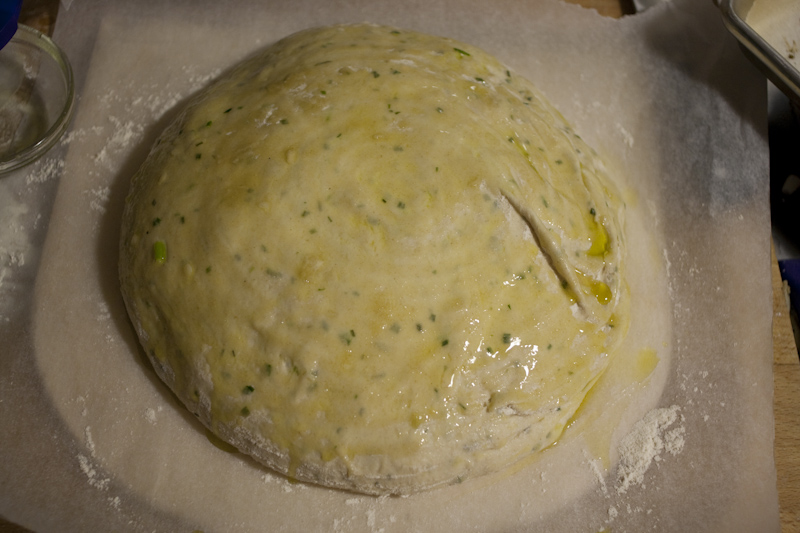

After the second rise, the bread is flipped over onto the peel and brushed with olive oil.


Then dimpled just like Foccacia.


And, like any good Foccacia, topped with the ingredients. Except that this time they were cheese and onions.


Normally, I just put flour on the peel and flop the bread onto it, score it and immediately load it into the oven using quick jerking motions to get the loaf from peel onto stone. The difficulty is compounded because the breads I love baking are actually the same diameter as the width of the stone. So I have to make sure that the bread is not falling off the back of the peel, and that I've approached the oven symmetrically, so that the sides fit on the peel. If I've done enough stretch-and-folds, the dough tends to just sit on the stone and not move. With doughs with considerably less structure and strength, the dough tends to melt to the edge before oven spring kicks in with its rising power.

With all that in mind, I decided on parchment paper for these loaves. I had a bad experience with a pizza sort of sticking to the peel and going onto the stone half-up and half-down, so I didn't want to chance it, especially with all these toppings and the very rare cheese!


I only remembered afterward that many in the Challenge had written about their onions burning in the oven, atop the bread. I also have the tendency to bake my loaves much darker than most others I know. Perhaps it's because I use darker flour, or because my electric oven has an exposed heating element at the top. Or maybe because I crank up the oven to the max and forget to turn it down. I'm not sure.


The crumb was absolutely lovely, with irregular holes, as well as tons of moisture. Perhaps because I kept to the recommended baking times and didn't overbake it to get it browner.


I was a bit disappointed that the onions burned, but they weren't so burnt that I had to pick them off.


When sliced, the bread took on a near-magical quality. All that cheese! It certainly added flavor to the bread, but you could barely recognize it in the crumb itself.


Though this was supposed to be a three-day bread, the bread sort of somehow started overproofing in the fridge during the last rise after only an hour, so I just took it out and baked it. This is the second loaf, just before going into the oven.


And the bottom of the second one the next morning. I froze half of the first loaf as soon as it came out. The other half we inhaled that evening with soup. I also froze half of the second loaf, and snuck slices from the non-frozen half. Note the smoothness of the bottom. Usually, I love the wrinkled flour dusted bottom of loaves, but for this one, I didn't mind.

It was perfect.

I have enjoyed baking with these other finishers of the BBA Challenge. I hope to be able to add your name soon!

Sally from Bewitching Kitchen
Phyl from Of Cabbages and King Cakes
Cindy from Salt and Serenity
Oggi from I can do that!
Sarah from My Runchey Life
Paul from Yumarama
txfarmer's blog (in chinese)
Abby from Stir it! Scrape it! Mix it! Bake it!
ap269 from Family and Food
Anne Marie from Rosemary and Garlic

If I've forgotten you, please send me an email or a comment with a link to your post and I'll include you in the blogroll.

Tuesday, September 14, 2010

Belgian Beer (Vacation) - Part One


I know. I know.

I went about a month without posting a single thing in this space. But, can you blame me? Everyone in Europe takes vacation in August, and it was my first vacation this year. Well, not counting the seven days I had to take off in March to use up the vacation days I had left over from last year. The policy is, use them by 31 March or lose them forever.

August turned into a stress fest mostly because of the six work days we were taking off. Which meant we both had to work overtime to get the work of those six days done before we left.

It didn't happen. But we still went. I was barely able to check my email, and even then, only replied to those emails that couldn't wait. I even ignored my twitter stream for six days. And when I returned, all my replies were gone.

So it goes.

So, instead of boring you with pictures of my Belgian Vacation. I am going to bore you with pictures of the beers we drank during the vacation.


In case you think that Stella Artois is a true Belgian Beer- it's not. Yes, it is brewed in Belgium, but it has not been brewed since 1366 as the advertising seems to indicate. There has been a brewery on the site since then, but it was introduced in 1926 as a Christmas Beer. Even though everyone knows the name, the beer itself is rarely found in Belgium. Most of it is brewed directly for export.

Why do I mention this? Well, because the Belgians, actually do drink a similar beer, brewed by the same international conglomerate that brews Stella. It's called Jupiler, and while it is also a pilsner, it's actually a very decent beer. Despite the presence of maize in the mash, it's actually better than most German Reinheitsgebot-adhering pilsners found in Berlin. Despite the presence of some really great beers, Jupiler remains the best-selling Belgian beer in Belgium. It's kind of the same in the States: even though you have some really great beers, people insist on drinking fizzy yellow beer.


After a weekend of beautiful weather in the middle of August, it began to rain. On one of those rainy nights, we ended up at the Camargue in Antwerp-Berchem. I have no idea where the pub was, since we parked two blocks away and were trying to avoid all the muddy puddles left over from all the construction that seemed to have taken over the neighborhood.

Amy had this beer. It's named after the dog Patrasche in the story A Dog of Flanders. Apparently, there is a companion beer named Nello, after the dog's owner. Though the glass states that it's brewed at a brewery in Hoboken, it's not. There's no brewery in Hoboken. We were there. It's actually brewed at De Proef, which is a contract brewery.


My first beer was from one of my favorite breweries of all time, Het Anker, which means, The Anchor. We ended up walking by the brewery, but they've apparently been remodeling for months, so it was closed. Judging from the state of things, they've got many more months to go.

This beer was called Hopsinjoor, named after Mechelen's 17tn century wooden mascot, Opsinjoorke, a really ugly doll, judging from the postcards we bought. The beer was super-hoppy, just the way I like them, with very floral hop notes, a grapefruit-like bitterness, ending in a soft bitter hop grassiness.


My second beer was a Rodenbach Grand Cru, which is an Oud Bruin, a beer that has been aged on oak, and then blended back with younger beer. Though I've had this one before, I'm always surprised at the mouth-puckering lactic sourness. It's a very interesting beer, but Amy and our travelling companion Ariana both refused to try it after taking a whiff of it. This is one of those beers that defies description. It's like biting into a piece of oak that has been pickled with sour milk and vinegar. But in a good way.


This beer, made by the Slaghmuylder brewery in Ninove was a bit of a surprise. It's a blonde ale, but tastes more like a wit. I'm not sure if it's because the coriander is a bit heavy in this one, but it was definitely one that caught my eye, or, tongue, despite the fact that I don't like witbier.

Now, if you want to know about some of the beers that are my absolute favorites, you've got to include the Trappists. Yes, Trappist monks. Who make beer. Originally, the beer was brewed as a supplement to Lent fasting. Most monasteries allow the brothers to have a daily beer, but most of them only drink on special occasions.


However, the history of this particular beer, St. Bernardus Abt 12, is a bit more complex. The St. Bernardus brewery used to contract brew for the St. Sixtus monastery at Westvleteren. When the agreement ended, in 1992, St. Bernardus continued to brew its own beer. The pub we were at had one of the original St. Sixtus glasses, and served it in that. The Abt 12 is a very complex brew. Notes of plum and raisins, and at the forefront, this unmistakable taste of something like Christmas Bread. But bread it is, and, in many ways, this beer epitomizes the saying that beer is "liquid bread".

The funny thing was that we ended up at the bar, speaking to a man who was half-Flemish and half-Swiss. He, in turn, introduced us to the owners, who were apparently unaware that their little bar was in Tim Webb's Good Beer Guide to Belgium, our primary guidebook for the trip. For the introduction to the book, the owners rewarded me with a bottle of Avec Les Bons Voeux from Brasserie Dupont, one of my favorite breweries. I know. I have many favorite breweries.

Two days later, we found ourselves in Ghent, at Het Waterhuis Aan de Bierkant, "The Waterhouse on the Beerside". Despite the choice of 170 beers, with nary a dud in the bunch, I went straight for the jugular.

A while back, in my Basic Sourdough Bread post, I mentioned a bunch of beers that are spontaneously fermented by wild yeast, much in the way that sourdough is made up of wild yeasts and beasties that ferment bread dough. So, this is the sourdough of beer. Gueuze. It's made by blending young and old Lambic, which is basically, wheat beer fermented with wild yeasts, and aged in oak barrels bigger than most people's living rooms. It is stinky much in the same way that sourdough is stinky, some would say "horse blanket". It's true, this term is often used in the beer world to describe these beers.


Gueuze Girardin Unfiltered is the Black Label version of this beer, and one of the prime examples of the beer style. It is acidy, lactic, almost vinegary without any bite, but is very smooth. It's not like drinking a jar of pickle juice, but more akin to the tanginess of yogurt. Again, I can't describe this beer, other than to say it is earthy and milky sour. And very much near to perfection.


Amy had a beer named "Mammelokker" which refers to a bas relief on the side of the Cloth Hall in Ghent. It's actually made for this pub, and was pushed as a beer for women. I looked up the story behind it, and you can find it here, if you dare.


Ariana's sister's friend- whose name I have completely forgotten- was not a beer drinker. Shocking, considering beer in Belgium is as revered as wine is in France. But I don't know if she was a wine drinker either. Instead, she drank Lipton Iced Tea, which was served in a glass that echoed many of the beer glasses in Belgium. We can't get Lipton tea in Germany, though. I didn't try it.

Later on, after visiting many sights, we ended up at the Dulle Griet, named after a cannon in the city.


I had a Moinette, which is brewed by the Dupont Brewery, one of my favorites, mentioned above. While the Moinette is good, no- great- whenever I drink it I long for the complexity and smoothness of the Saison Dupont. Still, this was all malty and complex and with just a little bit of bitterness. Unfortunately, it was freezing cold, which killed much of the flavor.

Sometimes, when I get served an ice cold beer, I tend to warm it up with my hands. Of course, you're wondering why I would do such a thing. Well, it's because cold kills flavor. You know when you see commercials advertising an "ice cold one"? It's because the beer actually tastes bad, and if it's ice cold, you won't notice how bad it is, though you will be drawn in by the experience. I've cracked open beers at room temperature just to see how good they are. If the beer is halfway decent at room temperature, or, in the case of Imperial Stouts, awesome at room temperature, then it will be very nice when it's cool, but not too cold.


Amy's beer was a Slaapmutske (Nightcap) Bruin, also brewed by de Proef on behalf of the Slaapmutske Brewery. It was pretty decent. If I encounter this one, I'll try it.


Ariana's beer was a Tripel called Straffe Hendrik (Strong Hendrik) brewed by De Halve Maan (The Half-Man) in Bruges. I didn't try this one, but it did cause Amy to make funny jokes about it, and about her "Slap Me Silly" beer.


That night, we met up with one of Ariana's cousins who was soon to leave for the States. Unfortunately, I did not pick the place, so I had a slim choice in what I could drink. Fortunately, I can always find something. In this case it was the local beer, Caves. It's not actually brewed in the city, but I can forgive that. The beer was slighty sour, mixed with some syrupy sweetness, almost like a red lifesaver, in truth. Fruity, but not bold like the Rodenbach Grand Gru above. The carbonation was quite fine, so it did cut some of the sour and temper the sweet. I ended up buying two bottles later for the trip home.


Remember how I said that I can always find something? I drank so much Westmalle Tripel that I should now be unable to drink it. But guess what? I still can. This is one of the most delicious beers to grace this Earth. Bitter in that grassy way. Spicy like earth and smoothly sweet with a lingering hop aftertaste. Despite the high alcohol content (9,5% abv), this remains a highly drinkable beer. You can taste the alcohol usually in the background, but you don't really take it seriously until you try to get up and you've forgotten how to walk. So, you have to be a bit careful because its beguiling flavor may cause you to overindulge.

Usually, however, I drink this one slow, sipping it carefully, and making the sensation last as long as possible. These are not beers that you chug. On a hot summer's day even I will put away half a glass of Hefeweizen in one gulp. But with these beers, the glassware adds to the ceremony of the beer, and you really can't help but drink slowly, intent in every single sip.

Stay tuned for Part Two!