
Showing posts with label yummy. Show all posts

Wednesday, December 22, 2010

BBA Challenge #43: Roasted Onion and Asiago Miche

 
So. Here we are. Shredded Asiago.


I've really been dragging my feet towards the end of the challenge. Not just because I didn't want it to end, but mostly because I couldn't find Asiago in Berlin. True, I was only half-heartedly trying.

The thing is, finishing the Bread Baker's Apprentice Challenge meant finishing a significant part of my baking education. Before I started the challenge bread for me meant measuring in cups, and always forgetting if I already had five or six cups. It meant a tablespoon of yeast and a tablespoon of salt. It meant baking bread either as a boule or in loaf pans, with no other possibilities.

But even as early as Brioche or Ciabatta, bread became transcendental. It might have been baking the Casatiello, which remains my favorite bread of the book. I remember slicing the first piece off the mushroom shaped loaf and just thinking about how much crust this piece had. In fact, it might have been all crust. It might also have been when I made my own starter in anticipation of the sourdough section. Or when I began baking 2 kilo sourdough miches as "practice" for the Poilane-Style Miche.

This bread, as well as the last one are included in the Gracenote section of the book, and are cheese-laden celebrations of what bread can be. For this bread, I really wanted to make everything as in the recipe. No changes, no shortcuts.

The Asiago was not easy to find. I asked at several cheese counters and shops in the city, and in an act of desperation, I posed my question on Twitter. In hindsight, I could have asked at KaDeWe, but it's not usually a place where you can find anything easily unless you shop there regularly, which, really, should not turn into a habit. I really only go there when I'm desperate or can't find something anywhere else, and I guess I wasn't at that point yet.

Despite her initial suggestion to use Parmesan cheese, as she had done for her bread, AP269 was the first to suggest Centro Italia. Further recommendations followed from Peggy at Multikulinarisch.es and Küchenlatein. Poking around on Centro Italia's website, I discovered that they have two locations (Now they have three, one just opened in Prenzlauer Berg). There's one near the Schloss in Charlottenburg, and one in the middle of nowhere in Marienfelde. Luckily for me, the one in Marienfelde was about ten minutes closer, and only required a single train. So, I decided to go to that one the following weekend.

That weekend, I looked up the train schedule, double-checked Google Maps and noted the hours. I left for the Marienfelde location.

It was closed.

Somehow, in the rush that defines the weekend, I had only written down the hours of the Charlottenburg location, which is open two hours longer on the weekend. So, Marienfelde? Closed. When I got home, I checked the train schedules for when I would have to leave for Centro Italia on Monday morning with enough time to get to work. I was determined to get this cheese.

On Monday, I arrived at Centro Italia two minutes before nine. There were three guys smoking just outside the entrance, and I just assumed they were also waiting for the store to open. Of course, I thought it was normal that people would be waiting in front of a large Italian supermarket waiting for it to open in the early morning. After about a half-minute of talking amongst themselves, one of the guys told me that I could go in.

I should have gone directly to the cheese counter and fled. But, instead, I went down every aisle. Zucchini spread, Linguine (!), nine thousand different kinds of tomato sauce. It was amazing how much stuff they managed to pack into such a small space.

I walked out of there with two kinds of olive oil, as well as assorted Italian groceries. When I was at their very extensive cheese counter, I asked about the Asiago and the guy didn't even flinch when I told him I needed a half kilo.

When I finally got home that night, I went to work measuring flour, but when I read down to the rest of the ingredients, I quickly realized we had neither chives nor green onions. So much for starting the bread. I had to wait until that Thursday to pop over to the grocery store after work and nab the last two bunches of green onions. I was looking everywhere for fresh chives in the pot (many fresh herbs are sold in a little pot in Germany, in case you want to try to grow them). No dice. I settled for a small box of frozen chives.

And then. I was able to start the last bread in the Challenge.


I've actually been meaning to write an entire post about this device. It's a Mouli-Julienne from Moulinex. I first heard of it on David Lebovitz's wonderful post about Celeriac salad, he pretty much raved about it, and after a bit of quick googling, I found a picture of it, and then, finally, found one on ebay. Amy refers to it as the "Eiffel Tower" which was puzzling until one day I took it out of the cabinet and the long part was on top, which made it look just like the tower. Take a second to look at it closer, and tilt your neck if you have to.


Asiago is a strange cheese. Not sharp like cheddar or some of the drier Italian Cheeses, and not as mild as say, aged Mozzarella.


As I was peeling the wax and paper from the cheese, I discovered these traces of the name. They were probably there just to make sure I hadn't accidentally bought a different cheese. Then again, it could have been "Asiag" cheese, and not Asiago.


And in under a minute, with the help of the "Eiffel Tower" I was done.


I set up my mise en place for the challenge one last time. The thing about having all your ingredients at the ready is that it is so convenient. You're not searching for the salt, and then measuring it out, cursing the spoon scale for being in two pieces- the spoon part on the drying rack, and the scale part in your baking drawer.


As usual, I used my Electrolux DLX/N26/AKM4110W. Just Add Water. And then everything else. It's odd how I haven't really mixed dough by hand ever since I got it at the beginning of last year. And to think that I bought it because I wanted to make pizza. I've made more bread than all the pizzas I've eaten since then.


Of course, when you have an ingredient that is a bit rare, you tend to go overboard with hoarding it until you need to use it. This was a warning for Amy and I, just in case we decide to make grilled cheese with the precious Asiago.


And then, as quickly as the shredding, the dough was done. Normally, I just walk away and then check on the dough periodically, eyeballing it to see how done it is. This is actually easier when I'm doing periodical stretch-and-folds, since the more difficult the dough is to fold, the closer it is to the end of the first rise.


After the allotted three hours, it had risen to between one-and-a-half and double. Perfect.


Despite what the book said (to do it the night before), I roasted the onions as I was making the bread. Yes, that is a quarter sheet pan, only because a half-sheet pan doesn't fit in the oven if I want the door to close.
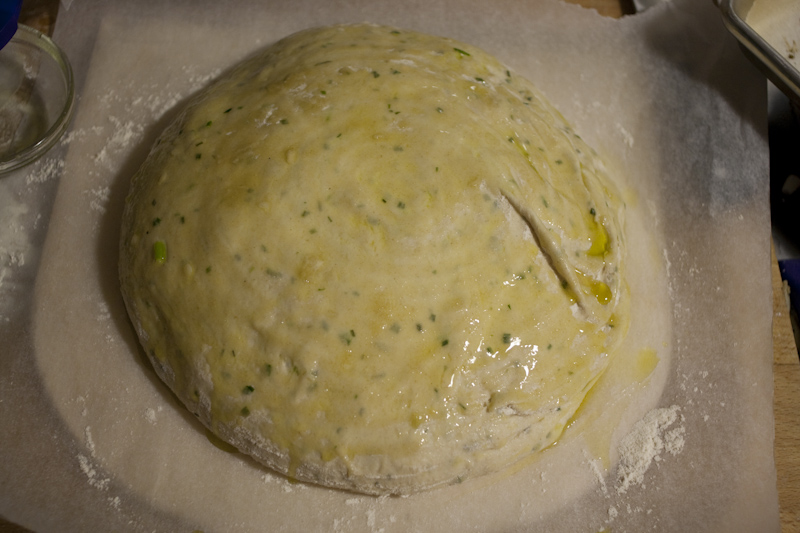

After the second rise, the bread is flipped over onto the peel and brushed with olive oil.


Then dimpled just like Foccacia.


And, like any good Foccacia, topped with the ingredients. Except that this time they were cheese and onions.


Normally, I just put flour on the peel and flop the bread onto it, score it and immediately load it into the oven using quick jerking motions to get the loaf from peel onto stone. The difficulty is compounded because the breads I love baking are actually the same diameter as the width of the stone. So I have to make sure that the bread is not falling off the back of the peel, and that I've approached the oven symmetrically, so that the sides fit on the peel. If I've done enough stretch-and-folds, the dough tends to just sit on the stone and not move. With doughs with considerably less structure and strength, the dough tends to melt to the edge before oven spring kicks in with its rising power.

With all that in mind, I decided on parchment paper for these loaves. I had a bad experience with a pizza sort of sticking to the peel and going onto the stone half-up and half-down, so I didn't want to chance it, especially with all these toppings and the very rare cheese!


I only remembered afterward that many in the Challenge had written about their onions burning in the oven, atop the bread. I also have the tendency to bake my loaves much darker than most others I know. Perhaps it's because I use darker flour, or because my electric oven has an exposed heating element at the top. Or maybe because I crank up the oven to the max and forget to turn it down. I'm not sure.


The crumb was absolutely lovely, with irregular holes, as well as tons of moisture. Perhaps because I kept to the recommended baking times and didn't overbake it to get it browner.


I was a bit disappointed that the onions burned, but they weren't so burnt that I had to pick them off.


When sliced, the bread took on a near-magical quality. All that cheese! It certainly added flavor to the bread, but you could barely recognize it in the crumb itself.


Though this was supposed to be a three-day bread, the bread sort of somehow started overproofing in the fridge during the last rise after only an hour, so I just took it out and baked it. This is the second loaf, just before going into the oven.


And the bottom of the second one the next morning. I froze half of the first loaf as soon as it came out. The other half we inhaled that evening with soup. I also froze half of the second loaf, and snuck slices from the non-frozen half. Note the smoothness of the bottom. Usually, I love the wrinkled flour dusted bottom of loaves, but for this one, I didn't mind.

It was perfect.

I have enjoyed baking with these other finishers of the BBA Challenge. I hope to be able to add your name soon!

Sally from Bewitching Kitchen
Phyl from Of Cabbages and King Cakes
Cindy from Salt and Serenity
Oggi from I can do that!
Sarah from My Runchey Life
Paul from Yumarama
txfarmer's blog (in chinese)
Abby from Stir it! Scrape it! Mix it! Bake it!
ap269 from Family and Food
Anne Marie from Rosemary and Garlic

If I've forgotten you, please send me an email or a comment with a link to your post and I'll include you in the blogroll.

Wednesday, October 13, 2010

Belgian (Beer) Vacation - Part Two

In case you missed part one, here's the link. I did get asked in my last post how long this vacation lasted, especially since we were trying all sorts of things. The entire trip lasted ten days, of which only nine were spent tasting beers. Of those days, these are only the beers that we had while we were out. Our friend's parent's house had a huge selection and the beers we had there were unfortunately not photographed.


Many beers in Belgium are bottle conditioned and often still have the yeast in the bottom of the bottle, something you really don't find in other alcoholic drinks. In the case of this beer, Hopus, the glass set includes a shot glass, not for a shot of Tequila and the beer as chaser, but as a holder for the yeast. These beers are poured into the glass slowly, being careful not to disturb the yeast that has settled on the bottom. However, some people prefer to have the yeast as well, often adding it to their beer at the beginning. For me, I sipped on the beer- a plain, smooth, malty ale, and then took the yeast as a shot at the end.


One of the biggest treats of the night was Tripel Karmeliet (careful, the website has music!). Take the description of Westmalle Tripel above, and double it, then add a bunch of flours in. I'm not saying that this was double as good as Westmalle. That would be impossible. However, this beer reeked of flowers. It was also served ice cold, and I had to use my hands to warm it up. Even then, you could tell the floral aroma. Almost like roses, but not quite overpowering. Maybe something akin to citrus flowers. Apparently, the beer is brewed with barley, wheat, and oats, giving it a full body and a smooth mouthfeel.


Again with the Iced Tea. I forgot who ordered it. Probably whoever was driving that night. The beer in the background is a Rochefort 10, made by Trappist monks at the Abbey of St. Remy at Rochefort. It is, again, one of my favorite beers, though I actually didn't have one until we came back to Berlin. I made sure to get 10 bottles, in order to age them.

Like wine, many beers benefit from aging or cellaring. Usually, this applies to beers that are refermented or bottle-conditioned, or beers over a certain percentage of alcohol. I use a minimum of 8% abv as a rule of thumb, though any beer with yeast at the bottom of the bottle will change, though not necessarily improve over time. Though there are examples of crazy aging- a bar in Belgium serves a 25-year-old Chimay- I don't think anyone has the will power to resist a beer that has been aging for more than two or three years.

About a year ago, I had a two-year old Rochefort 10 that I had saved from the last trip. The beer was amazing. All plums and figs and raisins and oh-so-very-smoooooooth. I could not get over how good it was. Since the beer has I still have a few bottles that I'm planning to take up to 10 years, though the beer is so good that I seriously doubt I will be able to hold out for that long. At 11,3%, this is a seriously complex beer that can hold its own up to maybe 10-15 years after it has been brewed. If you want to be astounded, surprised and convinced that world class beer exists, this is the one. Be sure to sip slowly, savoring it over the course of an evening.


I don't know how many 33cL bottles of Duvel I have drank in my lifetime, but it has been more than I can ever think to count. Duvel is one of those very drinkable beers with carbonation as fine as Champagne, and a smoothly sweet taste with a very pleasing spicy aftertaste. It is the embodiment of the Belgian Strong Golden Ale. I was once at the Knitting Factory in New York, and they had it amongst the mass-produced beers. After I offered a sip to a friend of a friend, he ordered it, and it cascaded until there were seven of us all having Duvel.

On one of the last days, we were in Bruges. I was trying to cross-reference the Good Beer Guide to Belgium with the small tourist map we bought at the train station. Unfortunately for us, the Beer Guide only provides the most rudimentary maps, which look nothing like the city itself. So we kept cross referencing. As luck would have it, however, we ended up stumbling across De Kuppe, in part because of their big signs advertising their selection of 100 beers.

After a scan of the beer list, I had a choice of about 15 that I really wanted to try. The one that really stood out was this one, from the Van Eecke brewery in nearby Watou. I have had this beer before, but it remains one of my favorites (I know, I know, I do say this quite a bit) because of its high hop content. All slight citrus and grapefruit with a fine carbonation. I absolutely love the flavor of hops, and wish they were used more often in European beers.

Amy opted for a local beer, Steen Brugge Dubbel, which we later found out, is brewed a hundred kilometers away in Steenhuffel. Still, it was malty and dark and barely chocolately, which is how Amy likes most of her beers.

Once had oriented ourselves, we looked for a place to have lunch. I don't remember where we ate, but I noticed that they had a lot of Trappist Beers on the menu, including Westvleteren. It was the only one without a price, though the others were about 4€ a bottle. I asked the waiter, "Is true that you have Westvleteren?" He gave me a funny look. He hadn't understood. I asked again, and pointed to the beer on the menu. "Ah, yes Westvleteren. Yes, we have it." I asked how much a bottle was, and he went in to check. When he came out he said, "25 Euros".

Now, the thing about Westvleteren is that it is brewed by monks who make a limited amount of beer. They say they make the beer in order to sustain their life as monks. In recent years, the beer's popularity has made the demand grow while the supply has remained exactly the same. Unlike other monasteries like Chimay, who are relatively huge businesses, Westvleteren prefers to stick with their monastic quietude. After their beer was named the best in the world, the monks got uncomfortable. The lines of cars waiting to buy beer stretched as long as 3km from the monastery, the only place where the beer could (legally) be bought.

Instead of dealing with it, the monks asked themselves- How can we maintain our monastic values, and save the town from the hassle of cars coming in and out all the time? Instead of the lines of cars, they set up a reservation system. The telephone line is open two hours every week, and there is only one monk answering one telephone, taking down names and license plate numbers in order to fill reservation slots to purchase the beer. For the monks, it makes life easier. For everyone else, it makes the beer more impossible to get, and that much more rare and desirable.

I've had the beer on two occasions. Once with my brother-in-law- we shared a dusty bottle I had found at a beer store. The second time was in Belgium at the home of a friend's uncle, out of the proper glass. It's good. Really good. But in truth, I'd rather avoid the hassle and get a St. Bernardus or a Rochefort 10. They're on par with the Westvleteren 12 without all the hassle.

So, why didn't I pay the 25 Euros for the beer? Not because I'm cheap, because I'm very rarely cheap when it comes to beer. It's because when you buy the beer at the monastery, you promise not to resell it. And while I think paying maybe double of what the beer cost- 2€ a bottle with deposit included- I don't think paying a 1000% markup is helping anyone but the cafe owner.


So, instead, I opted for a local beer, the Brugse Zot, which means, as you can deduce from the label, the Fool from Bruges. It's made by De Halve Maan brewery, the same brewery that makes Strafe Hendrik from the previous post. It was light both in color and body, with a delicate slightly grassy flavor with just a touch of sweetness. A good summer quencher, and the perfect accompaniment to the omelet I had for lunch.

After much walking around and exploring the city, we ended up at 't Bruges Beertje, one of the ultimate destinations in all the world for beer. Well, to be fair, it mostly has Belgian beers, but it has almost all of the good ones there, in one place.


After studying the menu (over 300 different beers, broken down by region) for several minutes, I decided on a Kriek from Boon from the Mariage Parfait (Perfect Marriage) series. Remember when I wrote about spontaneously fermented beers in my last post? Well, this is similar, but instead of blending three year old beer with one year old beer to make a Gueuze, you add cherries (with the stones) to the beer after a year and a half, and allow their sugars to ferment out.

You get a beer with a tart cherry flavor, and all the lactic sourness you can handle. The best thing about this beer, is that the Mariage Parfait series is no longer made for the Kriek, so the beer is rather rare. The second best thing is that the base beer for the Kriek is selected from the best tasting barrels of fermenting lambic, so this beer is pretty much the best of the best from this brewery. The beer was well rounded, not too sour, and not too tart, with just the right amount of full in-your-face cherry flavor. As the afternoon light faded, I took sip after sip.


Amy, on the other hand, somewhat overwhelmed by the huge selection of beer, asked me to pick something for her. I decided she should have one of the local beers, and in this case, picked a dark Brugge Zot, the companion to the blonde ale above.

It's odd how one beer can somehow create a thread that runs through an entire trip. On the very last day, we took an excursion to Hoboken, just outside of Antwerp to look at the statue of Nello and Patrasche from A Dog of Flanders. Patrasche is the name of the dog from the story, and also the name of the beer Amy had on the first Sunday that we were in Belgium. Unfortunately, the tourist office was closed, and the statue of Nello and Patrasche was actually quite small. Since the book is taught in Japanese schools, we were expecting to find a group of Japanese tourists milling about the statue, but I guess they only visit the Antwerp Cathedral.


So, after taking the required tourist pictures next to the statue, we looked around for a place that sold the Patrasche and Nello beers. Unfortunately, we couldn't find any. So much for Hoboken being a mecca for Patrasche lovers. Instead, we sat down at a typical Belgian cafe, and ordered typical Belgian beers. Amy, being the rebel in the group, ordered a "Scotch" which is what you call a Scottish-style beer. I thought it was funny that she was ordering a beer that was made in Scotland and imported for the Belgian market. I later found out that this dark and sweet beer with notes of dark caramel is now brewed in Belgium itself! What Amy didn't know is that Gordon's Scotch ale is pretty high in alcohol- 8% abv!


Our friend and host Ariana had a Hoegaarden Speciale, in one of my favorite glasses of all time (I'll say that quite a bit as well). She was shocked that it was available, since it is pretty much an autumn/winter beer. I've had this one before. It's like a deep witbier with an orangey flavor. Unfortunately, I really dislike witbiers, so I don't have very much to say about this one.


Last, I ordered a bolleke. I felt it was the most fitting beer for the trip. It was smooth and delicious, and just right. I sipped it in the warm summer air, and when it was done, photographed the hand on the glass that graced the beginning of the first post.

Friday, July 24, 2009

BBA Challenge #7: Ciabatta Redux

So.

I had already deemed the Ciabatta a failure in the post about it, and it was only after the fact that I realized that I had not even bothered to take pictures of the crumb.

I wasn't going to do it again, but the bakery across the street has beautiful Ciabatta and with olives, and I was determined to make it this time.

So the night before, I started the biga. It was a no biga deal, but I decided not to take pictures. Actually, it wasn't until the next morning that I actually set up the light stand and the flash.

I do know that I'm supposed to use sunlight, but that would require bringing everything into the living room. And even though the sun sets at some crazy hour like 21:30, I don't really use sunlight. The reason being that the flash allows me to obtain an aperture of f4.0, for the depth of field that I really want.


We begin on the day of baking with the biga. I cut it up into several small pieces to bring it up to temperature. Okay, I lie. I actually left it on the counter in the bowl for an hour before referring back to the book and realizing I was supposed to cut it up into pieces.


Here it is after the first rise, all puffed up in its silky high-hydration glory.


The last time I had made a couche I actually put a double batch on it and it didn't come out so good. This time I made sure each ciabatta had room enough to expand.


Rising in the traditional folded over letter-style.


The first loaf I baked (and yes, I did them one at a time, as my baking stone is only 30x30 cm square) stuck a bit to the couche, so the backside of it came out a bit long from being stretched.


Still, the loaves came out quite beautiful. All dusted and rustic. I would have actually liked them darker, but wanted to go by the book so as not to fudge up anything.

I brought this loaf to a 19km hike the next day. Everyone had a piece, but I actually had a raisin nut loaf as well, so that bread proved much more popular.


This one was actually my fave. I brought it along to our Book Club, and everyone except the children loved it. I think it was because of the lower salt content, or the two tablespoons of olive oil I added in for flavor.


The underside was also a bit pale.


I even remembered to take a crumb shot and even got some decent holes.


Of course the loaf you see here in these last two pictures was devoured an hour after coming out of the oven in an egg, cheese, tomato and soy slice sandwich.

I am actually glad I re-did this recipe, as the bread was much softer than last time, and had a nice moist crumb. Last time, the bread dried out immediately and was tooth-breakingly chewy the next day that I had to throw it out.

I'm actually thinking of making the mushroom ciabatta version pretty soon, so I'll post when I do.