Saturday, April 16, 2011

Garlic Soup and Walnut Bread


I used to love garlic as much as the next person, that is to say, not particularly. But it was this dish I can still remember, in an old Italian restaurant on Fifth Avenue in Brooklyn that changed my mind. I was hanging out with my friend Michael in his old neighborhood. We stopped at this restaurant where he had occasionally eaten after school. It was weird because, for me, growing up, I usually did the cooking after school for anything I wanted to eat. But he had grown up in Brooklyn, where he didn't have to go far in his explorations. In comparison, I had to walk 10 minutes to the nearest mini mart in order to get milk or chocolate.

The dish I ordered in that restaurant was called Chicken Garlissimo (back in my omnivore days). I would love to say that I had become a convert to garlic by that point, and that's why I ordered it, but, in truth, it was the name, the "issimo" that really made me order the dish. That, and the challenge of 27 roasted cloves of garlic in the description. It might have been gluttony, that drew me in, but what I took out of the experience, as I bit into every sweet, delicious, caramelized clove was that garlic is fantastic.

It wasn't until about a year later that I tried roasting my own garlic. I kept coming across it in restaurants, and every time I tasted it, I loved it. The weird thing is that, growing up, we very rarely had garlic. My mom actually had one of those long garlic braids, but we never used it. Actually, she probably still has it! Although I was conceptually aware of garlic, I never really considered that we might have used the garlic in the braid to use in food.


A few weeks ago, Kelly of Something Shiny mentioned something about garlic on Twitter. I no longer remember what it was, but I countered saying that I also love garlic, and Rebecca of Grongar blog chimed in that she also loved garlic. In order to see how far their love of garlic went, I mentioned this Garlic Soup on the wonderful 101 Cookbooks blog. I had been hankering to make for over a year, but only brought it up, half kidding, wondering if they would balk at a soup made out of garlic. Somehow, in the idle chatter, we decided to make it and our choice of walnut bread (as mentioned in the recipe) in the weeks that followed and post on the same day.

Now, this is one of the things I love about Twitter. I had met Kelly and Rebecca over Twitter during the Bread Baker's Apprentice Challenge, and they remain two of my favorite people in my Twitter stream. And this is one of the things I most dislike about Twitter. These two friends live an ocean away, thousands of miles even from each other! Which means, that, as much as I would love to meet and bake with them, it remains a far-fetched dream. But even so, it is an honor to have made their acquaintance and to be able to look at their breads (and cheeses!), even if it is only online.


It's a very simple soup, starting with a cool dozen cloves of garlic, some fresh thyme, a bay leaf, two sage leaves, and a teaspoon of sea salt. I didn't have fresh thyme, so I just added a few sprigs of thyme I dried myself. We usually get a big bunch of fresh at the market, and since we don't go through it fast enough, I just hang it up, let it dry, and use it as we go along.

You let the mixture simmer for 40 minutes, sieve the broth out, remove the sage and bay leaves, and then add the garlic back to the broth.


The  strangest thing of the soup is that it has a whole egg, two egg yolks, an obscene amount of oil (a quarter cup), 42 grams of freshly shaved Parmesan, and a dash of freshly ground pepper. You mix this up (pouring the oil in a drizzle) and then add some of the broth back to the emulsion, constantly whisking. Then, you add the whole mixture into the broth to create the soup.


Unfortunately for me, despite having successfully made zabaglione, I either didn't whisk fast enough, or I was too distracted with taking photos, or I let it go for too long. In any case, the soup separated a bit, but it was still freakin' delicious, full of this vegetal garlic flavor without being too harsh.


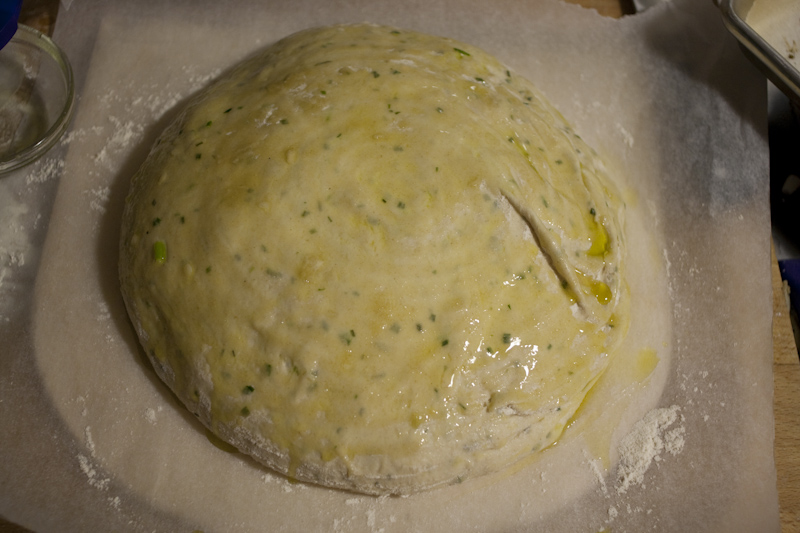
Oh, but you didn't think I was going to let you read all that and not mention the bread? My choice was a walnut bread from Dan Lepard's The Handmade Loaf that I had also been eying for about a year. It's made with sourdough and fresh yeast. Included in the bread is a delicious walnut paste that yields slightly more than you need in order to have some left over to spread on the bread.


The dough itself was a bit dry, but it came thogether rather quickly, which was lucky for me since I had to rush to work. I let it rise in the refrigerator, and left it to warm up on the stove while baking another loaf in the oven before letting it have its turn in the heat. Even though the recipe is supposed to yield two loaves, I was happy with it as a large single loaf.


Even though the crumb was a little tight, it has streaks of purple from the walnuts, and made an excellent foil for the garlic soup.


The last thing I wanted to mention is that we're moving. Which sucks when you realize you've collected a lifetime of things in five short years, including two of everything in the kitchen. But it promises a new start, and with it, much hope for happier and brighter tomorrows. And the promise of many delicious meals with old and new friends.

Kelly and Rebecca, I hope to meet you both one day in person.

Here's the link to Kelly's post on Something Shiny.
And the link to Rebecca's post on Grongar Blog will be forthcoming.

Saturday, March 5, 2011

Cake Successes, Frosting Failures


I often make bread in my sleep.

Okay, not really, but I sometimes start the dough just before I go to bed, knead it, and do a few stretch and folds before leaving it in a cool place in the house. Then I sleep, wake at six in the morning, shape the bread, plop it in the proofing basket, turn on the oven and sleep for an additional two hours before I bake. So, in a sense, for me, baking bread is integrated into my sleep.

Cakes, on the other hand, are not.

I've heard it been buzzed around that you are either a cook or a baker. And further, a cake baker, or a bread baker. I actually began with baking cakes. My dad had this recipe for a coffee cake that was very simple, with a bit of streusel at the top. The first time I made it, it was a complete flop. I think I might have mixed up the baking soda and baking powder. He didn't like it, but I ate it anyways, every odd bite.

At University, I would often buy cake mix- I know, I know. You're tempted to stop reading and shun me forever, but hear me out! It was THE FEAR. Forever I had been hearing that cake is difficult to make, that the only way I could make one was to add whatever it was in the box to water, oil, and eggs. I had decided that it was not for me. I stuck with bread and pies, both super-easy to make.


Eventually I progressed to quick breads, and brownies, and from there, it was a small Katzensprung to your basic cakes.


The first cake I made that I absolutely adored was Clotilde's eponymous Chocolate and Zucchini cake. In 2010, I made it a whopping five times in the first half of the year before moving on to the wonderful Buttermilk Raspberry Cake found on Gourmet's website. 


Then the delicious Almond Cake (also on Chocolate and Zucchini) three times. Just look at that crust. It needs nothing more. Not even frosting! Despite it appearing like I am strictly a bread baker, I have made my share of cakes.

When I got David Lebovitz's Ready For Dessert book last summer, I swore to myself that I would bake more cakes. In fact, there were so many amazing cakes in there that every time we needed any dessert for any occasion, I would look in there first. In fact, since I got it, it's one of the few cookbooks that has a permanent place in the kitchen.


The book is so foolproof that I made my very first cake involving folded egg whites. For someone who is so shockingly familiar with yeast, I am unshockingly unfamiliar with folding egg whites. And for good reason, no? I bake bread. You mix everything together, knead it a couple of times and then sit back and don't worry.


Cake baking is a little more complex- Sift dry ingredients together and then mix wet ingredients together then add both to each other slowly, taking care not to overmix. It's a little more complicated than baking bread, but you still let the baking powder or baking soda do its thing. With this sponge cake, however, it only has a shocking half-teaspoon of baking powder (for insurance, probably). I mean, look at this crumb! It almost looks like bread! I was shocked and pleased when I pulled the sponge cake out of the oven.


But that's as far as my cake baking success goes. I can now make a successful sponge cake, with custard, but I keep failing on the frosting.

Take another look at that Chocolate and Zucchini cake. Yes, that's ganache, but it is all melty. That's what happens when you decide to make it last minute on a hot summer night. At least the cake underneath the ganache went over super well. It almost made people forget about the runny ganache. Not that the cake needs any, because it is delicious with just a light dusting of powdered sugar.

Take another look at that beautifully crusty Almond Cake. Notice anything missing? Yes, frosting. I did say it didn't need any, but, still, it typifies the type of cake I make. Cake like bread. All almondy- dense and delicious.

And the Coconut Layer Cake above? It would have been perfect had it not been for the frosting. It was just whipped cream and a bit of sugar, topped with toasted coconut, and was the best Coconut Cake I've ever had- not to pat myself on the back or anything.

So, yes, I can make delicious cakes from recipes from my two favorite Parisian Bloggers. But it's frosting that I have problems with. And it's not like I can't make frosting. I just don't have enough experience, what with relying on Pillsbury canned frosting, long after I had moved past cake mixes.


Nevertheless, I keep persevering. With book in hand, and inspired by Kelly's post on Something Shiny (check out her picture-perfect cake), I set out to make the holy grail of cakes- well, at least in Ready For Dessert- the cake on the cover.

If you buy this book for one recipe alone- well, actually, that's not a phrase you'll be able to use for this book, because it's full of such recipes. One of them is actually a recipe within a recipe- Salted Caramel Peanuts, as part of the mouthful- Banana Cake with Mocha Frosting and Salted Caramel Peanuts. The name of the cake could have been Yum Cake, and it would not have mattered, because the Salted Caramel Peanuts are something of which you'll have to make sure to make a double recipe. Because they are awesome.


And because no matter how the cake looks like, or how much the peanuts get in the way and roll everywhere when you're trying to cut the cake, no one will be able keep their hands off them.


Oh, yeah, and the cake isn't shoddy either, banana layers mixed with the mocha frosting, creating this trifecta of deliciousness. I know, I know, I can't describe flavors, especially when they make me lose all objectivity.


What no one will notice, though, is the frosting- Years of being used to radioactive-colored frosting from a can will make anyone eat anything. Or, rather, they will make people not care, as long as what they are eating is delicious. Sure, appearance and a glossy frosting like the one on the cover of the book might be all you think about when you are ashamed to present the cake, but really, no one cares. Because the cake tastes good.

In case you're wondering where it all went wrong- I let the coffee go cold, and made the frosting a bit later than the rest of the cake. The cold coffee made the melted chocolate seize up, and it took lots of stirring and whipping and refrigeration (gasp!) to even make the mocha frosting lose its graininess. I almost died of shame, but luckily, I knew what to do to try to barely rescue the cake.


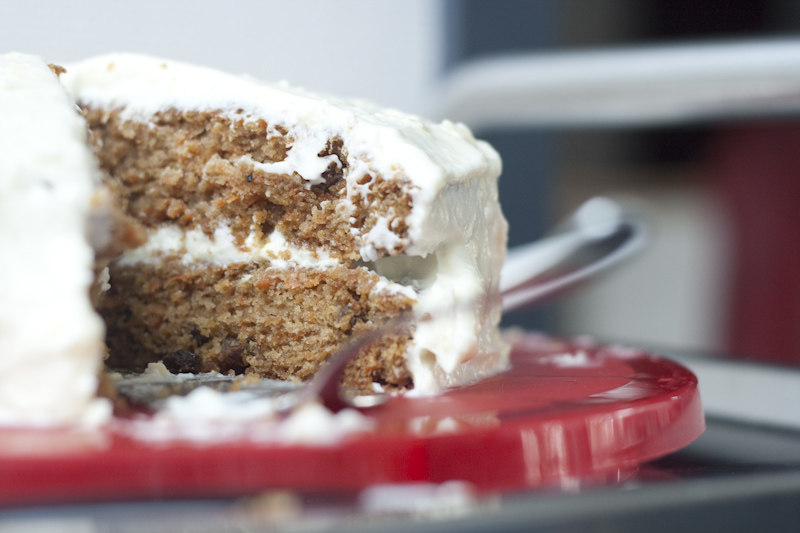
 My worst frosting disaster, though, has to be this amazing carrot cake from a guest post by Barbra Austin on David Lebovitz's blog.


Take a close look. Well, not too close, because my frosting-spreading skills have a way to go before they catch up to my photographic skills.


You don't see it? Well, let me change lenses for a closer look. You see those lumps? Don't say no, because they are clearly there. The recipe calls for cream cheese and butter to be creamed together, but somehow the whole thing started melting on me as I was putting it through the mixer. Again, cooling down the frosting did the trick, but the butter sort of stayed in little lumps in the frosting. Little yellow bits taunting me until the end.


Of course, the end of the cake came with people telling me how delicious the cake was. Someone even told Amy, "Tell Daniel this is what carrot cake is supposed to taste like." A high compliment indeed.

Oh, and in Germany, no one makes carrot cake. Almost all of them have been weak attempts to make a cake that has cross-over appeal for Germans, though, in truth, carrot cake is an acquired taste, even for most people in the States.


Still, it doesn't matter. If I can make a loaf as awesome as the one above that displays my mad scoring skills. I think I can try again and again to master frosting, no matter how many kilos of butter and powdered sugar I have to ingest.


After all. I'll still have my bread. And that, I can make while I sleep.

Wednesday, December 22, 2010

BBA Challenge #43: Roasted Onion and Asiago Miche

 
So. Here we are. Shredded Asiago.


I've really been dragging my feet towards the end of the challenge. Not just because I didn't want it to end, but mostly because I couldn't find Asiago in Berlin. True, I was only half-heartedly trying.

The thing is, finishing the Bread Baker's Apprentice Challenge meant finishing a significant part of my baking education. Before I started the challenge bread for me meant measuring in cups, and always forgetting if I already had five or six cups. It meant a tablespoon of yeast and a tablespoon of salt. It meant baking bread either as a boule or in loaf pans, with no other possibilities.

But even as early as Brioche or Ciabatta, bread became transcendental. It might have been baking the Casatiello, which remains my favorite bread of the book. I remember slicing the first piece off the mushroom shaped loaf and just thinking about how much crust this piece had. In fact, it might have been all crust. It might also have been when I made my own starter in anticipation of the sourdough section. Or when I began baking 2 kilo sourdough miches as "practice" for the Poilane-Style Miche.

This bread, as well as the last one are included in the Gracenote section of the book, and are cheese-laden celebrations of what bread can be. For this bread, I really wanted to make everything as in the recipe. No changes, no shortcuts.

The Asiago was not easy to find. I asked at several cheese counters and shops in the city, and in an act of desperation, I posed my question on Twitter. In hindsight, I could have asked at KaDeWe, but it's not usually a place where you can find anything easily unless you shop there regularly, which, really, should not turn into a habit. I really only go there when I'm desperate or can't find something anywhere else, and I guess I wasn't at that point yet.

Despite her initial suggestion to use Parmesan cheese, as she had done for her bread, AP269 was the first to suggest Centro Italia. Further recommendations followed from Peggy at Multikulinarisch.es and Küchenlatein. Poking around on Centro Italia's website, I discovered that they have two locations (Now they have three, one just opened in Prenzlauer Berg). There's one near the Schloss in Charlottenburg, and one in the middle of nowhere in Marienfelde. Luckily for me, the one in Marienfelde was about ten minutes closer, and only required a single train. So, I decided to go to that one the following weekend.

That weekend, I looked up the train schedule, double-checked Google Maps and noted the hours. I left for the Marienfelde location.

It was closed.

Somehow, in the rush that defines the weekend, I had only written down the hours of the Charlottenburg location, which is open two hours longer on the weekend. So, Marienfelde? Closed. When I got home, I checked the train schedules for when I would have to leave for Centro Italia on Monday morning with enough time to get to work. I was determined to get this cheese.

On Monday, I arrived at Centro Italia two minutes before nine. There were three guys smoking just outside the entrance, and I just assumed they were also waiting for the store to open. Of course, I thought it was normal that people would be waiting in front of a large Italian supermarket waiting for it to open in the early morning. After about a half-minute of talking amongst themselves, one of the guys told me that I could go in.

I should have gone directly to the cheese counter and fled. But, instead, I went down every aisle. Zucchini spread, Linguine (!), nine thousand different kinds of tomato sauce. It was amazing how much stuff they managed to pack into such a small space.

I walked out of there with two kinds of olive oil, as well as assorted Italian groceries. When I was at their very extensive cheese counter, I asked about the Asiago and the guy didn't even flinch when I told him I needed a half kilo.

When I finally got home that night, I went to work measuring flour, but when I read down to the rest of the ingredients, I quickly realized we had neither chives nor green onions. So much for starting the bread. I had to wait until that Thursday to pop over to the grocery store after work and nab the last two bunches of green onions. I was looking everywhere for fresh chives in the pot (many fresh herbs are sold in a little pot in Germany, in case you want to try to grow them). No dice. I settled for a small box of frozen chives.

And then. I was able to start the last bread in the Challenge.


I've actually been meaning to write an entire post about this device. It's a Mouli-Julienne from Moulinex. I first heard of it on David Lebovitz's wonderful post about Celeriac salad, he pretty much raved about it, and after a bit of quick googling, I found a picture of it, and then, finally, found one on ebay. Amy refers to it as the "Eiffel Tower" which was puzzling until one day I took it out of the cabinet and the long part was on top, which made it look just like the tower. Take a second to look at it closer, and tilt your neck if you have to.


Asiago is a strange cheese. Not sharp like cheddar or some of the drier Italian Cheeses, and not as mild as say, aged Mozzarella.


As I was peeling the wax and paper from the cheese, I discovered these traces of the name. They were probably there just to make sure I hadn't accidentally bought a different cheese. Then again, it could have been "Asiag" cheese, and not Asiago.


And in under a minute, with the help of the "Eiffel Tower" I was done.


I set up my mise en place for the challenge one last time. The thing about having all your ingredients at the ready is that it is so convenient. You're not searching for the salt, and then measuring it out, cursing the spoon scale for being in two pieces- the spoon part on the drying rack, and the scale part in your baking drawer.


As usual, I used my Electrolux DLX/N26/AKM4110W. Just Add Water. And then everything else. It's odd how I haven't really mixed dough by hand ever since I got it at the beginning of last year. And to think that I bought it because I wanted to make pizza. I've made more bread than all the pizzas I've eaten since then.


Of course, when you have an ingredient that is a bit rare, you tend to go overboard with hoarding it until you need to use it. This was a warning for Amy and I, just in case we decide to make grilled cheese with the precious Asiago.


And then, as quickly as the shredding, the dough was done. Normally, I just walk away and then check on the dough periodically, eyeballing it to see how done it is. This is actually easier when I'm doing periodical stretch-and-folds, since the more difficult the dough is to fold, the closer it is to the end of the first rise.


After the allotted three hours, it had risen to between one-and-a-half and double. Perfect.


Despite what the book said (to do it the night before), I roasted the onions as I was making the bread. Yes, that is a quarter sheet pan, only because a half-sheet pan doesn't fit in the oven if I want the door to close.


After the second rise, the bread is flipped over onto the peel and brushed with olive oil.


Then dimpled just like Foccacia.


And, like any good Foccacia, topped with the ingredients. Except that this time they were cheese and onions.


Normally, I just put flour on the peel and flop the bread onto it, score it and immediately load it into the oven using quick jerking motions to get the loaf from peel onto stone. The difficulty is compounded because the breads I love baking are actually the same diameter as the width of the stone. So I have to make sure that the bread is not falling off the back of the peel, and that I've approached the oven symmetrically, so that the sides fit on the peel. If I've done enough stretch-and-folds, the dough tends to just sit on the stone and not move. With doughs with considerably less structure and strength, the dough tends to melt to the edge before oven spring kicks in with its rising power.

With all that in mind, I decided on parchment paper for these loaves. I had a bad experience with a pizza sort of sticking to the peel and going onto the stone half-up and half-down, so I didn't want to chance it, especially with all these toppings and the very rare cheese!


I only remembered afterward that many in the Challenge had written about their onions burning in the oven, atop the bread. I also have the tendency to bake my loaves much darker than most others I know. Perhaps it's because I use darker flour, or because my electric oven has an exposed heating element at the top. Or maybe because I crank up the oven to the max and forget to turn it down. I'm not sure.


The crumb was absolutely lovely, with irregular holes, as well as tons of moisture. Perhaps because I kept to the recommended baking times and didn't overbake it to get it browner.


I was a bit disappointed that the onions burned, but they weren't so burnt that I had to pick them off.


When sliced, the bread took on a near-magical quality. All that cheese! It certainly added flavor to the bread, but you could barely recognize it in the crumb itself.


Though this was supposed to be a three-day bread, the bread sort of somehow started overproofing in the fridge during the last rise after only an hour, so I just took it out and baked it. This is the second loaf, just before going into the oven.


And the bottom of the second one the next morning. I froze half of the first loaf as soon as it came out. The other half we inhaled that evening with soup. I also froze half of the second loaf, and snuck slices from the non-frozen half. Note the smoothness of the bottom. Usually, I love the wrinkled flour dusted bottom of loaves, but for this one, I didn't mind.

It was perfect.

I have enjoyed baking with these other finishers of the BBA Challenge. I hope to be able to add your name soon!

Sally from Bewitching Kitchen
Phyl from Of Cabbages and King Cakes
Cindy from Salt and Serenity
Oggi from I can do that!
Sarah from My Runchey Life
Paul from Yumarama
txfarmer's blog (in chinese)
Abby from Stir it! Scrape it! Mix it! Bake it!
ap269 from Family and Food
Anne Marie from Rosemary and Garlic

If I've forgotten you, please send me an email or a comment with a link to your post and I'll include you in the blogroll.

Friday, November 5, 2010

BBA Challenge #42: Potato, Cheddar, and Chive Torpedoes


Every Saturday morning, Amy and I make a survey of whatever vegetables we have left in the house, grab our Oma Porsche (shopping trolley), and roll on out of there into the midst of a huge Turkish Market at Crelleplatz near our house.

The market itself is nothing special. Half the stalls are clothing, trinkets, and other low-priced wares. The thing that disturbs me the most is a singing doll, very likely made in China who says "I love you!" before launching into the most horrible rendition of Twinkle, Twinkle Little Star. I've sworn on not less than one occasion that one day that very annoying doll will make me reach my breaking point.

The market is not divided in any way between wares and vegetables, and the stalls are pretty much hit or miss. We have the stall where we always buy carrots, if they have them, the one stall which always has bundles of fresh herbs for an Euro, the stall where we never buy anything because they seem to rip us off and have very bad fruit and vegetables, and then there's the stall where the guy screams with so much projection, that you can hear him halfway down the market shouting "Lecker! Lecker! Lecker!"

The bad thing is that most of the produce has recognizable supermarket stickers. That is, they come in bags or plastic baskets, and look exactly like the kind you would get in a supermarket. The weird thing is that some of it can go bad rather quickly, so you have to be quite selective, and get there early in the morning before the afternoon rush. The rush, of course, is amplified by the vendors dropping their prices and offering you flats of produce for an Euro or two. We once got a flat of avocados for an Euro right before closing.


None of this is that extraordinary for Berlin, though. What is rather extraordinary is the potato vendor at the very fringe of the market, in the least traveled section right by the 2€ slippers and the stall where I was once yelled at for picking up a basket of cherry tomatoes to take a closer look. You see, the potato vendor is not Turkish. He's German. So, it's especially puzzling to see him chilling (and sometimes his friends) and selling potatoes that haven't travelled that far. His four kinds of potatoes, and two kinds of onions come from the Lüneberger Heide, just outside of Hamburg. Also strange, especially for this market is his old balance scale, with weights on one side, and a basket for the potatoes on the other.


Usually, I tell him what I'm making, and he'll tell me which potatoes are best. This time, however, I was a bit afraid to tell him that I'd be putting the potatoes in bread.

The penultimate bread in the Bread Baker's Apprentice Challenge is Potato, Cheddar, and Chive Torpedoes. I'm this close from finishing the challenge, and in truth, it's probably taken me twice as long as it should have, partly because I was dragging my feet, and partly because Asiago is near impossible to find in Germany.


Germany has sometimes proven to be a bit of a challenge for me, especially with food. The German tastes in cheese range from Quark to Frischkäse to mild Goudas. I find it surprising that their pre-shredded Pizza Cheese is made of Gouda instead of aged mozzarella, of which there seems to be none. Fresh mozzarella in its brine, however, can be found in little plastic bags in every grocery store in the city.

So, whenever I see Cheddar, I usually snap it up. Cathedral City is the most common one here, and while their 16 month old cheese is tasty, you sort of long for the variety (cough, Cabot) you can get in the States, or in the UK. In an odd twist of the cheese knife, this cheese claims "Cheddar- England's-Nummer1". Um, right.


The bread was supposed to be sliced, but, with when aged, this is the way cheddar crumbles.


The mise en place with both sourdough and fresh yeast. Another weird thing about Germany is that you can get fresh yeast at every supermarket in the country for about 15 cents. I love it, but I usually forget that I have it, and it ends up going bad.


The dough is mixed and the potatoes are thrown in there to be mashed into the dough. 


I know that many people out there own Kitchen-Aid mixers, but for making bread, I love my Electrolux mixer. the bowl is wide and open so you can throw more ingredients in while it is running, and you can even scrape down the bowl quite easily (when it's not running, of course). Also, I regularly mix about 2 kilos of dough in the machine, and it doesn't even get warm. How's that for a recommendation?


I love and hate using fresh yeast- the dough rises quicker than expected, so sometimes something like this happens. While it's good to know that the bread has at least doubled, it's also a sign that the gluten has become overstretched, so the structure of the final bread won't be as great as it could have been. 


And speaking of as great as it could have been- I sort of skimmed that part of the recipe where you add the chives to the dough. By the time I got to that part, I was already shaping the bread.


So I just kind of threw it all into the layer, knowing that the chives would be concentrated with the cheese, instead of dispersing their flavory goodness into the dough itself.


In all the bread talk I hear and read, everyone mentions dough scrapers and bench knives and metal scrapers, but no one mentions brushes. I ordered this one from MORA in Paris, and I use it every time I make bread. Sometimes to brush flour off the counter, other times to brush it off loaves going in or coming out of the oven. The biggest use, though? Brushing flour off my camera whenever I take photos of the process.


I'm not going to say that the loaves came out pretty, because they didn't, despite all the support gave them in the final rise, and the careful sliding onto the baking stone.


Because the dough was so slack- probably from letting the dough overrise, I put the dough in an improvised couche made of parchment paper, knowing I would never get them out if I put them in a regular linen couche.


Of course, I was on a miche kick back when I made the bread for the Challenge, so I also made a miche at the same time. Because of the scoring, and the way the bread expanded, it looks like it has a third eye and is smiling about it.


One of the things that I always kick myself about is that I never take notes. I would love to be the person who takes notes of everything. Rather, I rely on memory, which eventually fails once I make the next bread. Still, it can't be all that bad if I'm pulling loaves like this out of the oven.


Here's a close up of the mouth.


And the crumb structure right out of the oven. I think I hit a perfect mix of flours, water and time, but I'll never know what it was. I should, however, note that I really should have scored the bread down the middle. Check out how the holes all tend to go toward the left, where the mouth, the weakest point, was. But chalk it up to creative scoring, and a thousand little variables, no?


But the bread of this post (remember that one?) came out relatively flat.


 Nevertheless, you can still see the cheddar peeking through the slashes in the bread.


Unfortunately, I didn't get a good spiral in the middle. It was sort of like it just decided to form random pockets of cheese and chives in the middle.


But that certainly didn't stop us from eating all of it in one go. It was fabulous, but next time, I'll be sure to add the chives in for all of their flavory goodness.

Just one more bread to go!

Other bakers who have torpedoed their way to this part of the Challenge are:

Sarah at My Runchey Life

Cindy at Salt and Serenity

Paul at Yumarama

Cathy at Bread Experience

Phyl at Of Cabbages and King Cakes

Sally at Bewitching Kitchen

Janice at Round The Table

Anne Marie at Rosemary and Garlic

ap269 at Family and Food

TXfarmer at her blog (in Chinese)

Natashya from Living In The Kitchen With Puppies